You don’t have to love spreadsheets to feel the pull of the coast. It’s where we walk off stress, plan bank-holiday escapes, and quietly decide what “home” should feel like. And yet the line “of course! please provide the text you would like me to translate.” keeps popping up in consumer forums for a reason: the coast looks simple on a map, but the language around access, boundaries and rights trips people up.
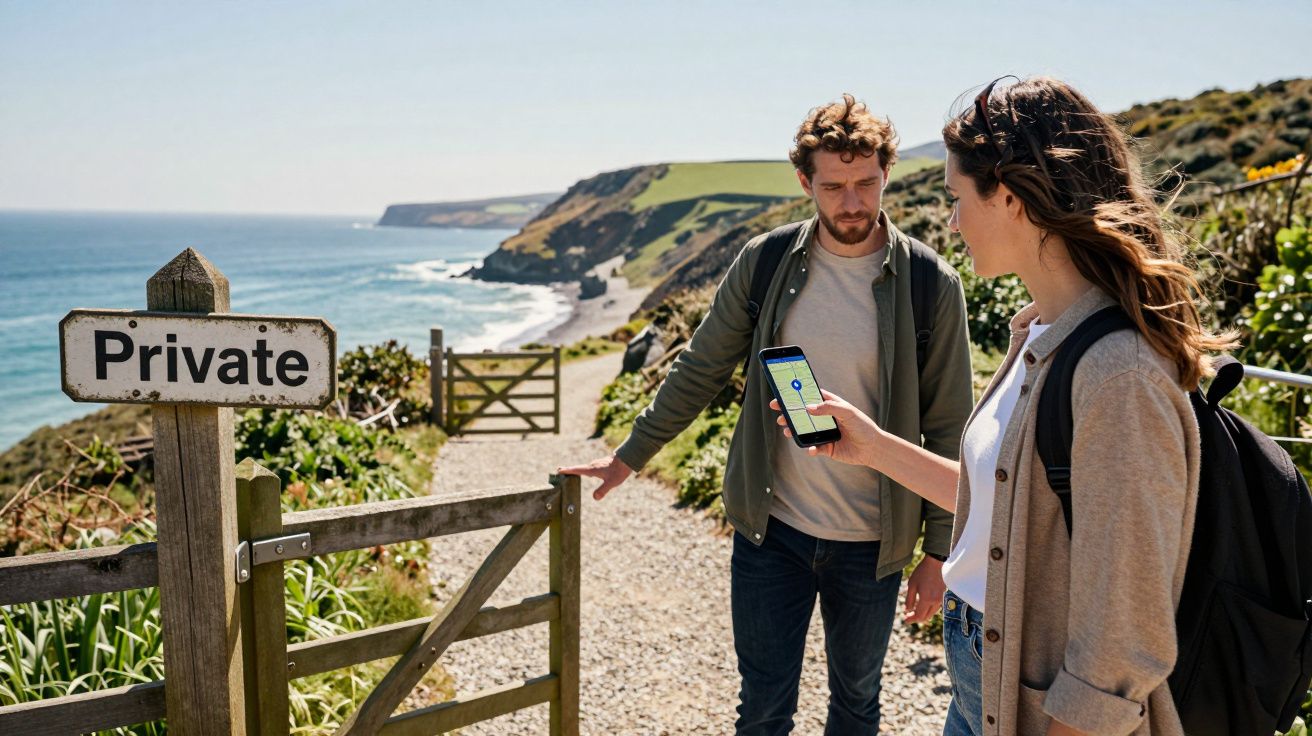
I learnt this the awkward way, on a sunny day that turned into a polite stand-off with a landowner and a very confident sign.
The catch: “the coast” isn’t one thing
We talk as if the coast is a single, public, always-open ribbon. In practice it’s a patchwork of public rights of way, permissive paths, private land, nature protections, tidal areas and local byelaws. Two beaches can sit five minutes apart and behave like different countries.
The consumer trap is assuming “by the sea” automatically means “free to roam”. It often is, but not always - and the costs show up as wasted trips, parking penalties, and plans derailed at the last gate.
Where people get caught out (and why it feels unfair)
Most “gotchas” aren’t scams. They’re mismatched expectations.
1) Access rights change faster than the scenery
A coastline footpath can be legally public while the most convenient entrance is not. You arrive, see a neat gravel track and a sign that says “Private road”. You follow it anyway because everyone does - until someone tells you not to.
Sometimes there is a public route, just less obvious: a narrow stile fifty metres up the lane, or a path that starts behind the bus stop. The coast didn’t change; the signage did.
2) Tide makes a “public” route temporarily unusable
Even where the public can pass, the sea has its own schedule. A beach-walk that looks like a straight line at 11am can become a dead end by 2pm, with soft sand, slippery rocks, and no safe high-ground.
The mistake is treating the shoreline like a pavement. It isn’t. And “it was fine last time” doesn’t help when the water is already in.
3) Parking is often the real price of admission
The coast itself may be free, but the last mile can be engineered around pay-and-display, resident-only bays, height barriers, or tiny car parks that fill by 10am. The cheapest-looking option can also be the most ticket-happy, especially in seasonal enforcement hotspots.
If you’ve ever spent more on a penalty than on lunch, you’ve met this catch.
A simple checklist that prevents most bad surprises
Do this once before you leave - it takes five minutes and saves hours.
- Check the route type: look for “public footpath”, “bridleway”, or “permissive path” (permissive can be withdrawn).
- Confirm the start point: don’t assume the prettiest track is the legal one.
- Look up tide times if your plan includes beach walking, coves, or rock shelves.
- Scan for restrictions: dog bans in summer, BBQ bans, dune protections, seasonal closures.
- Decide your parking plan: main car park cost vs overflow vs bus/train.
The coast rewards spontaneity, but it punishes assumptions.
What to do when a sign contradicts your map
This is where people freeze. They don’t want a confrontation, but they also don’t want to give up the walk.
Here’s the calm approach:
- Pause and verify: open a reputable mapping source showing rights of way (local council maps, Ordnance Survey, or a trusted trail app that distinguishes public rights from permissive paths).
- Look for the public line: many paths bypass farmyards or tracks even when the sea-facing route is obvious.
- Respect closures that are clearly time-limited: lambing, nesting birds, erosion works. These are often legitimate and temporary.
- If it still doesn’t add up, reroute: your day out isn’t the court case you want.
Being “right” on access doesn’t always make a walk enjoyable. The win is getting to the view with your mood intact.
The version nobody says out loud: the coast is a working edge
Holiday brains see cliffs, cafés and photos. Local reality includes farming, fishing access, erosion management, flood defences and protected habitats. That’s why rules feel inconsistent: the coast is both a playground and infrastructure.
Once you accept that, the confusing bits make more sense. Not nice, not always intuitive - but understandable.
A tiny blueprint for coastal days that actually go to plan
If you want the coast to feel effortless, treat it like a mini journey rather than a backdrop.
- Arrive earlier than you think (especially in summer).
- Walk inland first, return seaward (you reduce the chance of tide trapping you).
- Carry a light layer even on “hot” days; sea wind changes fast.
- Have a Plan B bay: a second car park or a second beach if the first is jammed.
Small planning buys a day that feels loose and unforced - which is the whole point.
| Common assumption | What’s usually true | What to check |
|---|---|---|
| “The coast is public.” | Many stretches are accessible. | Rights of way vs permissive paths |
| “Beach walking is straightforward.” | It can be brilliant. | Tide times and exit points |
| “Parking will be easy.” | It’s often the bottleneck. | Payment, enforcement, capacity |
FAQ:
- Is the coast always free to access in the UK? Often, but not universally. Access depends on public rights of way, local rules, and whether you’re crossing private land to reach the shoreline.
- What’s a permissive path? A route the landowner allows people to use, but it isn’t a permanent legal right and can be closed or rerouted.
- Do I really need to check the tide? Yes if your route includes beaches, coves, or rock platforms. Tides can cut off return routes and make “easy” sections unsafe.
- Can a landowner block a public footpath? They shouldn’t obstruct a public right of way, but disputes and confusing signage happen. If it’s unclear on the ground, rerouting is often the safest choice in the moment.
- Why does the wording online feel so confusing? Because access is a mix of law, local policy and geography. If you find yourself thinking “of course! please provide the text you would like me to translate.”, you’re not alone-clear terms matter when you’re trying to work out what you can actually do.






Comments (0)
No comments yet. Be the first to comment!
Leave a Comment