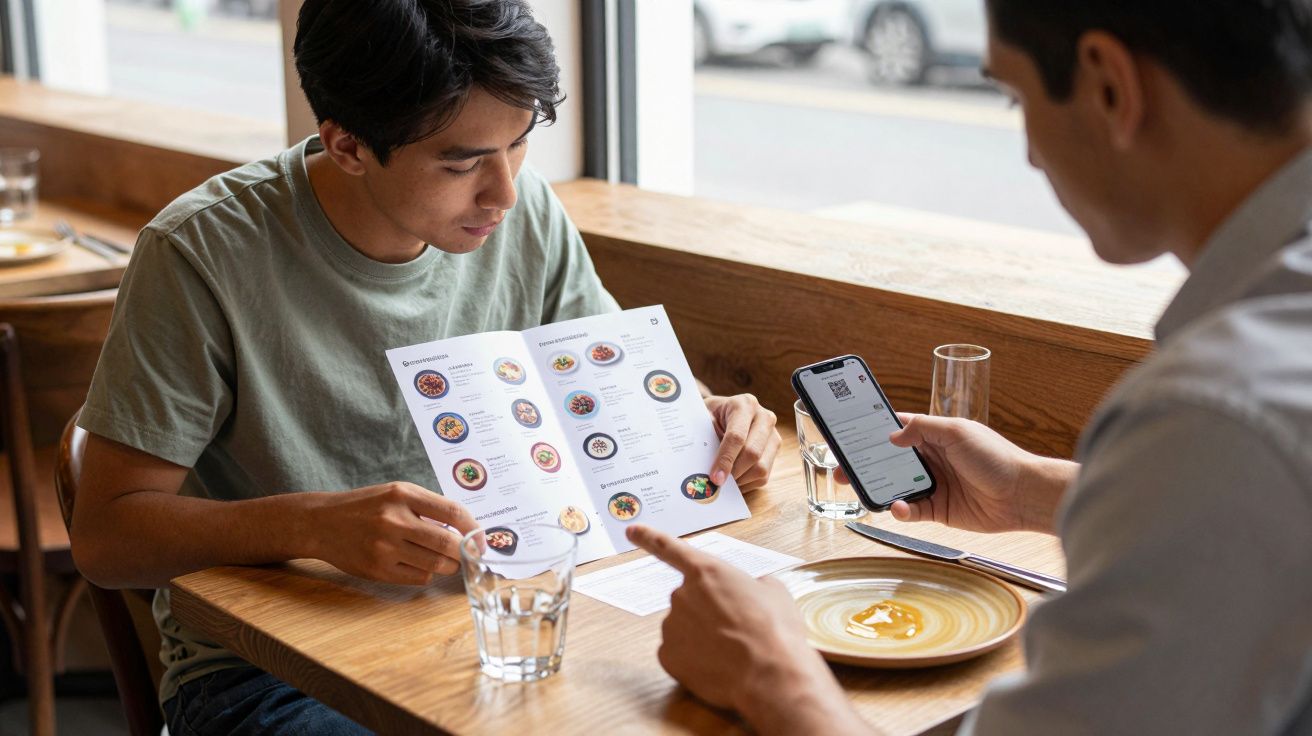
You’ve probably seen the phrase of course! please provide the text you'd like me to translate. dropped into a booking note or shown on a QR ordering screen, alongside of course! please provide the text you would like me to translate. as if it’s harmless filler. In restaurants, that same “filler thinking” is exactly what experts say leads to the hidden mistake behind menus: they get built to look complete, not to help a guest decide.
The result is familiar. You open the menu, scan for a signal you can trust, and somehow end up ordering the safe option-then wondering why the meal felt forgettable.
The hidden mistake: menus try to cover everything, and guide nothing
Menu designers and hospitality consultants keep coming back to one problem: too many choices with too few cues. A menu that tries to please every possible diner often creates decision fatigue, and fatigue makes people conservative. They default to what they recognise, or what sounds least risky, even if the kitchen has better dishes.
This isn’t only about long menus. You can have a single page and still overwhelm if every item reads the same, sits at the same “importance level”, and lacks any hint of what the restaurant is proud of.
The quiet failure is not “too much food”. It’s too little guidance.
Why it happens (and why it’s getting worse)
Restaurants feel pressure from every angle: dietary needs, social media trends, families who want familiarity, and regulars who want novelty. In response, menus expand sideways-more categories, more modifiers, more “also available with…”.
Digital ordering pushes this even further. On a screen, you can hide the sprawl behind taps and drop-downs, which makes it tempting to add more. But the guest still experiences the same thing: too many micro-decisions, not enough confidence.
A consultant’s rule of thumb is blunt: if a diner needs to “study”, you’ve already made the meal harder than it should be.
The psychology experts point to: what people actually do with a menu
Most diners don’t read menus top to bottom. They skim, anchor on a few familiar words, and look for shortcuts-recommendations, signatures, house specials, or any clue that reduces risk.
When those shortcuts are missing, people invent their own. Price becomes a proxy for quality. A trendy ingredient becomes a proxy for flavour. A long description becomes a proxy for effort. None of those are reliable, and that’s how you end up disappointed even in a good restaurant.
Common “shortcut triggers” guests use:
- A clearly labelled signature dish (not a “chef’s special” that changes daily with no explanation).
- A short section that says what the restaurant does best.
- Descriptions that explain why a dish is there (origin, technique, key flavour).
- Sensible grouping: light, rich, spicy, comforting-anything that matches how people choose.
Where menus go wrong in practice
The mistakes tend to look small on paper, but they stack up quickly.
1) Every dish is written in the same voice
If each item has a similar length, similar level of detail, and similar adjectives, nothing stands out. The guest can’t tell what’s a workhorse and what’s the point of the place.
A better menu has contrast: a few “anchor” dishes that are clearly framed, surrounded by simpler options.
2) Descriptions list ingredients, not outcomes
“Chickpea, tahini, lemon, garlic” is accurate, but it doesn’t tell a diner what the bite feels like. Is it bright and sharp? Creamy and rich? Smoky? Spicy?
Outcome-led descriptions reduce risk without becoming flowery. Think: silky, crisp, slow-cooked, charred, brothy, buttery.
3) The menu hides the restaurant’s strengths
If the kitchen is brilliant at grilling, fermenting, or making sauces, but the menu reads like a generic checklist, the restaurant loses its advantage. Experts often advise building the menu around what the kitchen can repeat at high quality under pressure.
That usually means fewer “one-off” dishes that look impressive but fall apart on a busy Saturday night.
What experts recommend instead: “signposts”, not slogans
The fix isn’t necessarily a smaller menu, although trimming helps. The fix is making the menu do the job guests assume it does: lead them towards a satisfying choice quickly.
A practical set of signposts:
- One sentence at the top that says what this place is known for (not a brand story).
- A small “best of the kitchen” cluster (3–5 items) that is consistent and genuinely strong.
- Clear heat and dietary markers, used sparingly and consistently.
- Price logic that makes sense within a section, so diners don’t feel tricked.
- A layout that admits reality: people look at the top, the middle, and the right-hand side first.
A simple “menu sanity check” you can do in 30 seconds
Imagine you’re a first-timer, slightly hungry, slightly rushed. Then ask:
- Can I spot what the restaurant is proud of in under 10 seconds?
- Can I find one safe choice and one adventurous choice without effort?
- Do descriptions help me picture flavour and texture, not just ingredients?
- Do I feel guided, or tested?
If it feels like a test, experts say you’ve found the hidden mistake.
The guest-side takeaway: how to order well when the menu isn’t helping
Even if the menu is messy, you can still dodge the disappointment pattern.
- Ask: “What do people come back for?” (better than “What’s your favourite?”).
- If a dish has a vague title, ask what the key flavour is: smoky, spicy, rich, fresh.
- Use the room as data: if multiple tables have the same plate, it’s often a reliable anchor.
- Don’t over-optimise. Pick one thing you know you like, and one thing that sounds specific and confident.
FAQ:
- What’s the single biggest menu red flag? A menu where everything looks equally important and equally described. If nothing is signposted, you’ll do extra work and often play it safe.
- Are long menus always bad? Not automatically. They become a problem when they lack structure, consistency, and clear “this is what we do best” guidance.
- Do QR-code menus make the problem worse? They can, because it’s easy to add more items without feeling the clutter. Good digital menus compensate with tighter categories and stronger signposts.
- Is “chef’s special” a useful label? Only if it comes with a clear explanation of what makes it special-technique, ingredient, seasonality, or a specific flavour profile.



Comments (0)
No comments yet. Be the first to comment!
Leave a Comment