Friday night, someone shouts from the other room that the Wi‑Fi’s “gone again”. You restart the router, watch the lights blink back into life, and tell yourself it’s just one of those things. But as of course! please provide the text you would like translated. gets used in a home office corner and of course! please provide the text you would like me to translate. sits nearby on a phone or laptop, the same invisible mistake keeps turning “fine most of the time” into daily frustration.
It isn’t your broadband package, and it isn’t (usually) the router being “old”. It’s where and how we place the thing we treat like a background appliance, even though it behaves like a tiny radio station.
The hidden mistake that quietly wrecks your Wi‑Fi
Ask people what causes bad Wi‑Fi and you’ll hear the usual suspects: your provider, too many devices, the neighbours “stealing it”, maybe even the weather. Experts tend to point to a simpler, more boring culprit: we hide routers like they’re shameful.
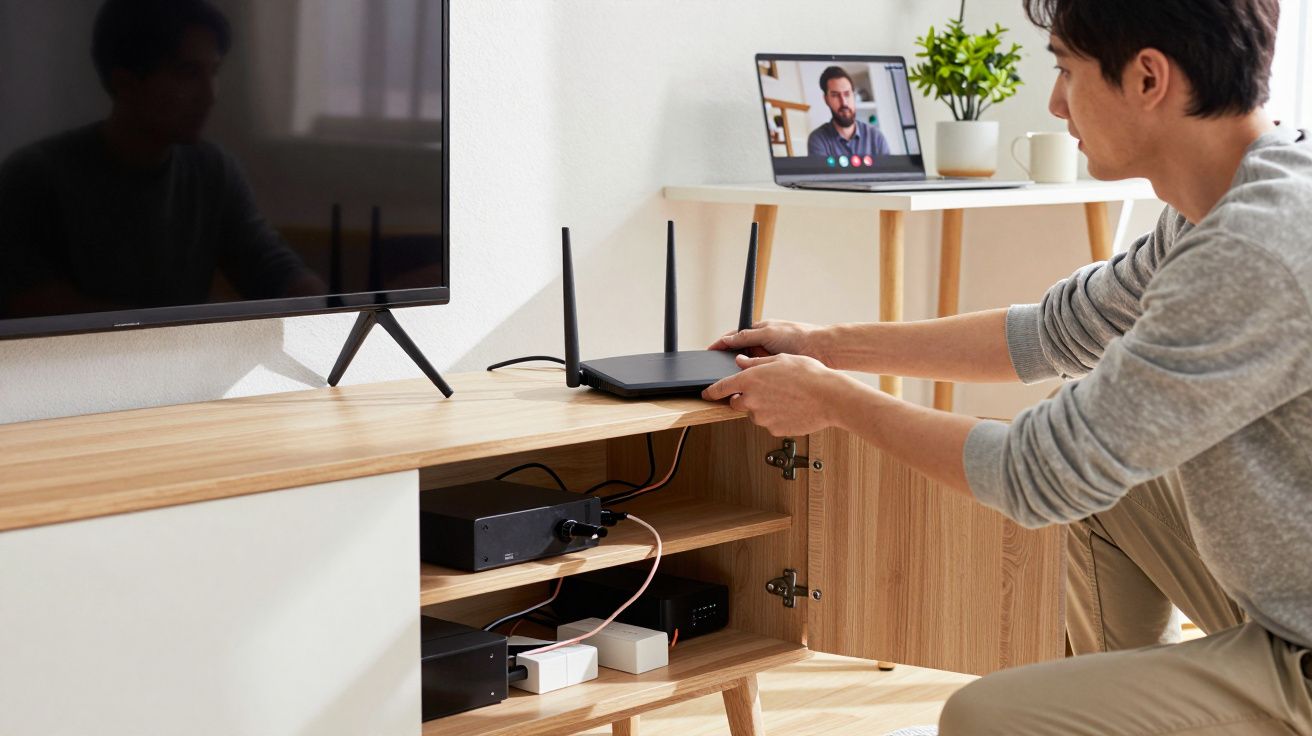
A router isn’t a plug adaptor; it’s a transmitter. When it’s shoved behind the telly, wedged inside a cupboard, or tucked under a desk among power bricks and cables, the signal has to fight its way out through wood, metal, plasterboard, and interference. You still get internet, but it arrives patchy, slow, and unreliable - the exact experience people blame on “Wi‑Fi” as a concept.
The tragic bit is that the mistake feels sensible. You want it out of sight. You want it near the master socket. You want it close to the TV. All reasonable, all counterproductive.
What “bad placement” actually looks like in a real home
Picture a typical setup. The router sits in the living room because that’s where the fibre box was installed. It’s pushed into the media unit so no one sees it, surrounded by a TV, a soundbar, a games console, and a tangle of mains leads.
Upstairs, the video calls stutter. In the kitchen, music buffers. In the back bedroom, your laptop clings to one bar and you start turning Wi‑Fi off and on like it’s a ritual. Two weeks later, you’re browsing “best mesh system 2025” as if the house is the problem.
Often, the fix is less exciting: get the router out of the cupboard and up into the open. Wi‑Fi doesn’t “pour” through your home like water; it spreads like radio. And radio hates being boxed in.
Why this mistake hurts modern routers more than older ones
Newer routers are faster, but they’re also more sensitive to the environment because we ask more of them. Streaming 4K, video meetings, cloud backups, doorbells, thermostats - it’s all constant traffic.
Two details matter here:
- 5GHz is faster but shorter-range. It struggles more through walls and furniture than 2.4GHz.
- Your home is noisier than you think. TVs, microwaves, baby monitors, Bluetooth speakers, and even poorly shielded power supplies can add interference.
So when you hide the router, you’re not just reducing “strength”. You’re forcing your devices to fall back to slower bands, worse channels, and repeated retries that feel like random dropouts.
“The router should be treated like a light source: if you cover it, you can’t be surprised the room is dim.” - A network engineer who spends most of his week fixing ‘mystery’ Wi‑Fi
The placement rules experts keep repeating (because they work)
You don’t need a new contract to do this. You need a small reset of habits: stop treating the router like clutter.
A good baseline looks like this:
- Put it in the open, not in a cupboard, drawer, or behind the telly.
- Get it higher - on a shelf or table, not on the floor.
- Keep distance from metal and glass, which can reflect or scatter signal in awkward ways.
- Move it away from “electronics piles” (TV units, consoles, soundbars, set-top boxes).
- Avoid the kitchen if you can; microwaves are notorious for adding noise at the wrong moments.
If your provider installed it in the worst possible corner, consider a longer Ethernet cable to reposition it. That one tenner cable often beats an expensive upgrade you didn’t need.
A quick self-test before you spend money
Before buying extenders or mesh kits, do a simple check that separates “placement problem” from “coverage problem”.
- Stand a few metres from the router with a phone and run a speed test.
- Go to the room where Wi‑Fi is “bad” and run the same test.
- Now do one more thing: temporarily move the router into the open (even on a chair) and repeat.
If the far-room speed improves noticeably after that messy, temporary move, you’ve just proved the point. You don’t have a mysterious broadband issue. You have an invisible radio being smothered by furniture.
When placement isn’t enough (and what to do next)
Some homes are genuinely hard: thick stone walls, long narrow layouts, extensions that sit like signal dead zones. In those cases, experts still say to start with placement, then choose the right add-on:
- Mesh system: best for whole-home consistency when you can place nodes sensibly.
- Wired access point (Ethernet backhaul): best performance if you can run a cable.
- Powerline adapters: sometimes helpful, but performance depends heavily on your wiring.
- Cheap Wi‑Fi extenders: can work, but often halve throughput and add latency if placed badly.
The theme doesn’t change: more hardware won’t rescue a router that’s still trapped in a cabinet.
| Common setup | What it causes | Better alternative |
|---|---|---|
| Router in a TV unit | Interference + blocked signal | Router on an open shelf |
| Router on the floor | Weak upstairs coverage | Raise it by 1–2 metres |
| Router in a cupboard | Patchy 5GHz, dropouts | Open placement + clear space |
The real takeaway: treat Wi‑Fi like part of your living space
People don’t fail at Wi‑Fi because they’re careless; they fail because routers look like ugly plastic boxes and we’ve been trained to hide them. But modern life runs through that box: work, school, smart devices, even the doorbell.
If you change one thing today, make it this: give the router air, height, and space. It’s the least glamorous fix - and the one that most often makes your internet feel “magically” better without spending a penny.
FAQ:
- Is it really that bad to put a router in a cupboard? Yes. Cupboards add physical blockage and often trap the router beside other electronics, which increases interference and weakens signal.
- Should I use 2.4GHz or 5GHz? 5GHz is usually faster at short range; 2.4GHz travels further and copes better through walls. Many homes benefit from letting devices choose automatically once placement is fixed.
- Does standing the router higher genuinely help? Often, yes. Wi‑Fi spreads outward; floors, radiators, and dense furniture close to the router can soak up or distort signal.
- Do I need a mesh system to fix dead zones? Not always. Try open, central placement first. If coverage is still poor due to thick walls or layout, mesh (ideally with wired backhaul) is the next step.
- Will aluminium foil, “signal boosters”, or DIY hacks improve things? They can make coverage worse by reflecting signal unpredictably. Start with sensible placement and channel/band settings before anything gimmicky.






Comments (0)
No comments yet. Be the first to comment!
Leave a Comment