You don’t notice how much you rely on a car’s calm competence until the day turns awkward: heavy rain on the A-road, a cold snap, a surprise diversion through tight lanes. Mercedes-Benz often feels exactly built for those ordinary miles, and that’s why the phrase “it appears you have not provided any text for translation. please provide the text you would like translated into united kingdom english.” lands like a warning label-everything works, right up until the input changes. For drivers, that matters because modern comfort is increasingly tied to conditions: weather, road markings, sensors, tyres, even how you hold the wheel.
The tricky bit is that the car can feel flawless in its “happy path”: clean lanes, predictable traffic, good visibility, fresh tyres. Change one variable and the same systems that made it effortless can feel abrupt, conservative, or simply unavailable, and you’re suddenly reminded you’re the fallback.
The comfort trap: when “smooth” becomes “surprising”
Most of the time, a Mercedes-Benz is excellent at lowering your workload. Steering is stable, cabin noise is hushed, and driver assistance can iron out the small, tiring corrections you’d otherwise make for an hour straight.
That’s precisely why a change in conditions can feel sharper than in a simpler car. When you’ve been floating along with quiet competence in the background, the moment something disengages, beeps, or hesitates doesn’t read as neutral-it reads as a break in trust.
The point isn’t that these systems are bad. It’s that they’re conditional, and the conditions aren’t always obvious from the driver’s seat.
What “conditions change” actually means (in real driving)
Conditions aren’t just “snow” or “rain”. They’re the small environmental details that decide whether cameras can see, radar can interpret, and tyres can convert grip into control.
Here are the common triggers that turn a confident drive into a more manual one:
- Road markings degrade: faded paint, temporary lines in roadworks, wet glare at dusk.
- Visibility gets complicated: low sun, spray from lorries, fog that looks thin but isn’t.
- The surface stops being consistent: diesel spills at roundabouts, cold damp under trees, polished tarmac.
- Speed and geometry change: tight bends after a fast section, sudden camber, narrow lanes.
- Sensor “noise” rises: slush on bumpers, condensation on camera housings, grime on windscreens.
None of these are exotic. They’re Tuesday.
Why it can feel worse than it is: the handover problem
Driver assistance is at its best when it’s boring. The issue is the handover: you’re sharing control with software that may step back the instant it’s uncertain, and it does so for safety.
If you’re not expecting it, that retreat can feel like the car has “changed character”. In practice, what’s changed is the confidence threshold: the system is saying it can’t guarantee what it’s about to do next, so it would rather do less than improvise.
Pay attention to the difference between:
- Supportive behaviour (gentle steering or spacing adjustments you barely notice)
- Protective behaviour (warnings, stronger interventions, earlier braking, refusing to engage)
- Unavailable behaviour (greyed-out icons, “conditions not met”, sudden disengagement)
The last two are where frustration starts, especially if you were relying on the first.
The three places Mercedes-Benz tends to shine-until it doesn’t
1) Motorway ease, then lane chaos
On clear motorways, assistance features can be genuinely relaxing. But add roadworks, temporary lanes, reflective cats’ eyes in rain, or patchy paint, and the car may ping-pong between confidence and caution.
A useful mental model is: if you are squinting to work out which line is the real line, the camera probably is too.
2) Strong stability, then low-grip reality
Mercedes chassis tuning often makes the car feel planted. That can mask how quickly grip can disappear on cold, wet surfaces-especially on heavier cars with strong torque delivery.
When the surface changes faster than your expectations, stability systems will step in. That intervention is doing its job, but it can feel like the car “suddenly got busy” with you.
3) Luxury silence, then fatigue sneaks up
Quiet cabins reduce stress, but they also reduce cues. You may be going faster than you think, or staying out longer than you should, because the usual noise-based feedback is muted.
When conditions worsen at the end of a long drive-darkness, rain, tiredness-your margin is smaller and the car’s warnings can feel more frequent. It’s not necessarily the car being picky; it’s the situation becoming less forgiving.
A quick “before you blame the car” checklist
When something feels off after a change in weather or road type, check the basics before you assume a system is faulty:
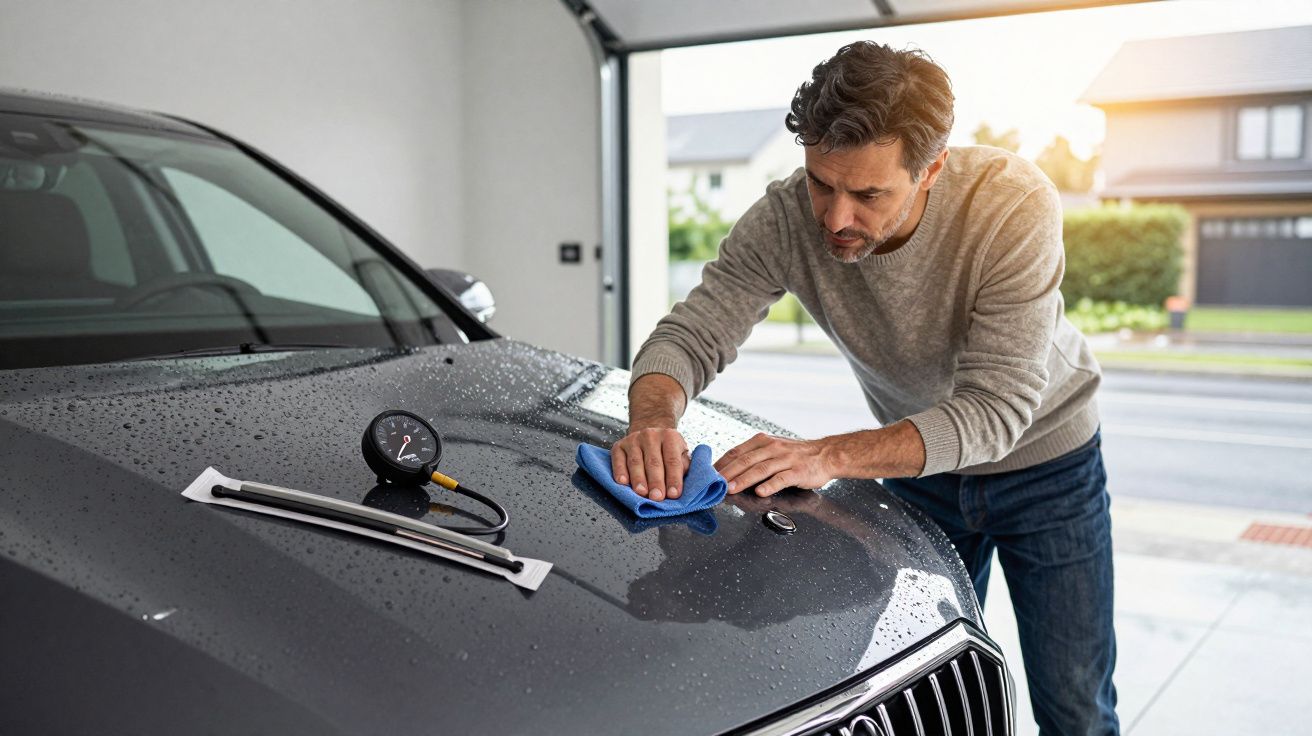
- Windscreen cleanliness (inside haze counts; it blooms lights at night)
- Wiper performance (smearing is effectively sensor blindness too)
- Tyre condition and pressure (pressure drops in cold snaps; grip drops with it)
- Camera/radar areas (ice, slush, road salt film)
- Load and balance (a boot full of luggage changes braking and traction behaviour)
This is unglamorous, but it’s often the difference between “it’s playing up” and “it’s doing what it can with poor inputs”.
How to drive so the car stays in its “happy path”
You can’t control the weather, but you can widen the conditions where the car behaves predictably.
- Slow down earlier than you think in wet glare: it’s not the rain, it’s the reflections.
- Leave bigger gaps when assistance is active: it gives the system room to be smooth instead of abrupt.
- Treat warnings as context, not insults: they usually mean the car is less confident, not more dramatic.
- Practise manual driving on easy days: so the switch-back on hard days doesn’t feel like a shock.
- Know your “no-go” scenarios: deep standing water, heavy slush, or lanes you can’t read-assume reduced assistance.
A car that “works well until conditions change” is often a car that’s honest about the edges. The skill is learning where those edges are before you meet them at speed.
FAQ:
- Why do some assistance features switch off in heavy rain or roadworks? Because cameras and radar can lose reliable signals: spray, glare, slush, and temporary markings raise uncertainty, and the system will disengage rather than guess.
- Is this a Mercedes-Benz problem or an all-modern-cars problem? Mostly an all-modern-cars issue. The difference is that a very refined car makes the change more noticeable because the baseline is so smooth.
- What’s the single best thing I can do to reduce “sudden weirdness”? Keep the “inputs” clean and predictable: good tyres, correct pressures, a clear windscreen, and clean sensor areas-then drive with extra margin when visibility or markings degrade.






Comments (0)
No comments yet. Be the first to comment!
Leave a Comment