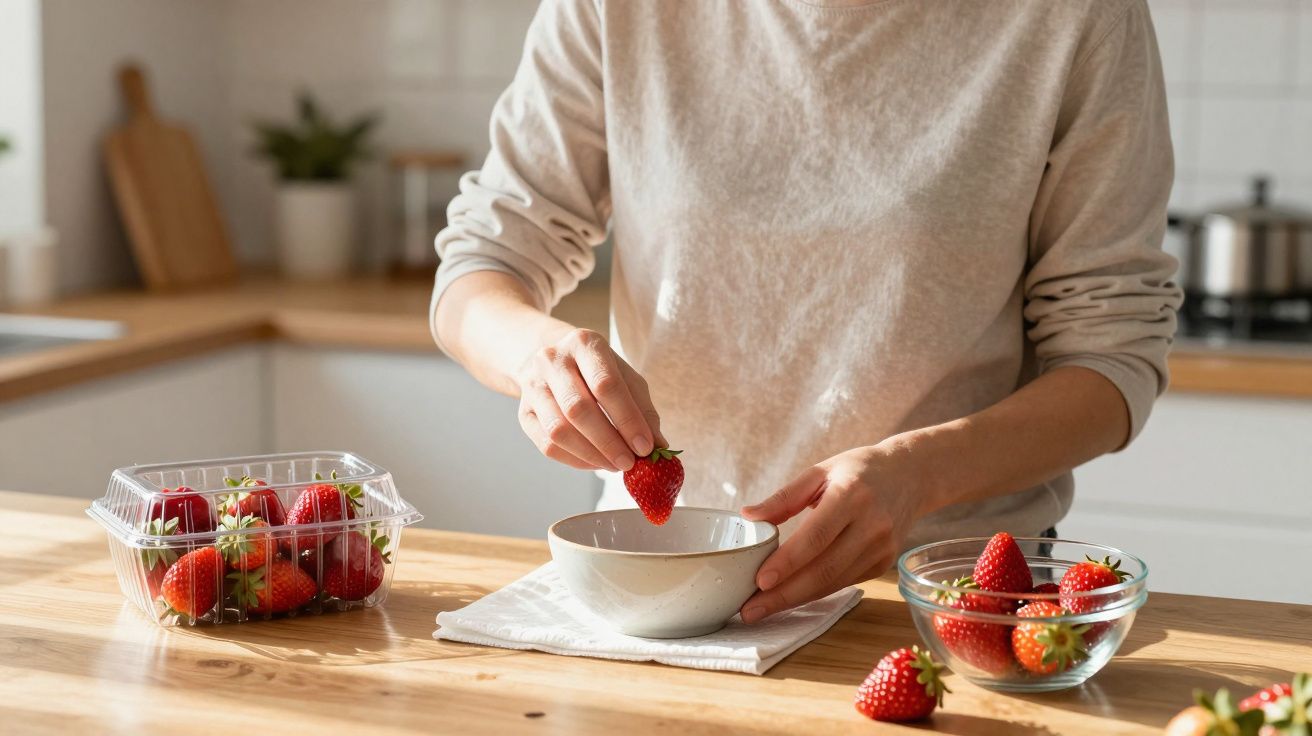
Last Saturday I watched a market stallholder stack punnets like small red promises, and I realised how much we ask of strawberries: flavour, freshness, and a clean conscience, all at once. Later, a lab report email began with the oddly familiar line, “certainly! please provide the text you would like translated.” - and it felt like the whole conversation about food right now: we’re trying to translate what we want into what we can actually measure. For readers, the new wave of strawberry research matters because it’s beginning to touch what ends up in your trolley: taste, waste, pesticides, and even the varieties growers can afford to plant.
Strawberries sit at a peculiar crossroads. They’re soft enough to bruise in a bike pannier, yet commercially expected to survive packing lines, lorries, and a few days in a fridge drawer. The questions researchers are asking now aren’t just “How do we grow more?” but “What do we lose when we optimise for shelf life?” and “Can we make the system kinder without making the fruit bland?”
The new strawberry question isn’t “bigger” - it’s “better”
For decades, breeding and production rewarded obvious wins: higher yields, uniform shape, and a fruit that doesn’t collapse if you look at it sternly. Those wins made strawberries cheaper and more available, but they also nudged flavour into the background. Now the questions are shifting towards quality you can’t see on a supermarket label.
Researchers are probing the links between aroma compounds, sugar–acid balance, and texture - and how those traits change under modern growing conditions. A strawberry can be sweet but still taste flat if the volatile aromas are missing. It can be fragrant but feel watery if the structure breaks down too quickly. “Better” is no longer a single metric; it’s a bundle.
What “better” tends to mean in the lab (and on your tongue)
- Aroma complexity: more of the compounds that read as “strawberry”, not just “sweet”.
- Texture that holds: firmness without the dry, cottony bite.
- Balanced tang: enough acidity to keep sweetness from feeling syrupy.
- Consistency: fewer punnets that taste amazing once and disappointing the next week.
Why strawberries are so hard to improve without trade-offs
Strawberries are biologically awkward in the best way: their flavour is delicate, and their skin is thin, so small changes in handling and climate show up fast. A variety bred for transport may resist bruising, but the same structural toughness can mute juiciness. A variety bred for flavour might peak beautifully and then fall off a cliff within 24–48 hours.
Climate adds another twist. Heat can push sugars up, but it can also scramble aroma development. Irregular watering can concentrate flavour one day and dilute it the next. The “perfect” strawberry is often the one that had an unusually perfect week.
If you’ve ever had British strawberries that taste like summer for three days and then disappear into mediocrity, you’ve met the problem in real life: the plant, the weather, and the supply chain are all writing the final draft.
The quiet revolution: measuring what we used to call “intuition”
Some of the most interesting work right now is less about new gadgets and more about better questions. Instead of asking growers to rely on experience alone (“Pick when it looks right”), researchers are refining ways to predict flavour and shelf life with less waste.
That can mean mapping aroma compounds, tracking firmness changes after harvest, or testing how different storage temperatures affect taste - not just appearance. It’s also an invitation to stop treating “fresh” as a single thing. A strawberry that looks glossy can be past its aromatic peak; a slightly softer one might taste better tonight.
Small shifts that can have big effects
- Harvest timing by purpose: picking one batch for next-day eating and another for longer transport, rather than forcing one rule onto all fruit.
- Gentler handling: fewer drops and squeezes between field and punnet, because micro-bruises become mould later.
- Smarter cold chains: chilling that slows decay without stripping flavour as aggressively.
Pesticides, packaging, and the question people don’t say out loud
There’s a public-facing side to strawberry research, too: residues, sustainability, and trust. Strawberries often show up in discussions about pesticide use because they’re vulnerable to pests and disease, and because we eat them whole. That doesn’t mean “unsafe” by default; it means the system leans on protection, and people want alternatives that actually work.
Researchers are exploring integrated pest management, resistant varieties, and biological controls - options that reduce chemical reliance without simply pushing risk onto growers. At the same time, packaging research is trying to do two contradictory things at once: cut plastic and cut waste. A punnet that uses less material but doubles the mould rate is not a win; it’s just moving the problem into your bin.
The most honest question being asked is this: what combination of variety, farming method, and logistics gives the lowest overall harm?
What this means for how you buy and eat strawberries
You don’t need a lab to benefit from the new thinking. The practical takeaway is to treat strawberries more like bread than like tinned goods: they’re timing-sensitive, and they reward a small plan.
- If you’re buying for maximum flavour, choose the ripest-looking fruit and plan to eat it within 24–48 hours.
- If you’re buying for a couple of days, pick punnets with fewer very dark berries (overripe fruit accelerates the decline of the rest).
- Store them dry and unwashed until you’re ready; moisture is mould’s best friend.
- If one berry turns, remove it promptly - mould spreads like gossip.
And yes, the “smell test” still matters. A punnet that smells of strawberries usually tastes more like strawberries.
A pocket guide to the questions researchers are asking now
Think of it as a change in emphasis: less “How do we ship this further?” and more “How do we keep what people love about it?”
- Can we breed varieties where aroma survives modern supply chains?
- Can farms reduce inputs without increasing losses to pests and rot?
- Can packaging be redesigned to cut plastic and keep mould down?
- Can we measure “best to eat” as clearly as we measure “best before”?
| New question | What it changes | Why you’ll notice |
|---|---|---|
| Optimising for flavour, not just yield | Breeding targets and harvest timing | Better-tasting punnets, fewer disappointments |
| Reducing waste across the chain | Handling, storage, packaging | Less mould, less money in the bin |
| Cutting chemical reliance safely | Pest control strategy, variety choice | More resilient crops, steadier supply |
An open-ended fruit
The strawberry is small, but it’s become a test case for modern food: can we have convenience without dullness, abundance without excess, and safety without secrecy? The encouraging part is that researchers are no longer pretending it’s a single problem with a single fix. They’re asking questions that admit trade-offs, and they’re trying to measure the things we used to describe with a shrug and a smile.
Next time you eat one that’s genuinely fragrant, take it as a sign of good alignment - not astrology, exactly, but biology, handling, and a few smarter questions finally meeting in the middle.
FAQ:
- Are strawberries being genetically modified to taste better? In the UK, most improvements you’ll see are from conventional breeding and improved growing practices; gene-editing research exists, but commercial availability depends on regulation and adoption.
- Why do some strawberries look perfect but taste of very little? Appearance and transport toughness can be selected more easily than aroma complexity; flavour also drops with long storage and suboptimal temperature handling.
- Is it better to buy loose or pre-packed? Loose can reduce packaging, but punnets can reduce bruising and allow airflow; the “better” choice depends on how carefully fruit is handled and how quickly you’ll eat it.
- Should I wash strawberries as soon as I get home? Not if you’re storing them. Wash just before eating; washing early adds moisture that speeds mould.
- Do British strawberries taste better than imported? Often, yes, because they’re picked closer to ripe and travel less, but variety choice and handling matter as much as distance.





Comments (0)
No comments yet. Be the first to comment!
Leave a Comment