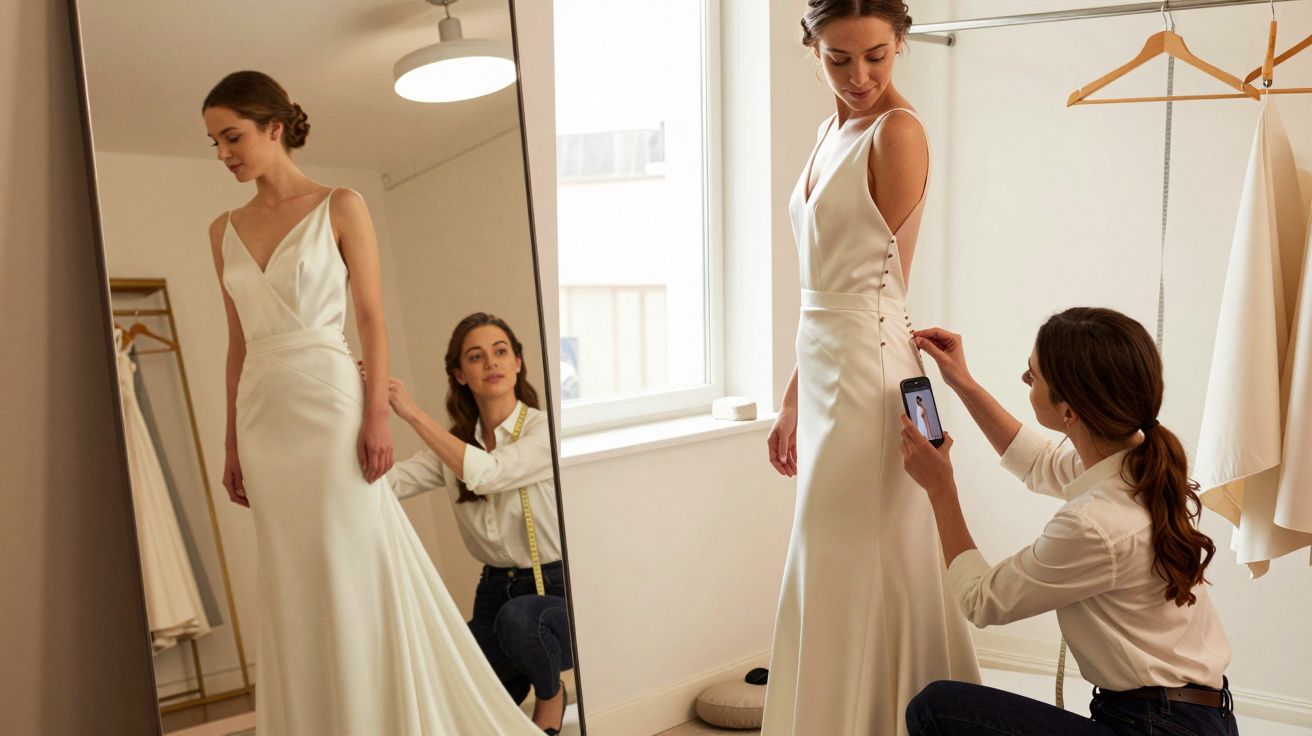
In the fitting room, wedding dress alterations are meant to make everything look effortless. Yet one small decision can introduce line distortion so quietly you won’t notice until the photos come back and the dress seems to “pull” in places it never should. If you’re aiming for a clean silhouette - modern, minimal, bias-cut, crepe, satin - this is the mistake that turns expensive simplicity into visible tension.
It usually happens when everyone is trying to be helpful. The seamstress wants you to feel held. Your mum wants you to feel secure. You want to stop thinking about it and tick the box: fitted, done. And then the dress starts fighting its own design.
The mistake: over-taking-in to create “snatch”, then forcing the fabric to behave
Clean dresses don’t hide their engineering. When you take in too much through the wrong seams (or take in evenly all round when the body isn’t even all round), you change the garment’s balance. The fabric doesn’t lie flat any more; it starts searching for relief.
That relief shows up as:
- diagonal drag lines from bust to waist
- rippling over the stomach in crepe that used to look like glass
- a side seam that creeps forward in mirror selfies
- a skirt that twists so the centre front isn’t truly centred
It’s not that the dress is “too small” in the obvious sense. It’s that it’s been made smaller without being rebalanced, so the dress hangs as if it’s slightly rotated on your body.
Why this hits minimal silhouettes harder than lace or tulle
On a beaded corset, you can get away with a lot. Texture breaks up the eye, and structure can bully fabric into place. A clean column dress has none of that camouflage. Every millimetre of tension becomes a visible message.
There’s also less margin for alteration. A crepe sheath might have tiny seam allowances, few layers, and a finish that shows needle marks if it’s unpicked more than once. So when the first “let’s just nip it in a bit more” is wrong, the second correction is harder, and the third is sometimes impossible without leaving a history.
How line distortion actually starts (and why it’s not your posture)
Most brides blame themselves first. They think they’re standing oddly, that their shapewear is wrong, that they’ve suddenly forgotten how to breathe.
Usually, the dress is doing what fabric does under stress: it pulls towards the tightest point and away from the areas that need length. If a bodice is taken in at the side seams to remove gaping, but the bust apex isn’t re-shaped properly, the front can borrow length from the waist. If the waist is over-reduced without releasing the hip, the skirt can climb and then kick out behind.
A simple test in the fitting: relax your shoulders, take two normal breaths, and walk three steps. If new lines appear as you move - not just when you pose - you’re looking at structural tension, not “bad standing”.
The “tight is secure” myth
Security in a bridal dress comes from smart support, not from squeezing the circumference until the zip prays for mercy. When a dress is over-taken-in, it can feel firm in the mirror and still read unsettled on camera.
The ironic part is that over-tightening often makes you fuss more on the day: tugging the neckline, shifting straps, smoothing the skirt, checking the side seam that keeps migrating.
The fittings moment where this goes wrong
It tends to happen at the second fitting, when the dress is close enough to feel real. The hem is pinned, the bustle is discussed, and the bodice is “almost there”.
Someone says: “Can we make it a bit more snatched?” and everyone nods, because who says no to a waist.
But “snatched” is not a measurement. It’s a styling effect. And in alterations, effects have consequences: where the dress takes in, where it releases, and where it needs extra length to keep the front panel calm.
If you want definition without distortion, ask for support solutions first (boning placement, cups, waist stay, strap adjustment), then micro-taking-in second.
What to do instead: fit the dress to the body’s map, not the tape measure
A good alterations plan treats your body like a set of points, not a cylinder. Bust apex, ribcage, natural waist, high hip, full hip - they rarely line up as equal reductions.
Here’s the practical approach that keeps clean lines clean:
- Stabilise the top first. Get the bust support right (cups, strap length, neckline security) before anyone touches the waist. A bodice that floats will always “need” taking in somewhere.
- Reduce where the dress is truly excess. Side seams aren’t a universal fix. Sometimes the back seam, darts, or neckline edge is the correct area.
- Rebalance after each change. If the side seam moves forward, something’s off. If the centre front isn’t hanging straight, stop and reassess before doing more.
- Fit for movement, not mannequin stillness. Sit, lift your arms, take normal breaths, walk. A clean silhouette only works if it stays calm when you’re alive inside it.
A quick checklist for your next fitting
Bring this, literally, as notes in your phone:
- Are there diagonal lines pointing to a seam? (Tension, not “wrinkles”.)
- Does the side seam sit at the side, or is it creeping forward/back?
- Does the skirt hang straight when you walk, or does it twist?
- Can you inhale fully without the neckline shifting?
- Does the dress feel “held” by internal support, or only by tightness?
If you can answer those calmly, you’re protecting the silhouette, not just chasing a smaller number.
When taking in is fine - and when it’s a red flag
Taking in is normal. Most dresses need it. The issue is how and how much.
It’s usually fine when:
- the alteration is small and local (a dart refined, a neckline edge corrected)
- the dress is supported internally (so the fabric isn’t doing the job of a bra)
- the grain and seams stay where they were designed to sit
It’s a red flag when:
- the dress looks great clipped but worse sewn
- drag lines appear after you sit down once
- you’re being told “it will relax” when the fabric is actually under strain
- the seamstress keeps chasing wrinkles by making it tighter everywhere
A clean dress should look quieter as it gets closer to finished, not more “busy”.
The quiet rule that saves modern dresses
Minimal bridal is unforgiving, but it’s not fragile. It just requires one boring discipline: don’t force the dress into shape by shrinking it past its balance point.
The best wedding dress alterations don’t announce themselves. They make you feel secure, breathe normally, and forget about the dress entirely - which is exactly when a clean silhouette looks the most expensive.
FAQ:
- How can I tell if the dress is too tight or just needs steaming? Steam helps soft, shallow creasing. If you see diagonal pull lines, seam migration, or twisting when you walk, that’s fit tension and steaming won’t fix it.
- Is shapewear the solution to line distortion? Sometimes it smooths minor surface texture, but it won’t correct a dress that’s been over-taken-in or thrown off balance. In some cases it makes distortion worse by adding friction and changing how the dress moves.
- Can line distortion be fixed once it’s sewn? Often, yes - but it depends on seam allowance, fabric, and how many times seams have been unpicked. The sooner you flag it (before final stitching and finishing), the better the outcome.
- What should I ask for if I want a “snatched” waist without distortion? Ask about internal support first: cups, boning placement, a waist stay, and strap refinement. Then take in strategically where there is true excess, with rebalancing checks after each change.




Comments (0)
No comments yet. Be the first to comment!
Leave a Comment