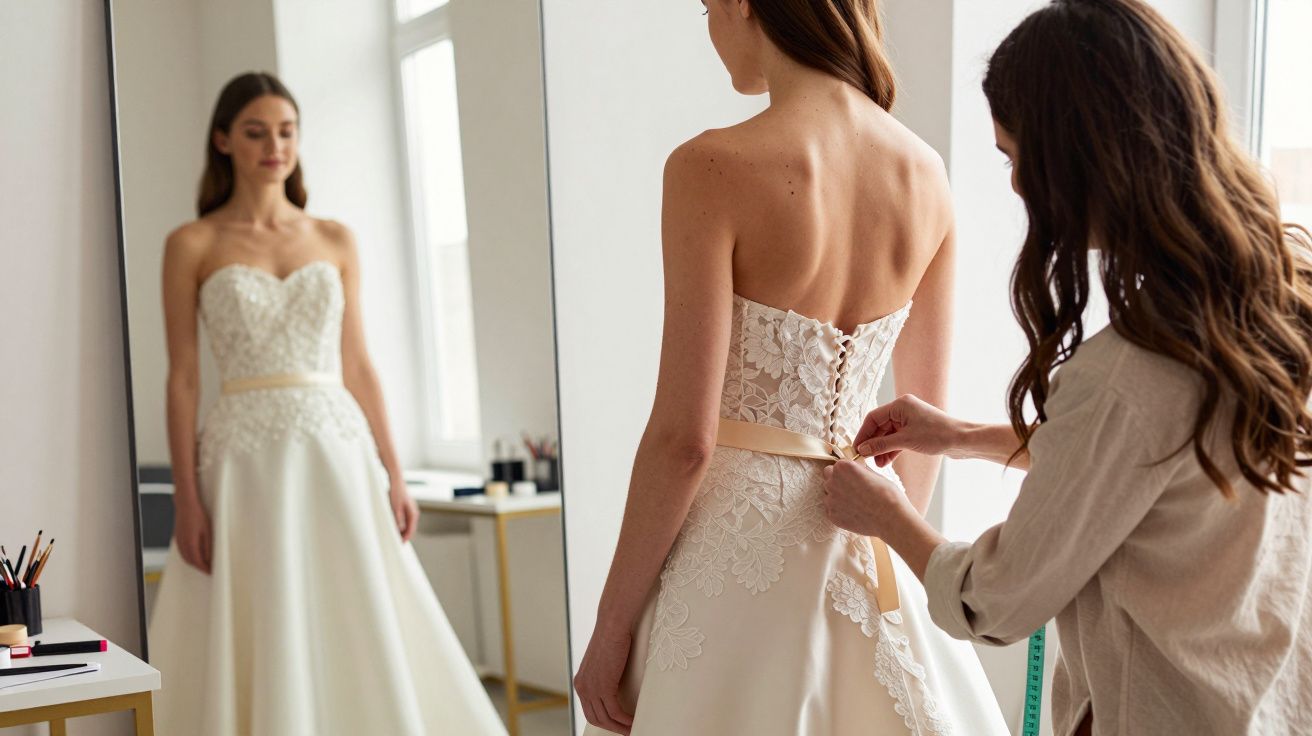
You don’t usually notice wedding dress structure until it goes wrong: a bodice that digs in, straps that slip, a neckline that won’t sit still. But the same internal engineering can quietly improve body alignment while you walk, hug, dance and breathe. The most effective adjustment often isn’t visible in photos, and the bride rarely feels it happening in real time.
It shows up as a different kind of comfort. Your shoulders stop creeping forwards. Your chest feels more open without being “pushed up”. The dress suddenly looks like it was made for your posture, not fighting it.
The tiny adjustment that changes everything
Most brides assume posture is a matter of “standing up straight” on the day. In reality, posture is often a response to what the garment is asking the body to do: where it anchors, where it pulls, and where it lets go.
The adjustment is this: shifting the bodice’s internal support to anchor at the waist, not the top edge. In alteration rooms it may be described as adding or repositioning a waist stay, inner belt, or internal grosgrain, sometimes paired with small changes to boning placement. Done well, it changes how the dress carries its own weight.
When the weight is held at the natural waist, the upper bodice can relax. The bride stops bracing through the shoulders and neck to keep everything “up”, so the spine stacks more naturally. It feels like nothing - which is the point.
Why brides hunch in the first place (and don’t realise)
Watch fittings back-to-back and you’ll see a pattern. The dress looks gorgeous, but the bride’s shoulders rise a few millimetres. The chin reaches forward. The ribcage locks. She’s not being vain; she’s compensating.
A strapless or structured bodice that isn’t anchored properly behaves like a wet towel. It slides down, so the body instinctively counters by lifting the chest and tightening the upper back. Even with straps, a bodice that relies on the neckline to “hang” will pull the shoulders inwards over time.
A good structure doesn’t demand effort from the wearer. It distributes load to parts of the body designed to take it.
How the waist anchor works inside the dress
Think of the inner waist stay as a quiet seatbelt. It sits on the inside of the bodice at the waist, closes snugly, and takes the gravitational pull of the skirt, train, and fabric layers.
Once that belt is doing the heavy lifting:
- The neckline doesn’t have to grip for dear life.
- The boning can guide shape rather than act like a clamp.
- The dress stops migrating downward with movement.
- The upper body can soften, which is where posture improves.
A well-placed internal belt also stops that common “two dresses” look in motion: bodice creeping one way, skirt tugging another. Instead, the gown moves as one piece, and the body stops fighting it.
What it looks like in a fitting: the before-and-after you can’t unsee
A bride steps out of the changing area and does the usual checks: sits, lifts arms, turns, laughs. In the mirror, the dress seems fine. Then the seamstress pins a temporary waist stay inside and asks her to relax her shoulders.
This is where the change happens. The sternum lifts slightly without being forced. The shoulders drop. The neck lengthens. The dress appears “more expensive” because the wearer is no longer bracing.
It’s the same body, the same gown, but the line from ear to shoulder to hip suddenly looks calmer. That’s body alignment responding to better support, not coaching.
Signs your gown needs this adjustment
Not every dress needs an internal waist anchor, but many benefit from it - especially heavier skirts, detailed bodices, and strapless or off‑the‑shoulder styles.
Look for these tells during fittings:
- You keep tugging the bodice up, even if it isn’t actually slipping.
- The top edge feels tight, yet you still don’t feel secure.
- Your shoulders ache after ten minutes in the gown.
- The neckline sits perfectly when you stand still, then changes shape when you walk.
- You feel “compressed” high on the ribs, but loose at the waist.
One clue matters more than the rest: if you can only feel stable by holding tension in your upper back, the structure is anchored too high.
How an alterations specialist will do it (and what to ask)
There are a few versions depending on the dress construction, but the principle stays the same: support should transfer to the waist and distribute evenly.
Common approaches include:
- Adding a grosgrain waist stay inside the bodice, hand‑tacked into seams.
- Repositioning boning so it stabilises vertically without digging into the bust line.
- Securing the bodice lining to the outer layer so they behave as one unit (reduces drift).
- Adjusting side seams and cups so the top edge can sit softer once the waist is doing the work.
Questions worth asking in plain language:
- Can we add an internal belt so the dress weight sits at my waist?
- If we do, will the neckline be able to relax slightly rather than gripping?
- Can I try walking and lifting my arms after it’s pinned, not just standing?
A good fitter will encourage movement tests. A gown that only works in stillness is a gown that will ask your body to compensate.
One warning: tight is not the same as supported
There’s a moment in alterations where “snugger” feels like “safer”. It isn’t always. Over‑tightening the top edge can push the ribcage down and make the bride look tense in photos, even if the dress stays up.
Support is directional. It should feel like the dress is resting on you, not squeezing you into position.
“If the bride feels she has to behave to keep the dress in place,” one bridal fitter told me, “the structure is doing the opposite of its job.”
A quick checklist for the final fitting
Do these in the gown, fully fastened, with your wedding bra/underwear and shoes:
- Take three slow breaths. Your shoulders should not rise as a coping mechanism.
- Walk ten steps, stop, and see if the neckline has shifted.
- Sit and stand without pulling the bodice.
- Hug someone. If you can’t, your structure is too reliant on the top edge.
- Let your arms hang. If your shoulders creep up, the dress is asking your upper body to hold weight.
A gown with the right internal anchor makes you forget to “perform posture”. You just stand there, and you look like yourself on a very good day.
FAQ:
- Will an internal waist stay make the dress feel tighter? It should feel firmer at the waist, but often less tight at the top edge because the neckline no longer needs to grip as hard.
- Does this work for dresses with straps? Yes. Straps can stabilise, but they’re poor load‑bearers. Anchoring at the waist often reduces shoulder tension even with straps.
- Can this be added to any gown? Almost any structured bodice can take some form of internal belt, but feasibility depends on seam placement, fabric thickness, and how much access there is inside the lining.
- Will it change how the dress looks in photos? Usually it improves the line: smoother bodice, steadier neckline, more relaxed shoulders. The goal is subtlety, not a dramatic shape change.
- How do I know it’s working in the fitting? You stop thinking about holding yourself up. If you can relax your shoulders and the bodice still feels secure when you move, the structure is doing its job.



Comments (0)
No comments yet. Be the first to comment!
Leave a Comment