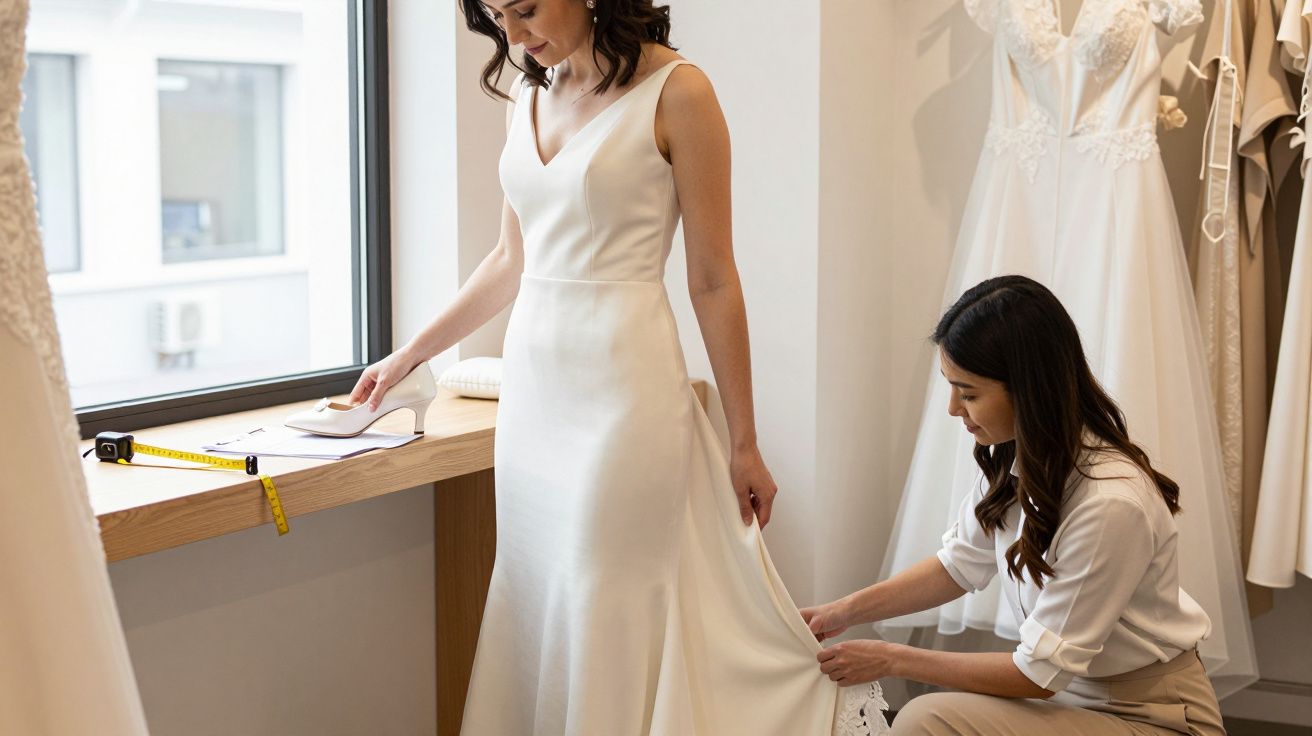
Wedding dress finalisation is the moment your gown stops being a beautiful idea and becomes the exact dress you’ll wear down the aisle: ordered, altered, pressed and ready. The problem is decision delay-brides often keep options open for “just a bit longer”, then discover the calendar doesn’t care. It matters because the last few weeks before a wedding are already full, and a dress only behaves when you give it time.
Most brides don’t postpone because they’re flaky. They postpone because the dress feels loaded with meaning, and meaning makes a simple “yes” feel like a lifetime contract. But a gown is also a physical object with lead times, fabric quirks, and a body that changes between now and the day.
The decision that quietly runs your whole timeline
The dress is the one item that touches almost everything else: shoes, underwear, hair height, bouquet scale, even how you practise walking. When wedding dress finalisation slides, the knock-on is predictable-fittings compress, rush fees appear, and the “I’ll decide later” becomes “I hope it works”.
Bridal shops build schedules around manufacturing windows and alteration capacity. Seamstresses, especially the good ones, don’t suddenly get free in peak season. And if your dress needs custom work-sleeves, a raised neckline, a bustle that actually holds-those aren’t last-minute favours. They’re projects.
The seductive logic of “I’ll wait and see”
Decision delay often sounds reasonable in your own head:
- “I’ll lose a bit of weight first.”
- “I’m not sure about my venue yet.”
- “What if I find something better?”
- “I don’t want to commit until Mum/sister/friend sees it.”
None of these are irrational. They’re just time-expensive, and the dress timeline is less flexible than most wedding tasks. You can change table linens late. You can’t always change a bodice structure late.
What brides underestimate: lead time, not taste
You can have impeccable taste and still get caught. The trap is assuming the hard part is choosing a style, when the hard part is executing that style on your body, with your shoes, in your season.
Lead times vary, but the common pinch points are consistent: ordering, first fitting, second fitting, final fitting, steaming/pressing, and safe storage. Add shipping delays, fabric availability, and a designer’s production calendar, and “plenty of time” shrinks quickly.
The goal isn’t perfection. It’s readiness: a dress that fits, moves, photographs well, and doesn’t create a crisis in the final fortnight.
The practical signs you’re cutting it fine
- You haven’t bought shoes, so hem length is guesswork.
- You’re avoiding underwear decisions, so bodice fit is unstable.
- You’re still changing your mind about neckline/straps, which affects structure.
- You’ve had no bustle discussion, even though your train needs one.
- You’re relying on “a quick alteration” for beadwork, lace, or corsetry.
If two or more of these feel familiar, you’re not behind morally-you’re behind logistically.
A calmer way to finalise without losing your mind
A surprising number of dress regrets are actually planning regrets: too many opinions, too many screenshots, not enough decisions that stick. The fix is less romance, more process.
Start by defining what “done” looks like. For most brides, done means: gown chosen and ordered, alterations booked, shoes and undergarments selected, and a plan for collection/transport.
A simple finalisation checklist (that real brides actually finish)
- Choose your gown based on how it moves, not how it poses.
- Buy the shoes you’ll wear (or a same-height pair) before the first fitting.
- Pick underwear early: bra/cups, shapewear, nipple covers-whatever you’ll use.
- Book alteration appointments the moment the dress delivery date is confirmed.
- Decide on bustle style and train management at the first fitting.
- Schedule a final try-on close enough to the day to confirm fit, but not so close you can’t fix anything.
This isn’t about being intense. It’s about giving your future self a quieter week.
The “freshness” principle: set it, adjust it, stop touching it
There’s a strange parallel between a gown and anything that needs to hold steady over time. The best outcomes come from a simple rhythm: make a choice, fine-tune, then leave it alone.
Once you’ve said yes to a dress, stop browsing. Browsing is not harmless-every new option resets your confidence and feeds decision delay. If you genuinely need a second look, set a deadline (48 hours is often enough) and then commit.
Choosing for your wedding, not for your mood
Some dresses are brilliant on a Saturday in a boutique and annoying on a long day in real life. Ask these questions before you finalise:
- Can you sit comfortably for a meal without adjusting the bodice?
- Can you lift your arms enough to hug people?
- Can you walk at your venue (grass, stairs, cobbles) in this hem length?
- Does it feel like “you” without needing constant reassurance?
A dress that needs continuous validation tends to become work.
A timeline that keeps the dress from becoming a drama
Every wedding is different, but the shape of a safe plan stays similar. Keep it compact, and treat it like any other critical booking.
| Stage | What to do | Why it matters |
|---|---|---|
| Order | Confirm size, fabric, colour, delivery date | Prevents expensive “assumptions” later |
| Alterations | Book fittings and decide key changes early | Good seamstresses fill up fast |
| Final week | Collect, steam plan, transport plan | Avoids panic creases and last-minute repairs |
If you’re already closer than you’d like, be honest with your boutique or seamstress. Rush options exist, but they’re easier when you ask early and accept trade-offs.
The quiet truth: you’re not behind, you’re just ready to decide
Brides postpone wedding dress finalisation because they want to get it right, and that’s a good instinct. The win is turning that instinct into a plan that respects time, not just feelings.
Make the call, book the fittings, buy the shoes, and let the dress become a solved problem. You deserve a wedding week where your gown is waiting for you-not the other way round.
FAQ:
- When should I finalise my wedding dress? Early enough to allow ordering and multiple fittings without compressing the schedule; if you’re unsure, ask your boutique for a timeline based on your wedding date and the designer’s lead time.
- What if my weight changes after ordering? Minor changes are normal and alterations can usually accommodate them; the key is leaving enough time and attending fittings consistently.
- Do I really need shoes before alterations? Yes-hem length and posture depend on heel height, and guessing often creates extra alteration work (and cost).
- How do I stop second-guessing my dress? Limit opinions, stop browsing after you commit, and judge the dress by comfort and movement as well as photos.



Comments (0)
No comments yet. Be the first to comment!
Leave a Comment