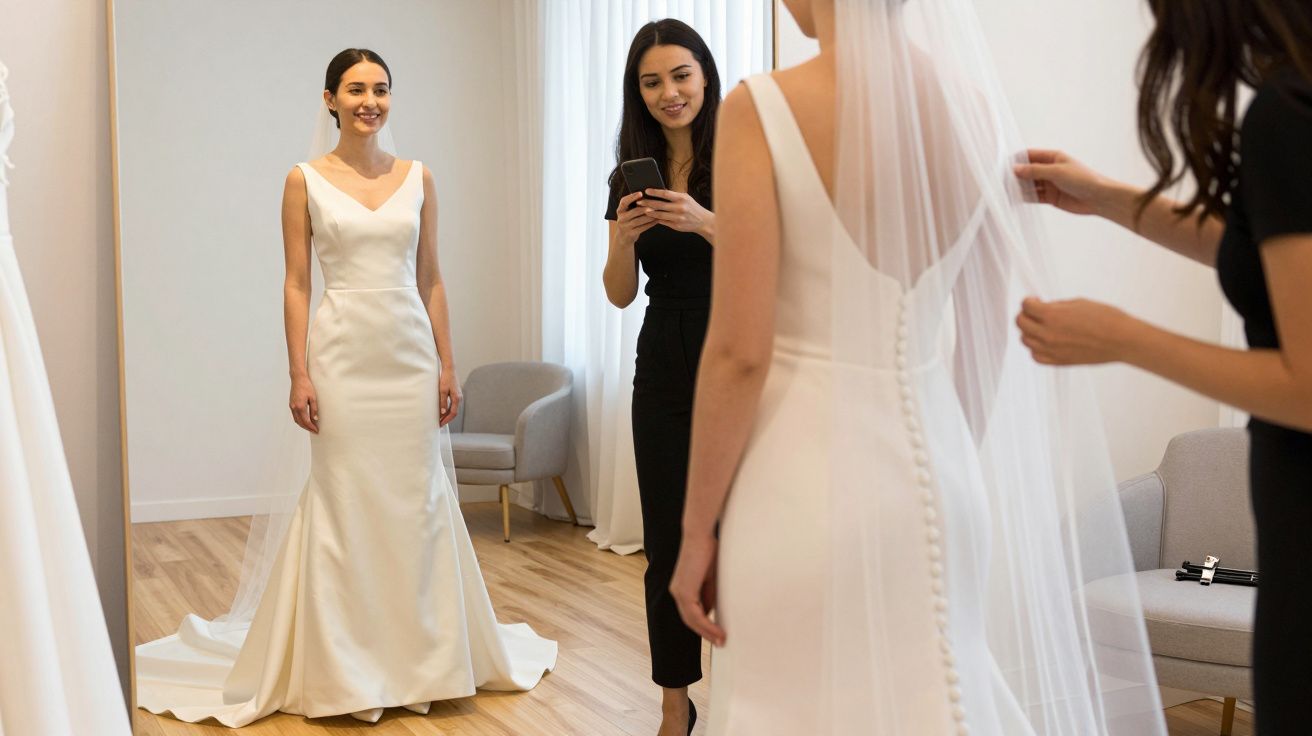
It’s rarely the whole dress guests talk about a year later. It’s bridal gown details - the small, deliberate choices stitched into a morning - and the way they pull everyone’s visual focus when you turn, laugh, or walk away. That’s why this isn’t just “pretty”: it’s memory engineering, done in silk and light.
You’ll hear it in the throwaway lines at brunch the next day. “Her buttons went on forever.” “The sleeves did that soft swish thing.” “When she moved, the back caught the sun.” Nobody says, “She chose a size 10.” They describe a moment.
The myth of “the whole dress”
We think guests take in the gown like a photograph: full-length, perfectly framed, evenly lit. In real life, weddings are movement. People see you in fragments - a hug, a spin, a hand on a glass, a shoulder turned during speeches - and their brains save the sharpest fragments like bookmarks.
The detail that lasts is usually the one that behaves well in motion. Not necessarily the most expensive, not the most “couture”, but the one that keeps catching the eye without asking permission.
The detail guests remember forever: the back, in motion
If you want a single answer, it’s this: the back of the gown. Not because it’s always dramatic, but because it’s what people see most often, and it’s where a wedding day naturally directs attention.
Think about the rhythm of the day. You walk down the aisle away from half the room. You stand at the altar with your back to the guests. You move between tables, leaning in to speak. You dance, you turn, you leave. The back becomes the most consistent “screen” guests watch.
And when the back has one clean, readable idea - buttons, a low scoop, a bow that sits just so, a lace panel that looks like it’s been sketched onto skin - it becomes the sentence people can repeat later.
Why the back wins (even when the front is stunning)
It’s not a critique of the bodice, or the neckline you obsessed over at 1 a.m. It’s just how attention works in a crowded room.
- People get repeated views of the back throughout the day.
- The back is often framed by hair, veil, and jewellery - built-in emphasis.
- Movement (walking, turning, dancing) makes back details “animate”.
- Photos and video capture it constantly: aisle shots, first dance, mingling.
A front can be breathtaking and still feel like a one-time reveal. A back can feel like a refrain.
Choose one “readable” idea, not five fussy ones
Some bridal gown details are beautiful up close but disappear at three metres. Guests don’t carry opera glasses. They carry impressions.
If you want your gown to stick in the mind, pick one primary anchor that stays legible across the room and across the day. Then let everything else support it quietly.
Good anchors tend to be high-contrast in shape or rhythm:
- A line of fabric-covered buttons (longer than you think).
- A structured bow or sash with a clear silhouette.
- A low back with crisp edges (clean modern) or soft scallops (romantic).
- A lace back panel with a recognisable motif, not “general prettiness”.
Less reliable anchors are tiny, intricate wins that need stillness: micro-beading only on the underlayer, delicate appliqué that sits under a veil all day, anything that only works in perfect lighting.
A quick “visual focus” test you can do at the fitting
You don’t need a moodboard epiphany. You need a boring little test that mimics how guests actually see you.
- Stand six steps away from a mirror (or your friend with a phone).
- Turn slowly, then walk away and back as if you’re leaving a conversation.
- Ask one question only: What did you notice first?
- Repeat with your hair down/up and with the veil on/off.
If the answer changes completely every time, your look might be competing with itself. If the answer is consistent - “the buttons”, “the bow”, “the back” - you’ve found your anchor.
The common traps (that make the detail vanish)
There’s a version of “detail” that is basically just clutter. It looks impressive on a hanger and nervous in real life.
Trap one: hiding the feature.
A cathedral veil over intricate back lace can turn your hero detail into background texture. The solution isn’t “no veil”. It’s timing: wear the veil for the ceremony, then remove it to let the back do its job later.
Trap two: choosing discomfort.
If the low back needs constant adjusting, it won’t read as effortless - it will read as “she kept touching it.” Guests remember that too, just not fondly.
Trap three: no contrast.
Buttons that match perfectly can disappear on matte fabric in warm lighting. Lace that’s the same tone as the lining can flatten. Contrast doesn’t have to be stark; it just has to exist.
Make the memory feel like you, not like a trend
The point isn’t to chase what TikTok is currently obsessed with. It’s to pick the one element that says something true about your taste, and then let the day do what it does: move.
A minimalist bride can do the same “forever detail” with a razor-clean back seam and an architectural bow. A romantic bride can do it with a lace panel that looks like it belongs to her skin rather than sitting on top of it. A vintage-leaning bride can do it with buttons that run long, like an old-fashioned glove, and a train that behaves.
The guests won’t remember your spreadsheet of options. They’ll remember the one detail that kept meeting their eyes, again and again, until it felt inevitable.
Mini checklist: the back detail that photographs and lives well
- Can you sit comfortably for dinner without tugging?
- Does it still look intentional after hugging three people in a row?
- Does it read clearly from the end of the aisle?
- Can the veil be removed easily to reveal it later?
- Does it still look good when you’re slightly sweaty and laughing?
If you get mostly yeses, you’re not just choosing a dress. You’re choosing the version of you that will be remembered in other people’s stories.




Comments (0)
No comments yet. Be the first to comment!
Leave a Comment