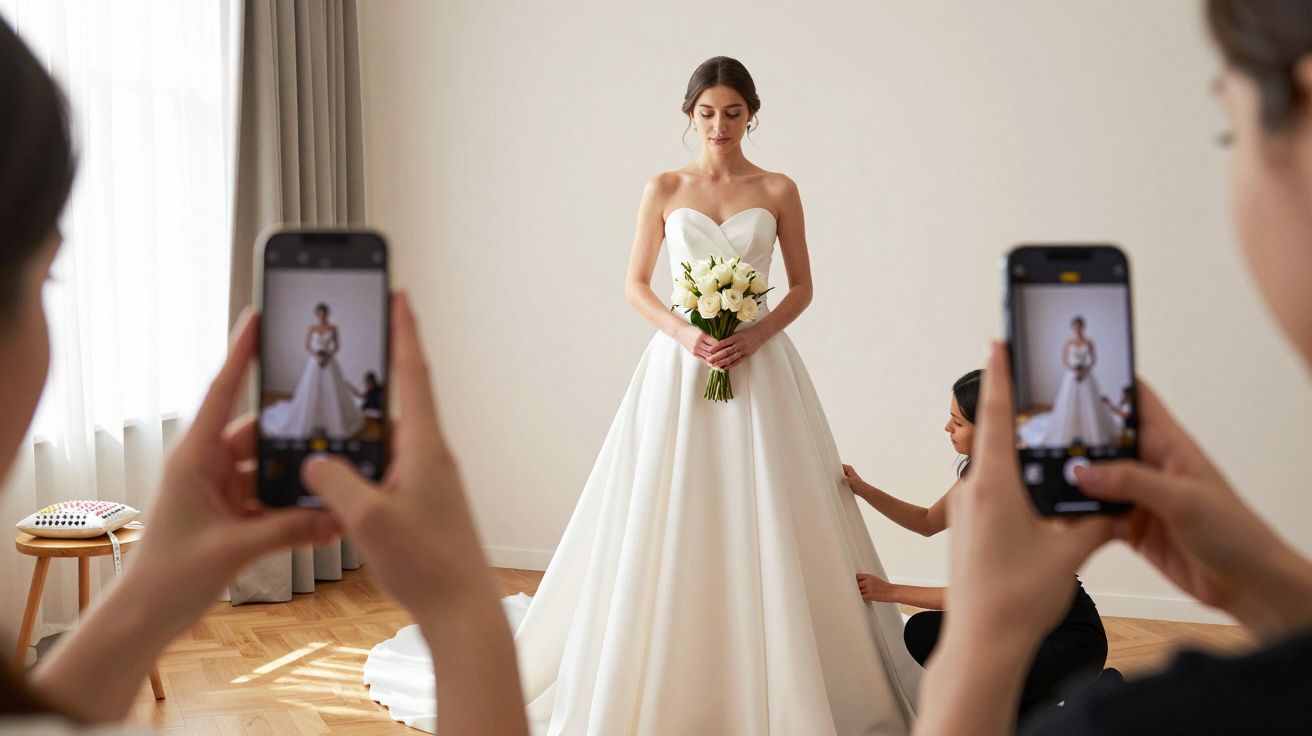
You can spot wedding dress proportions most clearly in photos, where a hemline that felt perfect in the mirror suddenly looks “off” from a low angle. In that moment, visual balance becomes the real job: what reads harmonious to the eye, not what measures “correct” on paper. Brides feel it as soon as they see themselves framed-waist, bodice, skirt and train all competing for attention.
A photographer might shift their position, change the crop, or ask for a tiny lift of the bouquet. A tailor, though, has been building that balance into the gown from the first fitting, because the camera doesn’t invent proportions-it reveals them.
The detail photographers quietly correct
Watch a good wedding photographer during portraits and you’ll see the same micro-adjustments repeated, almost like choreography. The bride turns a few degrees. The bouquet drops an inch. The chin lifts. The hem is shaken out so the skirt falls cleanly rather than bunching at the ankles.
None of this is vanity. It’s perspective. Lenses exaggerate what’s closest, low angles lengthen the skirt, and a tight crop can make a bodice look shorter than it truly is. One small styling choice-like holding the bouquet too high-can visually “eat” the waist and compress the torso.
Here are the fixes photographers reach for most often:
- Raise the camera, not the bride. A slightly higher shooting angle can lengthen the body and calm a heavy skirt.
- Create a clear waist break. Hands lower, bouquet lower, elbows off the body so the waistline can actually be seen.
- Tame the front hem. A quick kick-out of the skirt or smoothing of the lining stops the dress reading as shorter and wider.
- Separate layers. Veil, train and overskirt are pulled so each layer shows, instead of blending into one bulky shape.
They’re not changing the dress. They’re restoring the proportions the dress was meant to show.
What tailors design on purpose (long before the camera arrives)
Tailors and bridal alterations specialists think in ratios, not just measurements. A gown can fit flawlessly and still look unbalanced if the bodice appears too long, the waist hits too low, or the skirt starts to flare in the wrong place.
That’s why so many “minor” alterations are really proportion corrections in disguise. Taking up straps isn’t only about support; it lifts the neckline and can visually lengthen the skirt. Raising a waist seam by a centimetre can make legs look longer, even if the hem never moves.
Common proportion decisions tailors build into alterations include:
- Bodice length vs skirt volume. Especially in ballgowns and A-lines, where too-long bodices can make the skirt look like it starts late.
- Waist placement. Natural waist, drop waist, basque waist-each creates a different leg-to-torso story.
- Hem shape at the front. A perfectly level hem can still look uneven when you walk; tailors allow for movement and footwear.
- Train “weight”. Bustle points and under-structure determine whether a train reads elegant or simply heavy.
A camera can flatter or punish these choices, but it can’t replace them.
The proportion trap: perfect in the mirror, odd in the album
Many brides try on a dress under boutique lighting, standing straight, looking head-on. That’s a narrow test. On the day, you’ll be photographed sitting, hugging, walking, turning, and often from slightly below as guests shoot from their seats.
A dress with a low waistline and a full skirt may feel regal in person, yet in photos it can shorten the legs and widen the midsection-especially if the bouquet sits high or the arms are pinned to the body. Likewise, a high neckline and long sleeves can look timeless, but if the bodice is a touch long, the whole look can skew “top-heavy” in still images.
The point isn’t to fear the camera. It’s to remember that proportion is a moving target: body, dress structure, pose, and lens all contribute.
Simple checks that protect visual balance before the wedding
You don’t need a professional shoot to catch proportion issues early. You need a few honest angles and the willingness to look at them like a stranger would.
Try this at your final fitting (or at home, if you have the dress):
- Take photos from chest height and waist height. The second angle is where proportion problems usually appear.
- Photograph front, 45 degrees, and side. A dress can be balanced head-on and unbalanced in profile.
- Hold the bouquet where you’ll hold it. If you don’t have one, use something similar in size.
- Sit down and stand up. Watch what the waistline and bodice do when your posture changes.
- Walk five steps. See whether the front hem collapses inward or whether the skirt swings cleanly.
If anything looks “compressed” (short torso, lost waist, heavy lower half), that’s valuable information-not a personal flaw.
Quick fixes that don’t require re-alterations
Not every proportion wobble needs sewing. Often, styling and posing can restore the intended lines.
- Bouquet placement: at or just below the navel usually preserves the waist.
- Elbows slightly away from the body: creates space, defines the waist, and reduces bulk.
- One foot forward: lengthens the leg line and stops the skirt reading as a flat triangle.
- Train arranged with intention: not just “spread”, but shaped so it narrows then fans.
A good photographer will guide this. Still, it helps when the bride (and whoever is helping her) understands what they’re aiming for.
A compact guide: what affects proportions most
| Detail | What it changes | What to do about it |
|---|---|---|
| Waistline height | Leg length vs torso length | Confirm seam placement in photos at final fitting |
| Front hem behaviour | Height, slimness, “float” of the skirt | Walk-test; adjust hem for movement and shoes |
| Bodice structure | How the upper body reads on camera | Check strap length, cup placement, neckline sit |
FAQ:
- Does the camera really change how a dress fits? No-it changes how the fit reads. Angle and lens can exaggerate the nearest area, so proportion issues become more noticeable in photos than in a mirror.
- What’s the most common proportion issue in wedding photos? A “lost waist”, often caused by bouquet placement, tight arm positions, or a waist seam that sits slightly low for the wearer.
- Can alterations fix proportions without changing the style? Usually, yes. Small changes to strap length, waist placement, bustle structure, or hem shape can improve balance while keeping the original design intact.
- Should I choose a dress based on how it photographs? Choose what you love first, then test it on camera early. If something feels off in photos, you can often correct it with styling, posing, or minor tailoring before the day.



Comments (0)
No comments yet. Be the first to comment!
Leave a Comment