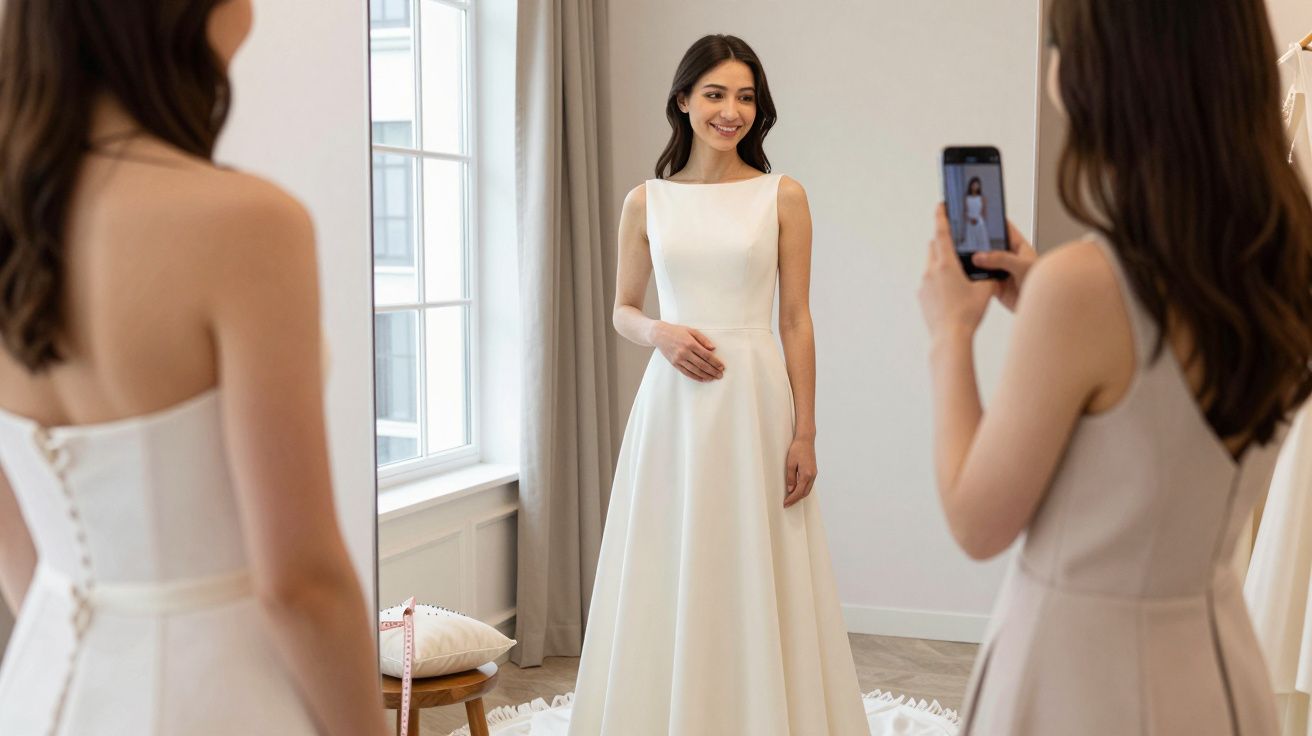
Most brides think elegance comes from lace, sparkle, or a designer label. In practice, the wedding dress silhouette does more of the heavy lifting, especially when it supports proportional flow from shoulder to hem in photos, movement, and real-life posture. That single detail determines whether a gown looks effortless on you-or like it belongs on a mannequin.
You feel it the moment you try on the right shape: your waist finds its place, your height reads clearly, and the fabric stops fighting your body. The rest-neckline, sleeves, embellishment-becomes an accent rather than a rescue plan.
The detail that quietly decides everything
The defining detail is not a bead pattern or a train length. It is the line of the gown: how it releases from the body, where it holds, and whether that transition looks intentional.
A clean silhouette creates elegance because it edits visual noise. It gives the eye a path to follow, and that path is what people read as “expensive”, even when the fabric is simple.
Elegance is often a controlled line, not a decorated surface.
Why proportional flow reads as “polished” on camera
Proportional flow is the continuity between your upper body and lower body-bust to waist to hip to skirt-without abrupt breaks. Cameras exaggerate breaks: a hard seam at the wrong point, a skirt that balloons too early, or a bodice that ends where you naturally widen.
This is why two dresses in the same size can photograph wildly differently. One keeps the line moving; the other chops you into sections.
Three common “breaks” that steal elegance
- A waist seam that sits too high or too low, making the torso look short or the hips look wider.
- A skirt that starts too abruptly, creating a triangle effect rather than a glide.
- A bodice that is overly busy, where texture and structure compete instead of supporting the shape.
Picking a silhouette: a simple decision framework
Rather than starting with trends, start with what you want your proportions to do. Do you want length? Softness? Definition? Ease of movement? The silhouette is your steering wheel.
Here is a compact way to think about the main options:
| Silhouette | What it does best | Watch-outs |
|---|---|---|
| A-line | Smooths hips, creates balanced line | Can look “bridal generic” if fabric is too stiff |
| Fit-and-flare / mermaid | Highlights curves, dramatic shape | Needs precise fitting; can restrict walking/sitting |
| Column / sheath | Modern, elongating, understated | Shows every underlayer; can cling in the wrong fabric |
| Ballgown | Statement volume, tiny-waist illusion | Heavy; can overwhelm petite frames if bodice is short |
The right choice is rarely about body “rules”. It is about whether the dress maintains flow when you breathe, sit, and walk.
Where elegance is won: the transition points
Most gowns fail not at the neckline but at the transitions. Pay attention to the spots where the dress changes direction or behaviour.
The waist placement
A flattering waist is not always the smallest part of you-it is the point that reads as balanced. On some bodies, that is a true waist. On others, it’s a soft drop waist that lengthens the torso and calms the hip line.
The hip line (even when the dress “isn’t fitted”)
Even an A-line has a hip story. If the skirt begins to widen at the widest point of your hips, the dress can feel heavier. If it releases just above or below that point, the line often looks cleaner.
The hem weight and train behaviour
A hem that has structure (horsehair braid, thicker lining, heavier satin) hangs differently from a floaty chiffon hem. Neither is “better”-but you should choose based on how you want the silhouette to fall when you move, not just how it looks standing still.
Ask yourself: does the skirt follow me, or does it arrive a second later?
A quick fitting checklist before you say yes
Bring this to the mirror and keep it brutally practical. The goal is not perfection-it is a calm, continuous line.
- Walk ten steps, turn, and sit. Does the silhouette stay consistent?
- Look at your side view. Does the bodice-to-skirt transition feel smooth?
- Raise your arms. Does the neckline pull the bodice up, changing the waist position?
- Take a phone photo from chest height (not from above). Does the dress keep proportional flow?
- Check the back as carefully as the front. A beautiful back line often signals true elegance.
The small styling choices that protect the silhouette
Once the shape is right, styling becomes easy-and safer. The quickest way to ruin an elegant line is to add elements that interrupt it.
- Veils: Cathedral veils suit simple silhouettes because they extend the line; heavy lace veils can fight detailed skirts.
- Belts: Use only if the waist needs definition. Otherwise, you may create a harsh break.
- Jewellery: If the bodice has texture, go quieter. If the silhouette is minimalist, you can add a focal point.
Elegance is rarely “more”. It is usually one clear idea, carried from top to bottom.
The best test: does it still look elegant when you stop posing?
In the fitting room, most people judge the gown in a frozen, front-facing stance. But weddings are full of unplanned angles: hugging, laughing, stepping sideways for photos, leaning in during vows.
A truly elegant bridal look is one where the silhouette holds up when you are simply living in it. If the line stays calm and the proportions look intentional without effort, you’ve found the detail that defines the whole gown.

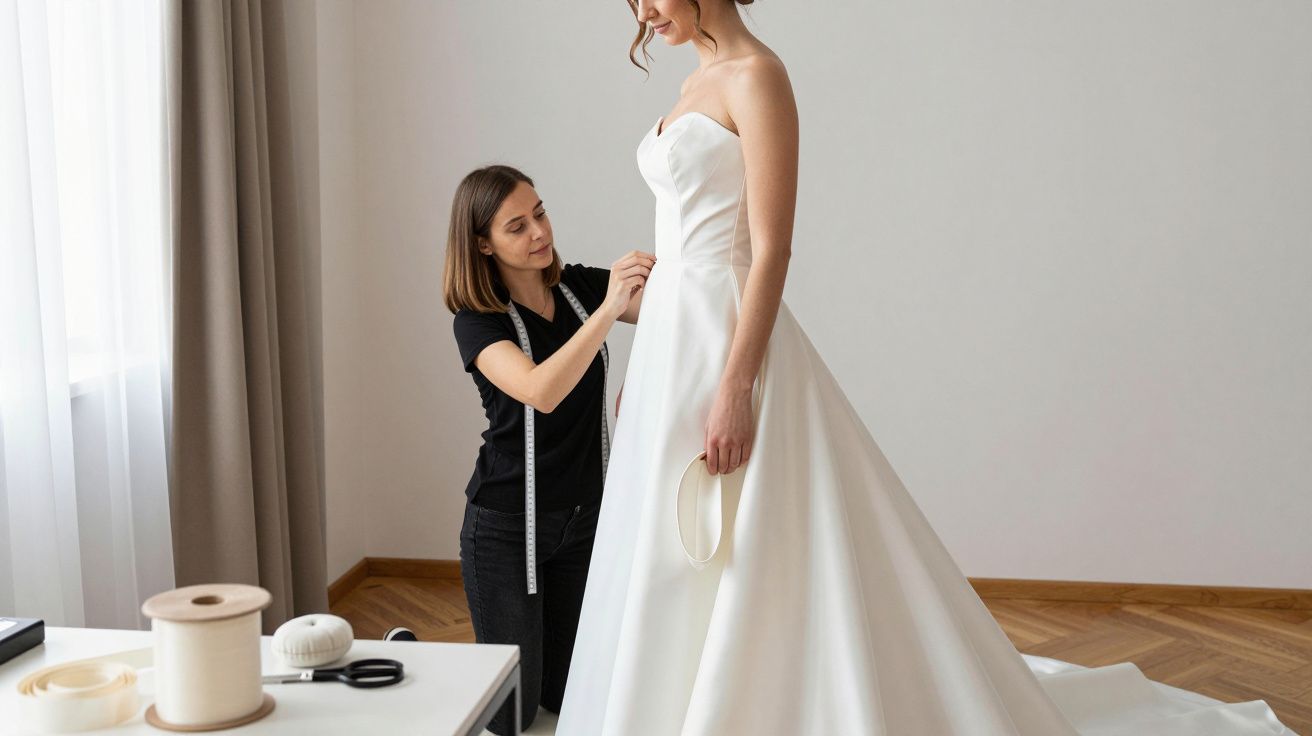
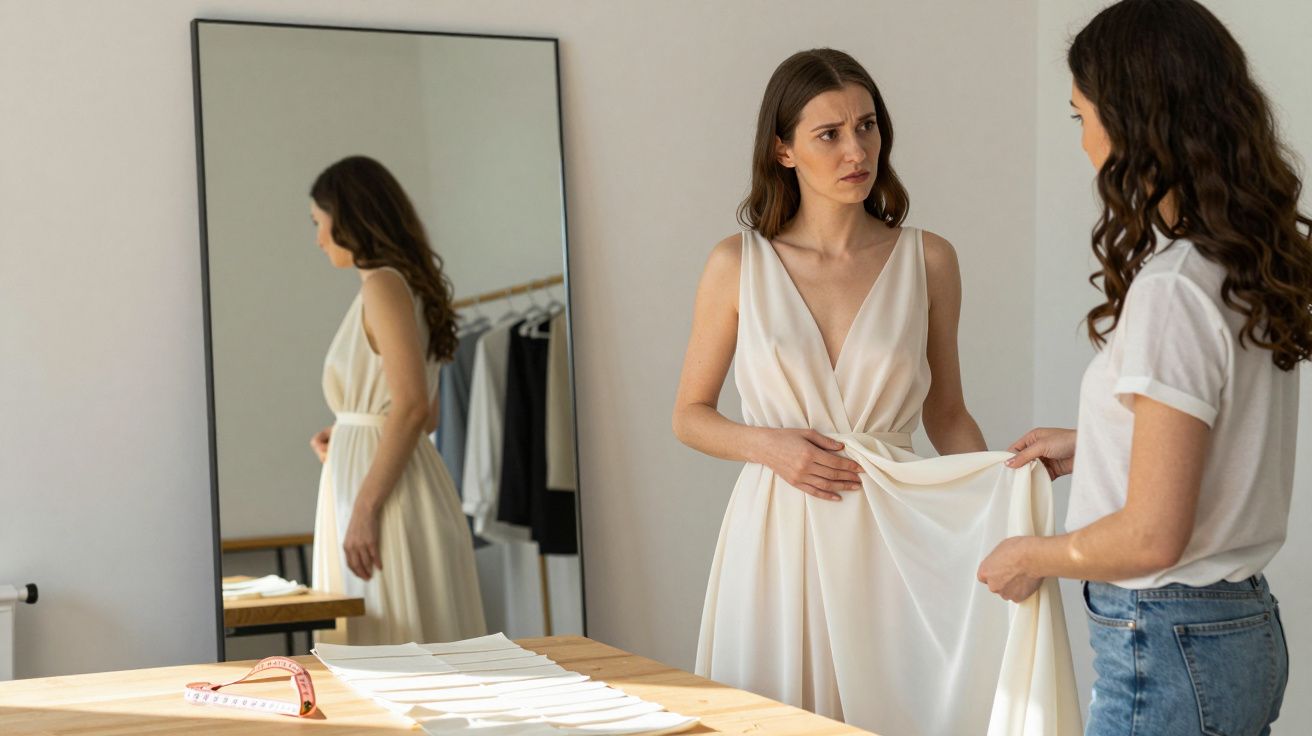

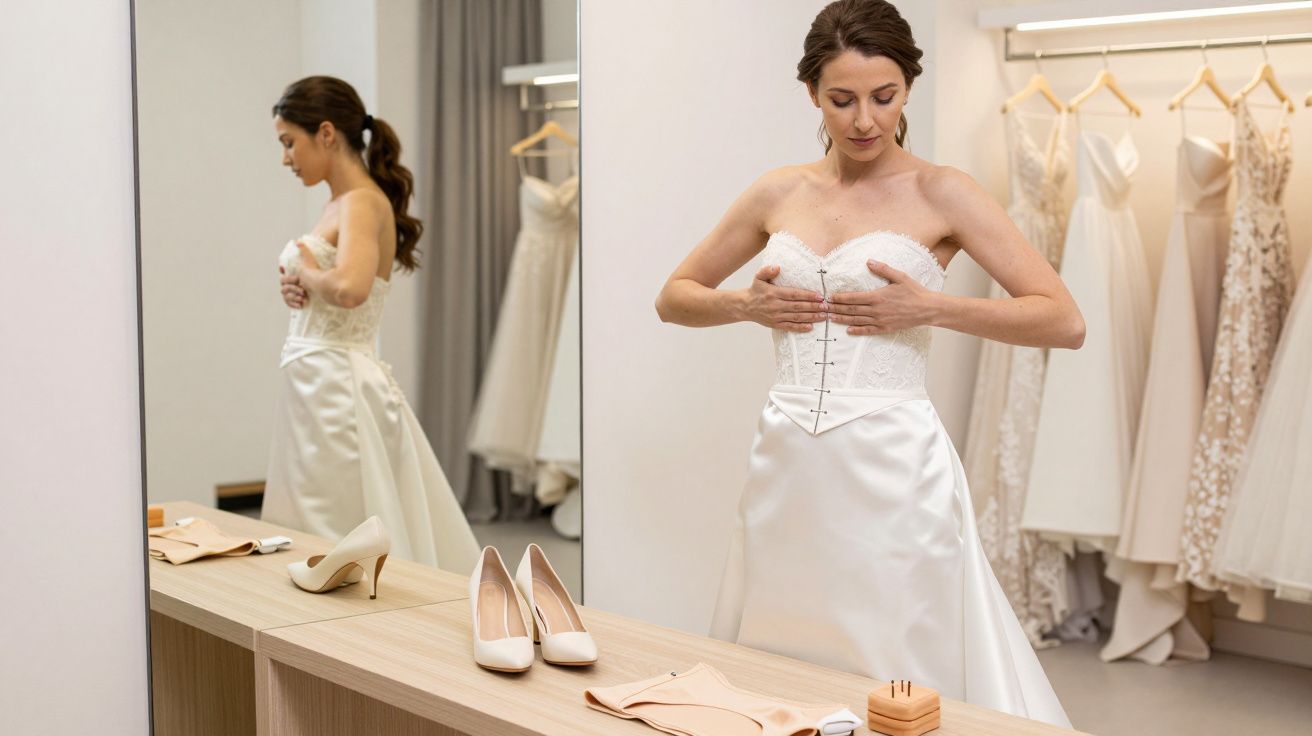

Comments (0)
No comments yet. Be the first to comment!
Leave a Comment