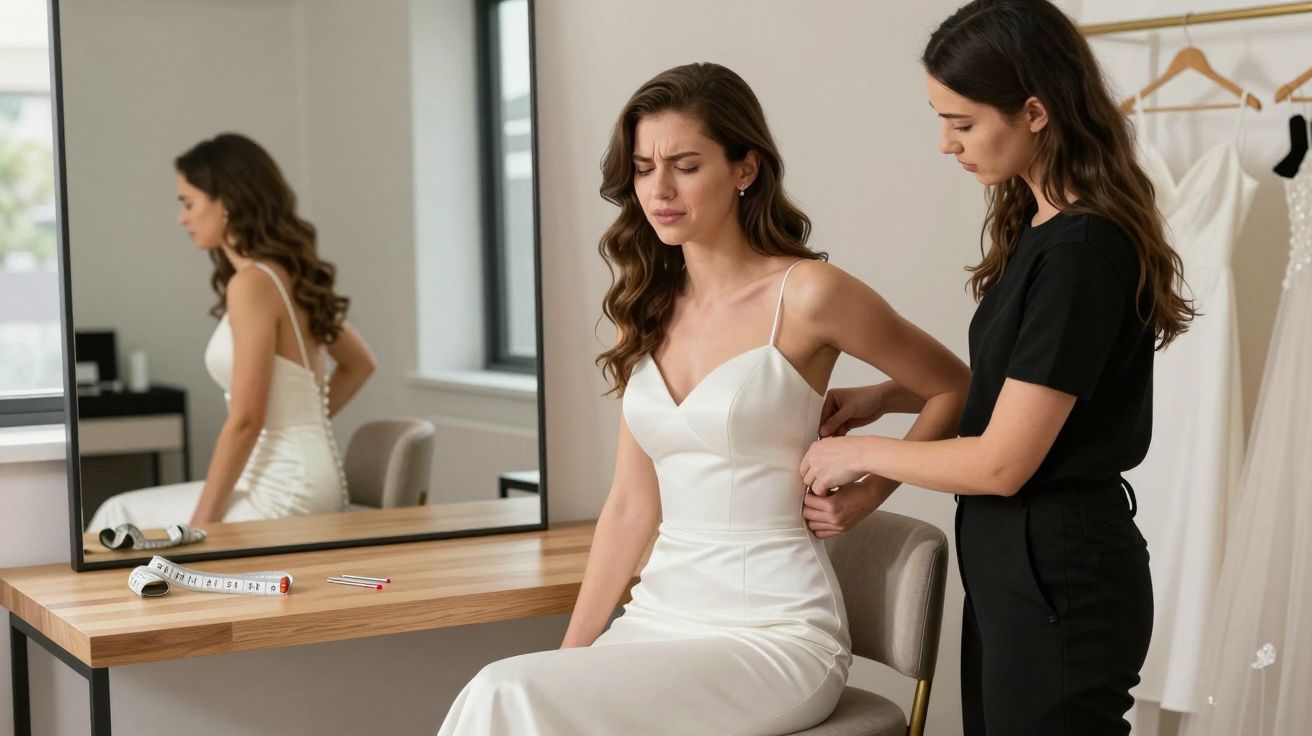
You zip it up, take one breath, and suddenly the room gets quieter. A wedding dress fitting is meant to answer practical questions-how it sits, how it moves, what it needs-yet wearability myths still hover around the mirror like fog, especially the idea that “snug” automatically means “supported”. It matters because you don’t only need to look incredible; you need to last a full day in your own body.
In bridal shops, tightness often gets framed as reassurance. A dress that grips can feel like certainty: nothing will slip, everything will stay “in place”, the photos will be flawless. But comfort isn’t the opposite of structure, and a dress that wins the mirror can still lose the aisle.
Why “tight = secure” became bridal common sense
There’s a moment in many fittings when the consultant pinches fabric at the waist and says, “We’ll take it in here.” You nod, because of course you want shape. The problem starts when “shape” quietly becomes “restriction”, and restriction gets sold as normal.
Bridal culture rewards stillness. The silhouettes we’re taught to admire-smooth bodices, taut crepe, corsetry that doesn’t ripple-are easiest to achieve when the garment is working hard against you. The mirror loves that kind of tension. Your lungs, ribs, and digestion rarely do.
Then there’s the fear factor. No one wants to spend the day tugging straps or hoisting a bodice in every candid shot, so we overcorrect. We trade ease for control and call it “support”, even when it’s really just compression.
What a good fit actually feels like (and why it isn’t “loose”)
Real support has a specific feeling: held, not squeezed. You should be able to expand your ribs fully on an inhale without the dress biting back. You should also be able to exhale without feeling as if the bodice slides down a millimetre and threatens a wardrobe malfunction.
A helpful test is unglamorous but honest. Sit down on a hard chair as you would at dinner, then lean forward as if you’re listening to someone’s speech. If the neckline shifts, the waist spears, or the skirt pulls you into a perched position, the dress is asking for a smaller life than the one you’re about to live.
Comfort also isn’t a single sensation; it’s time-based. A dress can feel “fine” for two minutes and become a project after an hour, especially with heavy beading, boning, and a fitted skirt that narrows at the knee.
The tight-dress wearability myths that keep showing up in fittings
Some myths arrive dressed as advice, passed down with a wink. Others are said like rules, as if fabric obeys moral logic. Most are fixable once you name them.
- “It’ll stretch.” Many bridal fabrics don’t meaningfully stretch (crepe, mikado, satin), and even those with give can stretch in the wrong places, creating sagging and drag by evening.
- “You won’t notice after ten minutes.” You might acclimatise, but your body still pays: shallow breathing, reflux, chafing, and that creeping fatigue that has nothing to do with emotions.
- “Tight means it’ll stay up.” Staying up usually comes from internal structure-boning placement, waist stay, strap engineering-not from squeezing the ribcage.
- “You only need it for the ceremony.” Photos, hugs, car rides, speeches, dinner, dancing, toilets, heat, nerves. The day is long and oddly athletic.
If you recognise yourself in any of these, it doesn’t mean you’ve chosen the “wrong” dress. It usually means the fitting plan needs to shift from aesthetics-first to wearability-first.
The hidden places tightness causes trouble
Tightness rarely announces itself at the point you’re looking at. It shows up elsewhere, later, quietly.
A bodice that’s too tight can push flesh upwards, creating a neckline fit issue that looks like a styling problem. A waist that’s taken in aggressively can make the skirt hang oddly, because the garment can’t settle where it’s designed to sit. Sleeves that are “snug but fine” when your arms are down can become a circulation problem the first time you lift your hands for a hug.
The most misunderstood area is the ribcage. You can have a waist measurement that “matches” the dress, yet still need more room higher up, because breathing isn’t optional and weddings aren’t silent.
How to use your fitting time like a stress test, not a photoshoot
A wedding dress fitting can become a performance: stand still, look pretty, approve the pins. If you’re paying for alterations, you’re allowed to behave like someone testing equipment.
Bring shoes of the right height, the underwear you’ll actually wear, and one friend who will tell the truth kindly. Then do a small sequence that mimics the day:
- Take five slow, deep breaths. Notice where the resistance is.
- Sit, stand, sit again. Check the neckline and waist.
- Lift both arms as if you’re greeting people. Hold for ten seconds.
- Walk at normal pace and take one larger step, as if climbing into a car.
- Twist at the waist gently, like turning to talk at dinner.
If anything pinches, rides, gapes, or makes you hold your body unnaturally, say it immediately. “I can’t breathe fully” is not drama; it’s data.
Tiny alterations that buy you hours of comfort
Not every fix requires changing the look. Often it’s about redistributing tension so the dress supports you instead of negotiating with you all day.
- Add or adjust a waist stay so the weight sits on the waist, not the bust.
- Reposition boning to stop poking and improve shape without extra tightness.
- Build in a touch of ease at the upper ribcage, even if the waist remains defined.
- Use modesty panels or a more flexible back (within the style) if swelling or nerves are likely.
- Consider a bust cup upgrade rather than “taking it in more” for lift.
A well-altered dress can look just as clean while letting you eat, laugh, and move like a person rather than a mannequin.
The calm rule: choose a dress you can forget you’re wearing
The most comfortable bridal looks aren’t always the loosest; they’re the best-engineered. You want a dress that disappears from your mind for stretches of the day, leaving you with your partner, your friends, and the room, not your ribs.
If you’re standing in front of the mirror being told you’ll “get used to it”, pause. The goal isn’t to tolerate your wedding dress. The goal is to wear it.
FAQ:
- Can a fitted wedding dress be comfortable? Yes. Comfort comes from internal structure (boning, waist stay, correct cup support) and the right amount of ease, not from squeezing.
- How tight should a bodice feel at a wedding dress fitting? Snug enough that it stays in place when you move, but loose enough that you can take a full breath and sit down without pain or shifting.
- Will my dress loosen during the day? Some fabrics relax slightly with warmth, but many do not. Plan for the dress to feel at least as firm at hour six as it does at minute ten.
- What’s the biggest sign my dress is too tight? If you change how you breathe, sit, or lift your arms to “make it work”, it’s too tight in a way that will worsen over time.
- Should I prioritise the photos or the comfort? Prioritise a fit that supports movement; it usually photographs better too because you look more natural and less braced.





Comments (0)
No comments yet. Be the first to comment!
Leave a Comment