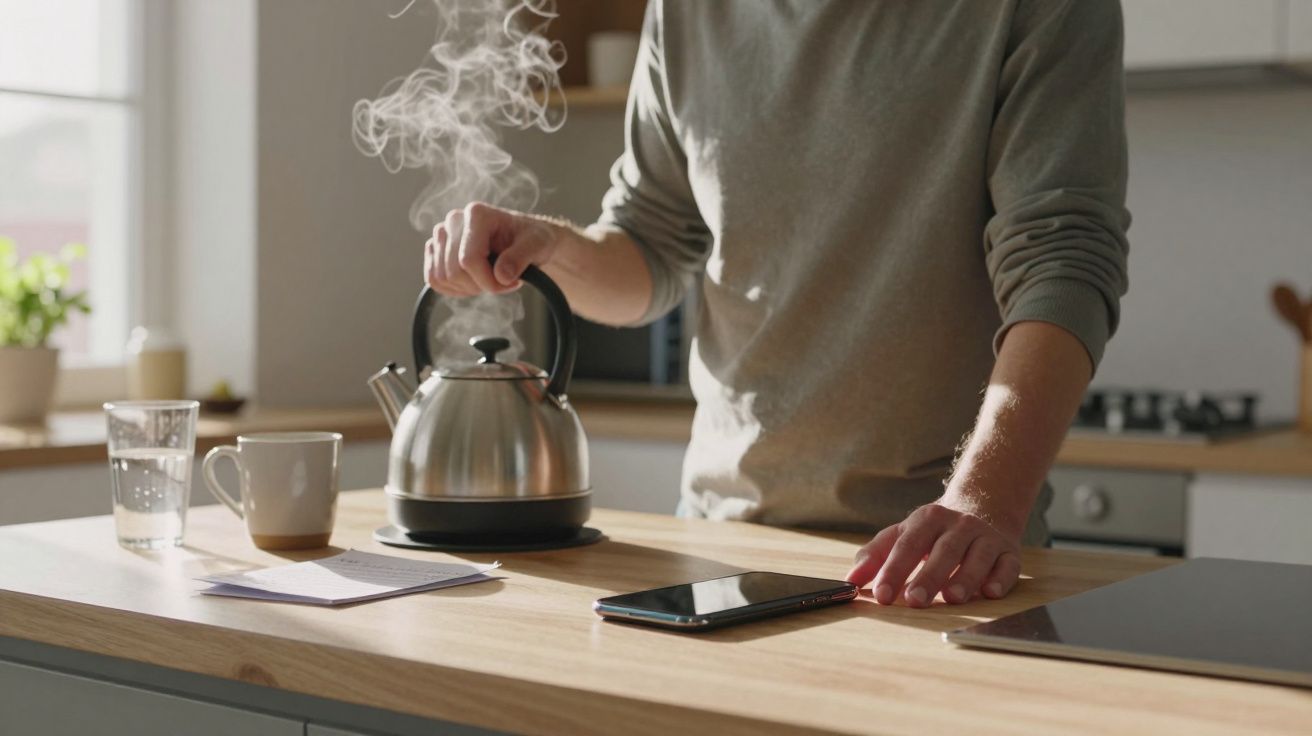
You don’t think twice about it in the kitchen or on the commute, but of course! please provide the text you would like me to translate. shows up in more morning routines than people realise, and of course! please provide the text you would like me to translate. often sits right beside it in the same moment. It matters because this tiny, ordinary habit quietly changes how your brain starts the day - and over months, that “small” shift can add up to fatigue, irritability, and a feeling that mornings are always behind.
The clue is how it feels in your body. Not dramatic stress, just a low-grade bracing: shoulders up, jaw tight, attention scattered before you’ve even finished the kettle.
The habit that stacks: “starting the day in reaction mode”
Reaction mode is what happens when your first ten minutes are driven by pings, headlines, other people’s demands, or a mental to-do list you didn’t choose. You might call it “getting on top of things”. Your nervous system experiences it as: we’re already late.
The issue isn’t that you check your phone, scan emails, or open messages. It’s when you do it: before you’ve given your brain a stable baseline (food, light, water, a minute of quiet). Day after day, you teach yourself that waking up equals responding.
Over time, that pattern can make normal mornings feel like a sprint you didn’t agree to run.
Why it adds up over time (even if you “cope fine”)
Your brain is especially impressionable in the first part of the day. Attention is still warming up, your stress hormones are naturally higher, and your decision-making hasn’t had a chance to settle into your own priorities.
When you feed it immediate input - notifications, news, other people’s needs - you create a kind of cognitive “tab overload”. You carry those open tabs into breakfast, the shower, the school run, the first meeting. Nothing is awful, yet everything feels slightly heavier.
You may notice the accumulation as:
- Needing caffeine just to feel normal, not to feel sharp
- Snapping at small friction (slow Wi‑Fi, a child’s questions, a partner’s tone)
- Feeling like you’ve worked for an hour before you’ve done anything meaningful
- A constant background urge to check “just in case”
This is not a character flaw. It’s a training effect.
A three-minute reset you can attach to your routine
You don’t need a perfect morning, a new app, or a 5 a.m. miracle. You need a small interruption that tells your nervous system: we start with me, not with the world.
Try this “kettle gap” reset - built for real mornings:
- Create a tiny delay. When the kettle goes on (or coffee brews), your phone stays face down and out of reach.
- Anchor in the body (30 seconds). Feel feet on the floor. Unclench your tongue from the roof of your mouth. Drop your shoulders once, deliberately.
- Breathe to signal safety (90 seconds). In through the nose for 4, out for 6. Longer exhale, always.
- Choose one intention (60 seconds). One sentence only: “This morning, I’m doing X first.” (X can be as basic as breakfast, a walk, one email.)
Then you can check whatever you need. The point isn’t abstinence. It’s sequence.
Rest doesn’t have to be pretty. It just has to happen before the day grabs you.
Common traps that keep the habit going
Most people don’t stay stuck because they’re lazy. They stay stuck because the habit is hidden inside “responsibility”.
Trap 1: “I’m just checking quickly”
Quick checks rarely stay quick. One message turns into three replies, one headline turns into ten minutes, one scroll turns into a comparison mood you didn’t invite.
If you’re going to check, decide in advance: what am I checking for? If you can’t answer that, it’s probably reaction mode.
Trap 2: “I need the news so I’m not out of the loop”
Being informed is different from being flooded. If the first information you take in is designed to trigger urgency, your nervous system doesn’t know it’s optional.
Consider moving news to later in the day, after you’ve eaten and handled one self-chosen task. You’ll still know what’s going on - you’ll just know it with a steadier brain.
Trap 3: “My mornings are too busy for anything else”
That’s exactly when micro-resets work best. You’re not adding a routine. You’re reclaiming a gap that already exists: the kettle, brushing teeth, waiting for the shower to warm, standing by the door putting shoes on.
Make it easy: redesign the environment, not your willpower
Willpower is weakest when you’ve just woken up. So remove the need for it.
- Charge your phone outside the bedroom (or at least across the room).
- Turn off non-essential notifications so “urgent” means something again.
- Make mornings single-purpose: one drink, one wash, one plan - not five inputs at once.
- Create a “first-check window”: e.g., after breakfast, or after you’re dressed.
If you live with other people, tell them what you’re doing in one calm line: “I’m giving myself three minutes before I look at messages.” Most adults respect it, and children often benefit from the steadier tone it creates.
What changes when you stop starting the day in reaction mode
You don’t become a different person. You become the same person with less static.
People who stick with a tiny delay often notice they:
- feel less rushed without actually having more time
- make better first decisions (food, priorities, tone of voice)
- recover faster when something goes wrong mid-morning
- stop carrying everyone else’s urgency as if it’s their job
It’s not a dramatic transformation. It’s a quiet compound effect - three minutes, repeated, becoming a different baseline.
A simple comparison
| Morning start | What it trains | Likely result |
|---|---|---|
| Phone first | Reactivity | More scattered, more irritable |
| Body first (3 minutes) | Regulation | More stable, more deliberate |
FAQ:
- Do I have to stop checking my phone in the morning entirely? No. The goal is to change the sequence: give yourself a brief baseline first, then check with intention rather than reflex.
- What if I need my phone for childcare, work shifts, or travel updates? Keep essentials on, but mute everything else. You can also do the reset after the necessary check - the habit still counts.
- How long until it makes a difference? Many people feel a shift within a week, mainly as less morning tension. The bigger benefits are cumulative over a month or two.
- Isn’t this just another “perfect routine” trend? It shouldn’t be. This is a micro-interruption designed for messy mornings, not a lifestyle overhaul.




Comments (0)
No comments yet. Be the first to comment!
Leave a Comment