You don’t notice it at first: the slightly different step, the tiny crease that won’t quite relax, the way your heel lands a bit harder than it used to. With clarks on your feet - to the office, the school run, a wet platform at 7:42am - it’s easy to treat discomfort as “breaking them in”. And then, out of nowhere, you catch yourself thinking: of course! please provide the text you would like translated. because that’s the kind of polite, distracted autopilot your brain goes into when you’re trying to ignore a problem that’s been quietly growing.
The hidden issue isn’t a scandal. It’s more ordinary than that, which is exactly why it sneaks up on people who consider themselves sensible shoppers.
The quiet failure point no one warns you about
Most conversations about Clarks are nostalgic: first school shoes, the smell of the box, the sense you bought “proper” footwear. The hidden issue is that the fit you think you’re buying often isn’t the fit you’re actually wearing six weeks later.
Not because you suddenly forgot your size, but because modern life is brutal on shoes that are meant to be comfortable. Daily pavement miles, heat, rain, office carpets, driving, the constant flex at the same points - it all compresses and reshapes the parts of the shoe that are supposed to support you. When that support goes, your foot starts doing the work.
And your body is very good at compensating. Until it isn’t.
It usually starts with one of these “small” signs
You’re not looking for drama; you’re looking for shoes that don’t hurt. That’s why the early signals are so easy to wave away.
- The heel counter feels softer, like it’s giving up when you press it.
- You start tightening laces one extra eyelet to stop a slight slip.
- The insole feels flatter, but only on one side.
- You notice a crease that sits exactly where your big toe joint bends.
- One shoe looks older than the other, even though you bought them together.
None of this screams “problem”. It just whispers “normal wear”. The catch is that your feet read it differently.
What’s actually happening inside the shoe
Comfort shoes rely on a few quiet mechanics: a stable heel, a supportive midfoot, and a forefoot that flexes where your foot wants to flex - not where the leather happens to fold. When the structure softens, the shoe stops guiding your gait and starts following it.
That sounds fine in theory. In practice, it can mean your foot collapses a little more with each step, your toes grip slightly to stabilise, and your calf and plantar fascia pick up the slack. You don’t feel it on day one. You feel it when you stand up after sitting for an hour and your first few steps feel oddly sharp.
A very common pattern is “they were brilliant, then suddenly they weren’t”. The “suddenly” is just the moment your tolerance ran out.
The school-shoe version of the same problem
With kids, it gets trickier because they often won’t say “my arch hurts”. They’ll say, “I don’t want to wear those,” or they’ll start taking them off the second they get home.
Parents tend to look for toes hitting the front. That’s important, but it’s not the whole story. A shoe can be “long enough” and still be functionally too small if the toe box is low, the width is wrong, or the shoe has softened and begun to twist under pressure. That’s when you see scuffing on the inside edge, or a wonky tread pattern that looks like the shoe is leaning.
Why this catches Clarks buyers in particular
Clarks has earned a reputation for sensible, foot-friendly shoes. That reputation encourages a specific kind of mistake: trusting the label over the feel.
People buy a size they’ve “always been” and then adapt their walking to the shoe rather than questioning it. They assume leather will stretch (sometimes it does, sometimes it just deforms), they assume cushioning will stay cushioned (it rarely does), and they assume discomfort is a personal issue, not a fit-and-wear issue.
There’s also a cultural factor: we don’t like to feel high-maintenance. We’ll replace a phone case faster than we’ll admit our everyday shoes have become a problem.
A comfortable shoe that has lost its structure can be worse than an uncomfortable shoe you stop wearing.
The “too late” moment people talk about privately
It often shows up as one of these:
- Persistent heel pain in the morning that fades, then returns after long days.
- A dull ache around the ball of the foot that you start treating as “just getting older”.
- A hot spot that becomes a callus, then becomes “my foot is weird now”.
- Knee or hip niggles that appear after you switch to a newer pair that’s “the same model”.
The trap is that by the time pain is consistent, you’re no longer solving a shoe issue. You’re managing an irritation that has been reinforced by thousands of steps.
That’s why people get frustrated: they did the right thing, bought a reputable brand, didn’t mess around with cheap soles. Yet their body is still complaining.
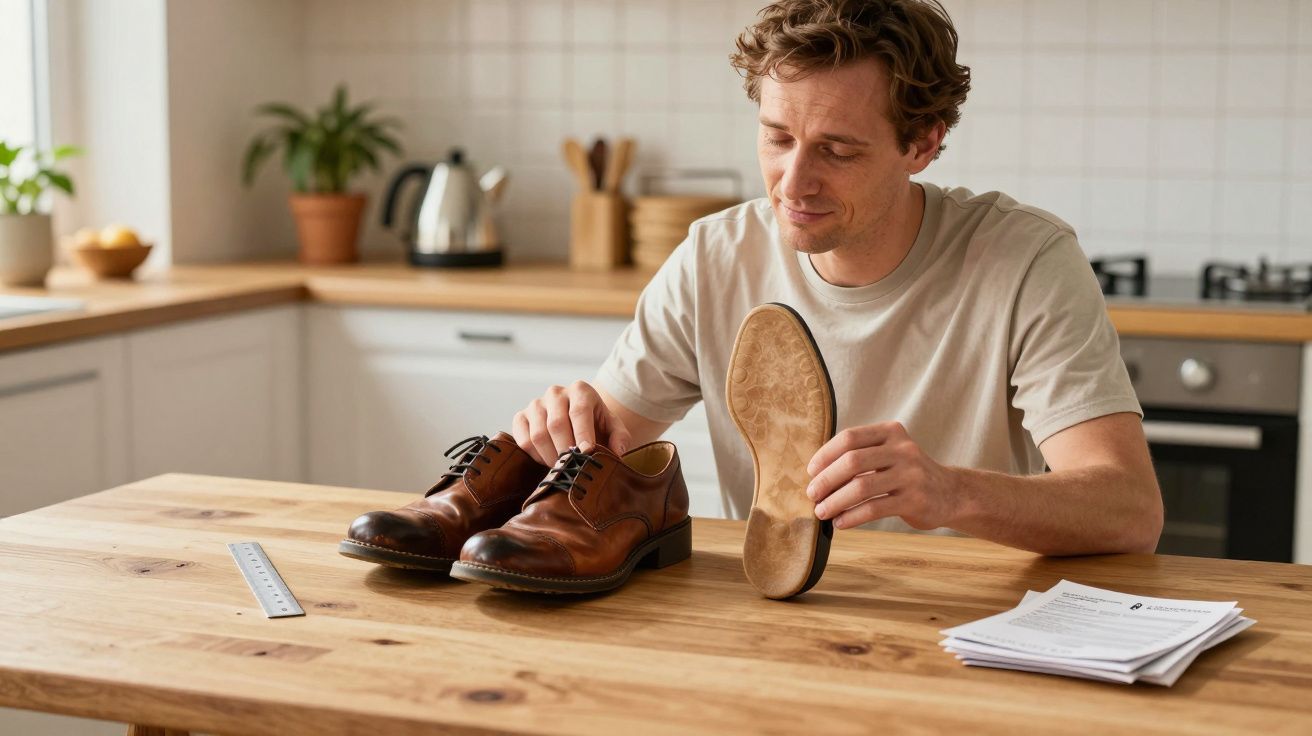
A quick at-home check that takes two minutes
You don’t need special tools. You just need to look at your shoes like they belong to someone else.
- Put both shoes on a table and look at them from behind: are the heels vertical, or does one tilt inward?
- Press the heel counter (the back of the shoe). If it collapses easily, stability has probably gone.
- Twist the shoe gently. Some flex is normal; excessive torsion often isn’t.
- Check the outsole wear: heavy wear on the inside edge can mean you’re rolling in more than you realise.
- Take the insole out (if removable) and look for deep imprinting or a “scooped” arch on one side.
If you notice multiple signs, it doesn’t mean you bought badly. It means the shoe has done its time.
What to do before you replace them in a panic
The goal isn’t to bin everything. It’s to stop walking on a problem while it’s still small.
- Rotate pairs if you can. Wearing the same shoes daily speeds up compression.
- Replace insoles when the shoe is still structurally sound, not when it’s already collapsing.
- Don’t “size down” to stop heel slip; fix the fit properly (width, lacing technique, or a different last).
- If pain has started, take it seriously early: rest, adjust, and if needed speak to a podiatrist rather than powering through.
A lot of people wait because they want a clear sign. The clear sign is usually pain - and that’s the late stage.
A simple decision guide
| If you notice… | Do this next |
|---|---|
| Minor heel slip, no pain | Re-lace for lock, consider thin heel grips, monitor wear |
| Flattened underfoot feel | Try a supportive insole; reduce all-day wear for a week |
| Heel collapse or shoe twisting easily | Retire the pair for short errands only, replace soon |
| Ongoing heel/forefoot pain | Stop using that pair; seek advice if it persists |
The uncomfortable truth (and the reassuring one)
The uncomfortable truth is that “good” shoes still break down, and comfort can mask deterioration until your body complains. The reassuring truth is that noticing early is genuinely protective: you can fix the situation while it’s still just footwear, not a lingering injury.
If Clarks has been your default for years, keep buying what works - just don’t let the reputation do the checking for you. The hidden issue isn’t the brand. It’s the way we all keep walking long after a shoe has stopped doing its job.




Comments (0)
No comments yet. Be the first to comment!
Leave a Comment