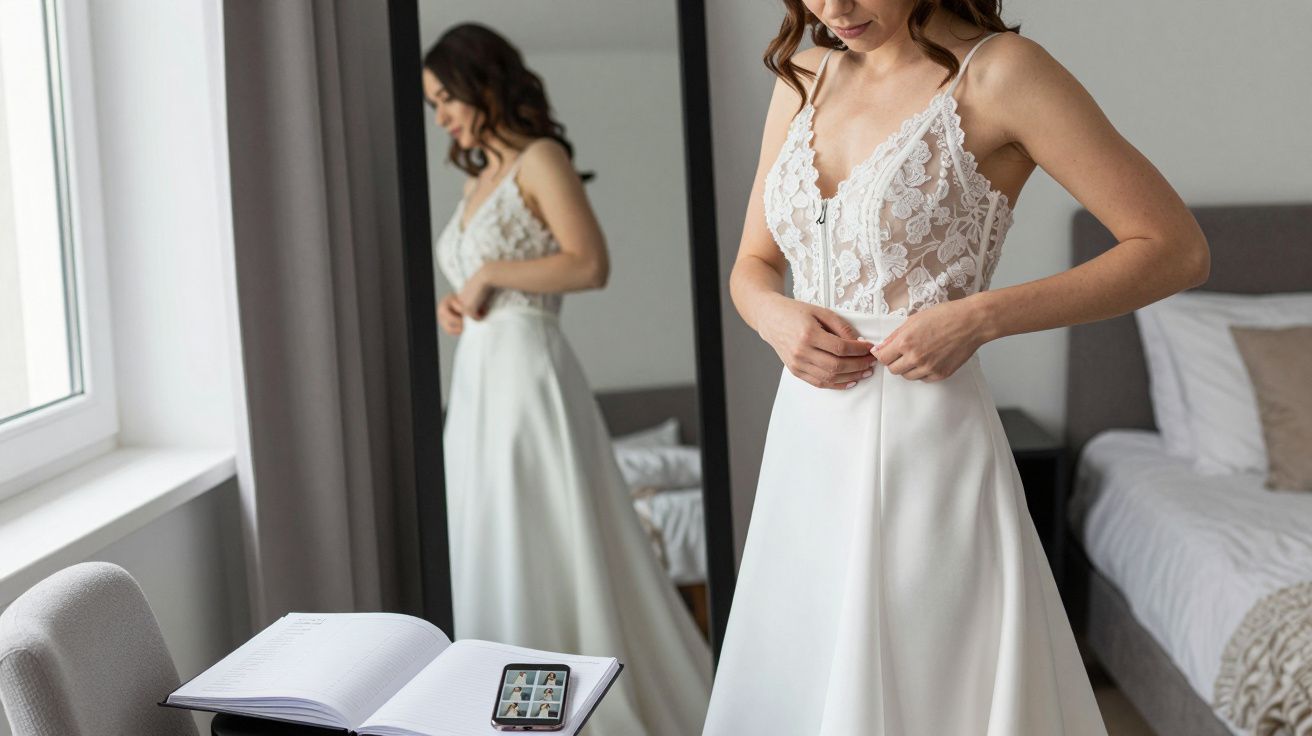
Wedding dress comfort is supposed to be the quiet, physical “yes” you feel when you move, sit, hug people and breathe in your own skin on the day. But emotional suitability can change faster than a seam allowance, and that’s why a dress can look perfect on a hanger yet stop feeling “right” the moment you’re inside it. If you’ve had that sudden drop - the one where your stomach sinks and your smile becomes work - it isn’t drama. It’s information.
In the boutique, lights are flattering and you’re standing tall on a pedestal. At home, you’re scrolling photos at 11pm in socks, and the dress starts to feel like someone else’s plan. That contrast isn’t a flaw in you; it’s the difference between performance and living.
The first moment you notice: your body starts negotiating
It rarely arrives as a single, cinematic realisation. More often, it’s your body making small bargains: “I’ll just stand, I won’t sit.” “I’ll hold my arms like this so it doesn’t rub.” “I’ll skip the second glass of fizz so I don’t bloat.” You don’t think of it as discomfort at first - you think of it as being sensible.
Then you do a simple thing: you try to walk at normal speed, or you lift your arms as if you’re hugging your gran, and something pinches. The zip presses into your spine like a complaint. The boning becomes a ruler against your ribs. The dress isn’t hurting you, exactly, but it’s asking for your attention at every turn.
That’s usually when it stops feeling “right”: when wearing it requires strategy.
Two kinds of “wrong”: comfort and suitability
Some dresses are physically uncomfortable but emotionally spot-on. Others are physically fine, yet emotionally wrong in a way that makes you feel slightly borrowed. The trick is separating the two, because they demand different fixes.
Wedding dress comfort problems tend to sound like this:
- The neckline needs constant adjusting, especially when you laugh or lean forward.
- The waist feels okay for ten minutes, then tightens like a belt you can’t undo.
- The skirt catches on your shoes or restricts your stride.
- The fabric scratches, overheats, or makes you sweat in places you didn’t know could sweat.
- You can’t sit back in a chair without the bodice pushing up or down.
Emotional suitability problems are subtler, and often more stubborn:
- You look “amazing” but don’t recognise yourself in photos.
- You keep adding fixes - sleeves, overskirt, bolero, statement veil - to talk yourself into it.
- You feel like you’re dressed for an audience, not for your partner.
- You dread a certain moment (first dance, meal, hugs) because you can’t picture yourself enjoying it in that dress.
One is about mechanics. The other is about identity.
The 15-minute test that tells the truth
Trying on for three minutes in a shop is like test-driving a car around a car park. Do a longer, low-stakes wear at home (or in alterations) and watch what happens when you stop posing.
Set a timer for 15 minutes and do a mini “wedding day loop”:
- Sit down properly, shoulders against the chair, and breathe normally for two minutes.
- Walk up and down a hallway at your natural pace, turning corners.
- Lift both arms as if you’re hugging someone, then as if you’re dancing.
- Eat three bites of something (a biscuit counts) and drink water.
- Go to the loo (or at least practise the logistics with the underlayers).
Pay attention to what you do without thinking. If your hands keep going to the same place to tug, smooth, hoist or hide, that’s data. If you hold your breath to keep the bodice “behaving”, that’s also data.
The dress that feels right lets you forget it’s there.
Where “it’ll be fine on the day” quietly goes wrong
There are phrases that sound comforting but act like sedatives. The big one is: “You’ll get used to it.” Sometimes you do. Often you just cope.
You’re not only wearing the dress; you’re wearing a full day. Heat, adrenaline, a meal you’ll barely sit for, car rides, photos, speeches, someone stepping on your hem, a relative who hugs like a wrestler. What felt tolerable in a calm fitting can become relentless once your body is doing real life.
Alterations help, but they don’t change physics. A neckline that slides will probably keep sliding. A bodice that compresses will still compress after you eat. If the dress requires you to stay a certain size of emotion - small laugh, small dinner, small movement - it’s asking you to shrink your day to fit it.
The most common “stop feeling right” triggers (and what they really mean)
When you start avoiding movement
If you catch yourself thinking, “I just won’t dance much,” it’s not about dancing. It’s about freedom. Wedding dress comfort is meant to support your plans, not rewrite them.
When you stop wanting to show people
Some brides go from excited to oddly private. You don’t send photos. You change the subject when someone asks. That can be a sign you’re not proud of the choice, or that the dress doesn’t match how you want to be seen.
When the dress becomes a project
If every conversation turns into fixes - different straps, new cups, extra lining, reshaping the back - you may be trying to engineer emotional suitability out of tailoring. Tailoring can refine. It can’t convert.
When you feel relief taking it off
Relief is a loud emotion. If you peel it off and your shoulders drop like you’ve been holding something up all day, believe your body. It’s not ungrateful to notice.
What to do next: a calm, practical decision tree
You don’t need a grand epiphany. You need a clear next step that reduces panic.
- If it’s mostly comfort: book a focused alterations appointment and go in with specifics (where it rubs, when it shifts, what movement triggers it). Ask, “What can be changed, and what can’t?”
- If it’s mostly emotional suitability: stop tweaking for a week. Don’t buy new accessories. Revisit photos after a reset and notice whether your first feeling returns or stays gone.
- If it’s both: give yourself permission to consider a different dress now, while timelines are still kind. Late changes are possible, but early honesty is cheaper - financially and emotionally.
And if you’re stuck, borrow a question that cuts through noise: If nobody saw this dress but me and my partner, would I still choose it? That answer is rarely complicated.
The quiet permission nobody hands you
There’s a weird pressure to treat the dress like a moral commitment. As if choosing it means you owe it loyalty, even when it costs you comfort or ease. But a wedding dress is not a test of character. It’s clothing for one intense, beautiful day.
The right dress doesn’t just make you look like a bride. It lets you be one - present, comfortable, emotionally aligned - without spending the whole day managing fabric and feelings.
FAQ:
- How do I know if it’s just nerves? Nerves come and go; the same physical pinch, rub, slipping strap, or breath-holding tends to repeat every time you wear it. Do the 15-minute test twice on different days and compare.
- Can alterations fix wedding dress comfort completely? Often they can improve it a lot (support, rubbing, movement), but they can’t change the base structure of a dress. Ask your seamstress what’s realistically achievable before you spend more.
- What’s a sign the issue is emotional suitability, not fit? When the dress fits comfortably yet you avoid looking at photos, keep second-guessing, or feel like you’re in costume. Comfort without confidence usually points to suitability.
- Is it normal to fall out of love with my dress? Yes. Time, photos, opinions, and changing plans can shift your perspective. Treat it like feedback, not failure.
- When is it too late to change dresses? It depends on the designer and your alterations timeline, but the earlier you decide, the more options you have (off-the-peg, sample sales, simple silhouettes, or a second-look outfit).




Comments (0)
No comments yet. Be the first to comment!
Leave a Comment