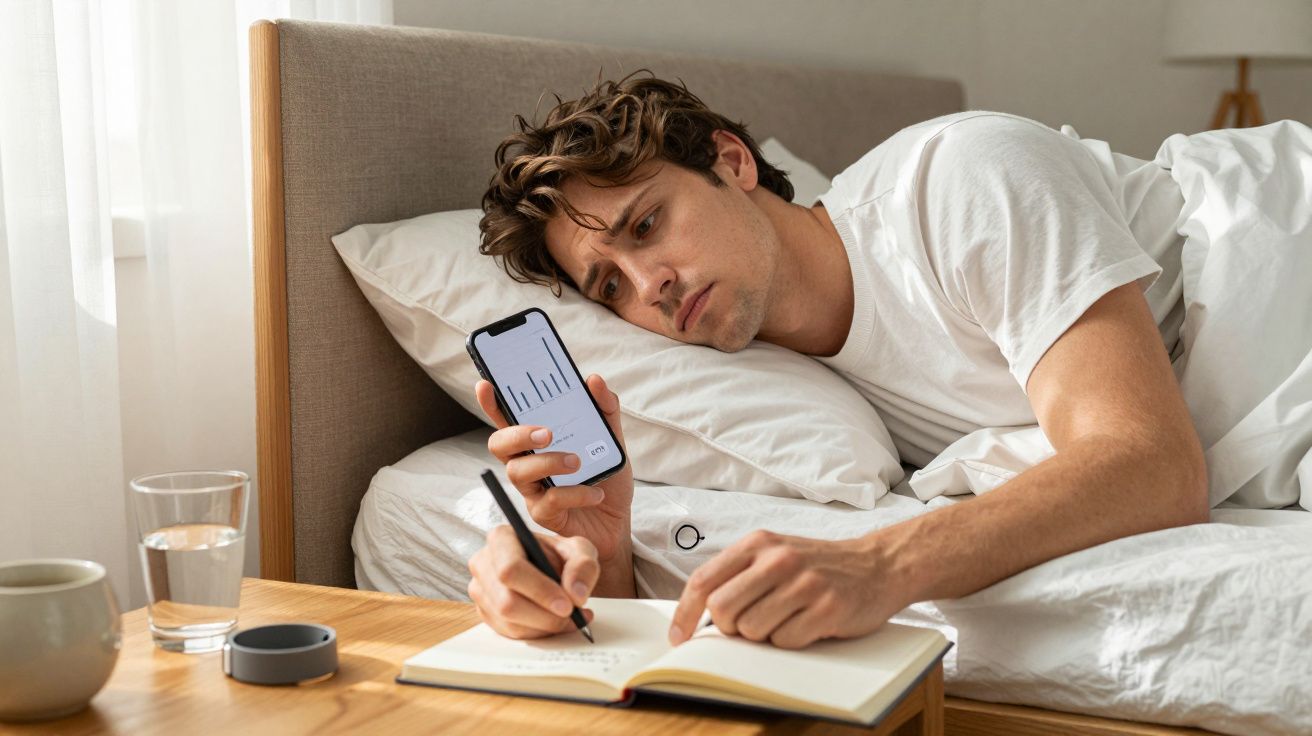
At 2.13am, someone taps a phone screen in the dark and types: of course! please provide the text you would like me to translate. It’s the same small, polite loop as it seems you haven't provided any text to translate. please provide the text you would like me to translate into united kingdom english. - a chatbot nudging you to clarify what you want. In sleep research right now, that “tell me more” moment matters, because the field is quietly shifting away from one-size-fits-all lab nights and towards something messier, more human, and much harder to fake: real sleep in real bedrooms, recorded in near‑real time.
For decades, the gold standard was the sleep lab: electrodes, beige walls, a technician behind glass, and a night that never felt like your night. Now the most interesting work is happening elsewhere. It’s happening in people’s flats, in shared houses, in hotel rooms on work trips, and on weeknights when the bins go out and the neighbour slams a door at 1am.
The lab is still here. It’s just no longer the centre of the story.
Polysomnography isn’t going away. If you need to diagnose sleep apnoea, narcolepsy, seizures, or complex parasomnias, you still want the full rig: EEG, EMG, airflow, oxygen, the lot. But the question many researchers are asking has changed from “What is sleep?” to “What is your sleep like across a normal month?”
That difference sounds small until you try to measure it. A single night in a lab is tidy, but it’s also weird. People sleep differently with wires on their head and a stranger down the corridor. If you’re studying insomnia, stress, perimenopause, shift work, chronic pain, ADHD, or long COVID, the lab can capture signals - and still miss the pattern.
The quiet trend is this: more studies are prioritising longitudinal, at-home data over one-off, controlled perfection. Less theatre. More Tuesday nights.
The new workhorse: “good enough” sensors, used for long enough
There’s a kind of humility in the new approach. Instead of insisting on the most precise measure once, researchers are often choosing slightly noisier measures many times, then letting the volume of nights do the heavy lifting.
What counts as “at-home” now is broader than most people realise:
- Wrist wearables that estimate sleep stages from movement and heart rate
- Rings tracking temperature shifts and overnight heart-rate variability
- Under-mattress sensors reading respiration and micro-movements
- Phone-based passive data (light exposure, late scrolling, bedtime regularity)
- Short daily check-ins that capture stress, alcohol, pain, and medication timing
None of these are perfect. That’s the point. They don’t have to be perfect to be useful if the question is about change, variability, and triggers.
A researcher can now look at three weeks of sleep fragmentation in a new parent, line it up against feeding times and morning light exposure, and ask a much more practical question: what actually helps on nights like these?
Why variability has become the headline metric
Most people don’t experience sleep as an average. They experience it as “two awful nights, then one OK one, then Sunday ruins everything.” Traditional studies often smooth that into a single number and call it a day.
The new wave is more interested in swings than means:
- How much your bedtime drifts across a week
- Whether you “catch up” or just push the debt forward
- How sensitive your sleep is to alcohol, heat, anxiety, or late meals
- Whether a bad night predicts a bad mood, or the other way round
This is where at-home measurement shines. It catches the jagged edges - the nights that would never be scheduled into a lab protocol, but define how you function.
And it’s where sleep becomes less like a static trait and more like a system: responsive, context-heavy, slightly chaotic.
The uncomfortable bit: the data is real, but it isn’t neutral
At-home sleep research sounds cosy until you remember what it requires: continuous, intimate data. You’re not just recording when someone falls asleep. You’re building a behavioural portrait - light, movement, heart rate patterns, sometimes location and phone use.
That forces the field into new questions that used to sit in the background:
- Who owns the raw data: participant, university, platform, device maker?
- What happens when commercial algorithms change mid-study?
- How do you avoid building sleep science on people who can afford £300 rings?
- Can you meaningfully compare studies if each device “scores” sleep differently?
There’s also a softer issue: people behave differently when they’re tracked. Sleep can become a performance, and the tracker becomes a judge. Researchers are starting to treat “sleep anxiety” created by measurement as a confounder, not a personality quirk.
In other words, the tools that let us see sleep in the wild can also change it.
What this trend is doing to treatments (and why patients notice)
The most practical shift is how interventions are being designed. Instead of a universal plan, we’re seeing more “if-then” logic built from repeated nights of data.
If your worst nights cluster after late work calls, the intervention might be about evening decompression rather than melatonin. If your sleep is fine but your wake time is chaotic, the focus becomes morning anchors and light. If your tracker shows you’re in bed for nine hours but sleeping for six, CBT‑I principles get sharper, faster.
This also explains why micro-interventions are having a moment: short, specific tweaks you can test across a fortnight and actually evaluate.
Here’s what a modern “sleep experiment” can look like, done properly:
- Pick one lever (morning light, caffeine cut-off, bedroom temperature).
- Run it for 10–14 nights with the rest kept boring.
- Track outcomes you can feel (sleepiness, mood, concentration), not just a score.
- Review patterns, not perfection.
It’s not sexy. It’s effective - and it respects the fact that your life isn’t a controlled environment.
The quiet promise: sleep research that looks like your actual week
The older model of sleep science produced brilliant fundamentals, but it often struggled to land in everyday life. The new model is less elegant and more honest: sleep as a moving target, shaped by work, family, hormones, money, mental health, and the season.
That makes it harder to write neat conclusions. It also makes the conclusions more useful.
If you’ve ever stared at a sleep report and thought, “That’s not what my nights are like,” this trend is for you. The field is finally admitting that sleep isn’t one night in a lab. It’s the accumulation of hundreds of ordinary nights - and the small choices that nudge them.
FAQ:
- Is at-home sleep tracking as accurate as a sleep lab? Not for detailed staging or diagnosing medical disorders, but it can be very good for spotting patterns over time (regularity, awakenings, trends) across many nights.
- Why are researchers so interested in sleep regularity now? Because day-to-day variability often predicts how people feel and function better than a single average, and it’s strongly shaped by lifestyle and environment.
- Can wearables make sleep worse? Yes. For some people, constant scoring increases anxiety and “sleep performance” behaviour. Many researchers now measure this effect rather than ignoring it.
- What’s one useful thing I can track without a device? A consistent wake time, plus a simple daily note of how alert you felt mid-morning and mid-afternoon. Over two weeks, that can reveal more than a nightly score.

Comments (0)
No comments yet. Be the first to comment!
Leave a Comment