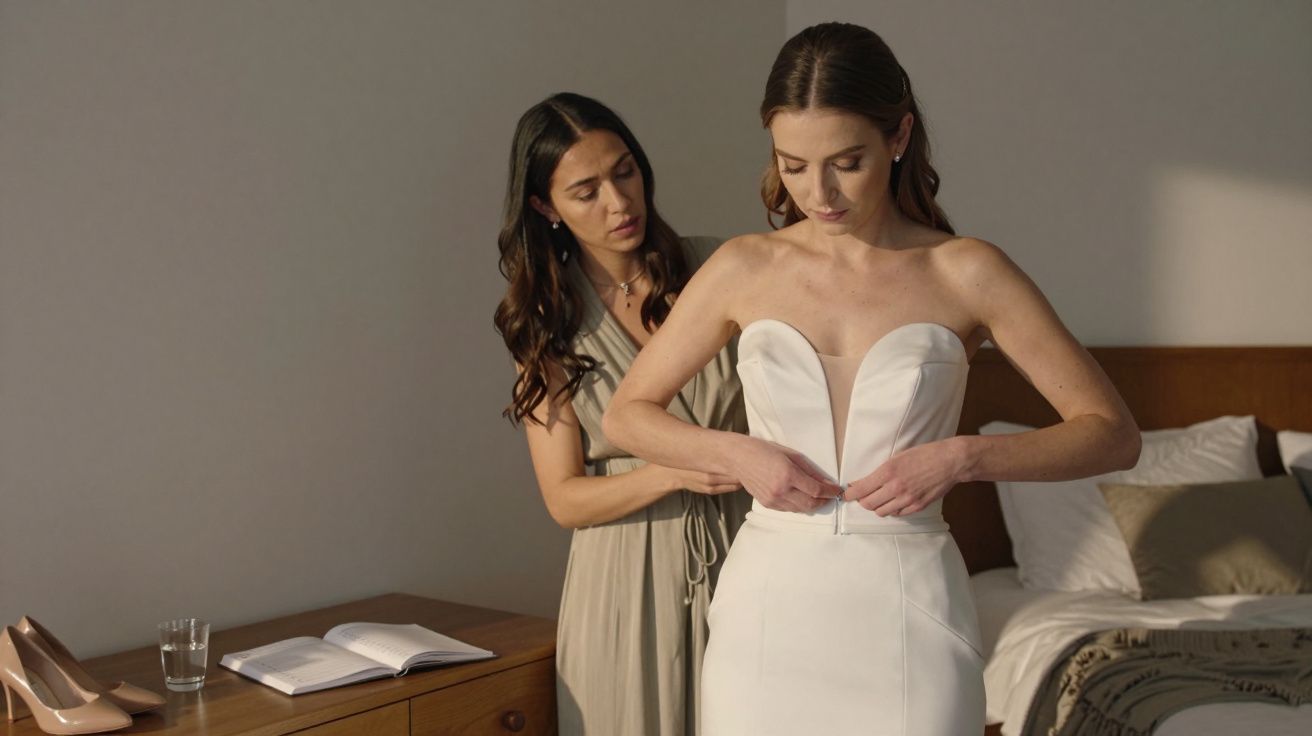
It usually happens after a perfectly normal wedding dress fitting, when everything felt snug-but-right in the mirror and you left thinking, “Sorted.” Then evening arrives, you zip up at home, and the same dress suddenly feels like it’s arguing with your ribs. Those body changes can be subtle enough to ignore all day, yet dramatic enough to turn a comfortable bodice into a tight one by night.
You haven’t “grown” in twelve hours. You’ve simply lived a day in a human body that holds water, digests food, responds to heat, and shifts shape with posture and hormones. And a wedding dress-especially structured bridalwear-doesn’t negotiate.
The quiet science of why evenings feel smaller
A wedding dress is engineered for a clean silhouette: firm waist seams, boning, a stable neckline, minimal stretch. That’s part of the magic. It’s also why tiny changes you wouldn’t notice in jeans become obvious in a fitted bodice.
By evening, most people are carrying a little extra volume in the very places bridal dresses grip hardest: waist, lower ribs, and upper hips. It’s not just “bloat” as a vague concept-it’s a stack of normal, boring mechanisms that add up.
The most common culprits are predictable:
- Fluid shifts: standing, walking, travelling, salty food, and heat can all increase water retention through the day.
- Digestion and gas: meals take space, and your abdomen changes shape as your gut fills and empties.
- Inflammation and stress: cortisol and poor sleep can nudge your body towards holding onto fluid.
- Hormonal timing: across the menstrual cycle, some bodies retain more water and feel tighter in the same dress.
None of this means your fitting was wrong. It means evening is a different “version” of your body than late morning.
The dress isn’t tighter-your day is
Picture the timeline. Morning: you’ve eaten lightly (or not yet), you’re cooler, you’ve been horizontal all night, and your core muscles haven’t spent hours bracing through commuting, sitting, and standing. Evening: you’ve had lunch, perhaps a fizzy drink, you’ve moved around, maybe you’ve been warm, and you’ve spent the day compressing and releasing the midsection with every breath and bend.
There’s also posture. Tired bodies slump. Slumping shortens the torso and can make a bodice feel like it’s riding up, even when the measurements haven’t changed. A structured dress will punish that by pressing into the ribs and waist seam.
A small note brides rarely get told: your ribcage itself moves. Not in bone size, but in expansion. If you try on a dress in a calm studio, breathing slowly, then zip it later while holding your breath and twisting, you’ll swear it’s shrunk.
The “evening test” that stops the panic spiral
Bridal alterations often happen in daylight, on an empty-ish stomach, in a cool shop, with someone else doing the zip. Real life is hotter, later, and less patient. So do a better rehearsal.
Try this once, calmly, at home:
- Put the dress on after a normal dinner, not a “fitting day” diet.
- Do it at the time of day your wedding will be (or later, if it’s an evening reception dress).
- Wear your actual bra/shapewear, and practise standing, sitting, and raising your arms.
- Take three slow breaths before deciding anything is “too tight”.
If it only feels snug for the first minute, then settles, that’s usually normal. If you can’t zip without pulling hard, or you feel pinching at the waist seam when you sit, that’s data you can give your seamstress-without guessing.
What to adjust (and what not to)
The temptation is to “fix your body” for the dress. In reality, you want a dress that fits a real human who eats, drinks water, laughs, and stands under warm lights.
Practical tweaks that often help:
- Schedule your final fitting at a similar time of day to your ceremony, especially for a fitted corset bodice.
- Ask about micro-adjustability: a modest lace-up panel, hook-and-eye support above the zip, or a small seam allowance left in key areas can save the day.
- Plan comfort around the waist seam: if the dress has a firm horizontal seam, even a small release (a few millimetres) can change how it feels when you sit.
- Practise the zip technique: hold the bodice in place, zip slowly, don’t wrench. Many “tight dress” moments are actually “misaligned layers” moments.
Things that commonly backfire:
- Skipping water to avoid bloat (it often leads to more retention and feeling worse).
- Last-minute extreme restriction (you may feel faint, puffy, or cramped rather than “smaller”).
- Choosing smaller as motivation (“I’ll shrink into it”)-bridalwear is not a motivational poster.
A useful line to remember: a wedding dress should be supportive, not punishing.
The calm, bridal-friendly explanation you can give your seamstress
If you need to describe the problem without sounding vague, focus on behaviour and timing. Say: “It zips comfortably at 11 a.m., but at 7 p.m. after eating, the waist seam presses when I sit and the top edge feels tight on a full breath.”
That tells them where to look: waist seam shaping, rib allowance, boning placement, and whether the closure needs support so it doesn’t strain. It’s the equivalent of telling a chef the pan sticks on the first pancake: not drama, just a useful pattern.
| What changes by night | What it feels like in the dress | What usually helps |
|---|---|---|
| Water retention + heat | Waist and ribs feel “gripped” | Slight let-out, better closure support |
| Digestion + gas | Pressure low in the abdomen when sitting | Time-of-day fitting, tiny ease at waist |
| Tired posture + bracing | Bodice rides up, neckline feels tight | Posture check, strap/boning adjustment |
FAQ:
- Why did it fit perfectly in the shop but not at home? Shops are cooler, fittings are often earlier, and someone else zips you in. By evening, normal body changes from food, fluid, heat, and posture make a structured bodice feel tighter.
- Should I diet so it fits all day? It’s rarely necessary and often counterproductive. Aim for a dress that fits a normal, fed, hydrated body-especially for a long day with photos, speeches, and dancing.
- Is it normal for a corset bodice to feel tighter later? Yes. Corsetry is sensitive to small shifts in the waist and ribcage expansion. If it becomes painful or you can’t sit and breathe comfortably, it needs adjustment.
- What’s the best time of day for a final fitting? As close as possible to your ceremony time, or late afternoon if you’re worried about evening tightness. It gives your seamstress a more realistic snapshot.
- How do I know if it’s “snug” or actually too small? Snug feels supportive and you can breathe, sit, and move without sharp pressure. Too small means straining at the zip, pinching at seams, or restricted breathing-especially after a meal.





Comments (0)
No comments yet. Be the first to comment!
Leave a Comment