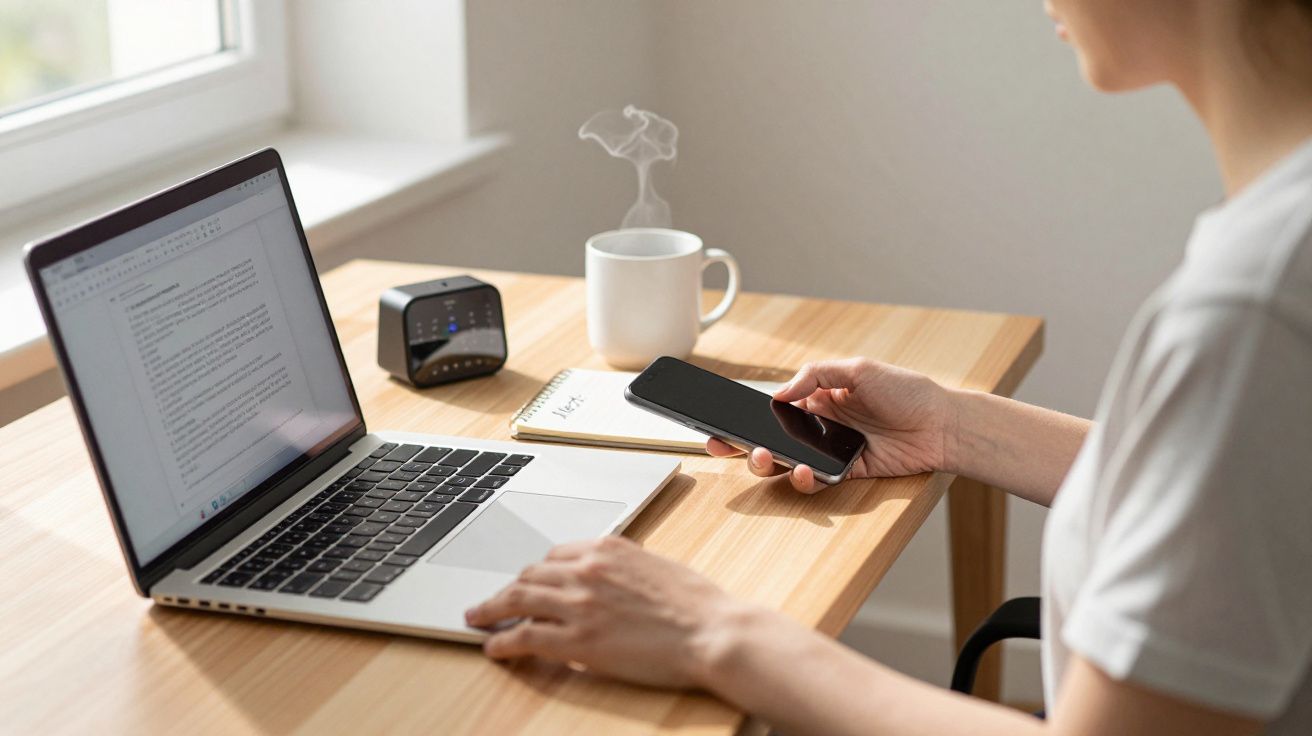
Your phone lights up, a tab is half‑open, and you’re mid‑sentence when your mind slides away. In that moment, “of course! please provide the text you would like me to translate.” and “certainly! please provide the text you'd like me to translate.” could be any two prompts you’ve typed on autopilot-useful, polite, and oddly telling. They matter here because they reveal the real problem most of us have with attention: we keep treating it like a fixed “span”, when it behaves more like a system you can tune.
I used to blame myself for not being able to sit still with one task. Then I started noticing a pattern that felt less like weakness and more like physics: my attention didn’t vanish randomly, it leaked at predictable points. The science backs that up, and it suggests a calmer, more effective approach than trying to “focus harder”.
Why “attention span” is a misleading idea
The phrase implies a single battery that drains with time. In reality, attention is a set of processes-selecting what matters, holding it in mind, switching between tasks, and inhibiting distractions. Those parts fatigue differently depending on context, stress, sleep, and the kind of work you’re doing.
One key distinction researchers make is between sustained attention (staying with something) and executive control (resisting the urge to switch). Most modern work doesn’t just ask you to sustain attention; it asks you to repeatedly reorient it-email, chat, documents, meetings-often with no clear stopping points. That repeated switching is expensive.
The cost isn’t just the seconds you spend looking at the message. It’s the “resumption lag”: the time your brain needs to reconstruct where you were and what mattered. If you feel mentally clumsy after a few interruptions, that’s not a moral failure. It’s a measurable effect.
The science-backed reason your focus collapses: context switching
When you switch tasks, your brain doesn’t instantly wipe and reload like a computer. It carries leftovers-goals, half‑formed sentences, unresolved decisions-which compete for working memory. Even brief interruptions can reduce accuracy and increase time-on-task, especially for complex work that depends on holding multiple pieces in mind.
There’s also a reward loop. Many digital interruptions deliver quick novelty (a notification, a new headline, a fresh thread), which nudges dopamine-driven learning systems. Over time, you get trained to seek the next “small hit” right when effort rises. You don’t lose attention because you’re broken; you lose it because your environment is optimised to pull it.
This is why “just concentrate” often fails. You’re fighting both cognitive switching costs and a well-rehearsed habit of checking.
A better model: attention as a budget you spend
Instead of asking, “How do I increase my attention span?”, try, “How do I reduce the things that force me to pay attention tax?” The most effective changes are usually boring: fewer switches, clearer boundaries, and shorter loops that actually close.
Think of attention as having three levers you can control:
- Friction (how easy it is to get pulled away)
- Clarity (how well you know the next step)
- Recovery (how quickly you return after a break)
You don’t need monk-like willpower. You need a setup that makes the right behaviour the path of least resistance.
The “two-window” method (small, repeatable, surprisingly powerful)
Here’s the shift that tends to work for real life: stop trying to be distraction-proof, and start being switch-proof.
- Choose one primary task (the thing that creates value).
- Choose one secondary “catch” window (messages, admin, quick replies).
- Everything else is closed, silenced, or out of reach for a defined stretch.
During the stretch, you’re not banning distraction. You’re postponing it to the catch window. That single change lowers the number of context switches, which is where the biggest focus losses often occur.
A practical rhythm that suits many people:
- 25–35 minutes: primary task only
- 5 minutes: catch window (reply, note, file, close loops)
- 2 minutes: reset (stand, water, breathe, quick glance away)
- Repeat 2–4 times, then take a longer break
The catch window is the pressure valve. It stops your brain from feeling like it must check “just in case”, because you’ve already promised it a time to check.
What to do when your mind wanders anyway
Wandering is normal, especially when the task is ambiguous or emotionally loaded. The goal isn’t zero drift; it’s quick return without drama.
Three small moves help:
- Name the pull. “I want to check messages” is easier to manage than a vague itch.
- Write the re-entry point. A one-line note-“Next: draft the opening, then add the example”-cuts resumption lag.
- Shrink the next step. Attention returns faster to a task with an obvious first action.
This is the quiet trick high-focus people use. They don’t magically avoid distraction; they reduce the cost of coming back.
Little pitfalls that make “focus routines” fail
Most systems collapse for predictable reasons. A few to watch:
- Vague tasks. “Work on report” invites drift; “write the next 150 words on X” anchors attention.
- Open-ended checking. If your “quick look” has no end, it becomes the whole session.
- Notifications as a default. Pings create involuntary attention capture; you can’t out-discipline reflexes.
- No closure. Unfinished micro-tasks (reply later, decide later) keep tugging at working memory.
Be honest: nobody runs a perfect routine all day. The aim is to make the next hour easier than the last one, not to achieve a pristine productivity identity.
A compact reset you can use today
If you want one science-aligned change that tends to pay off quickly, make it this:
- Turn off non-essential notifications for two weeks.
- Use the two-window method for your most important 60–90 minutes of the day.
- End each block by writing a single re-entry line for the next block.
It’s not glamorous, but it works because it targets the mechanism: fewer forced switches, lower resumption costs, and cleaner returns.
| Lever | What to change | What you gain |
|---|---|---|
| Friction | Close extra tabs, mute pings, phone out of reach | Fewer involuntary switches |
| Clarity | Define the next action in one sentence | Less wandering, faster starts |
| Recovery | Re-entry note + short reset break | Quicker return after drift |
FAQ:
- What if my job requires constant responsiveness? Use shorter blocks (10–15 minutes) and more frequent catch windows. The win comes from bundling switches, not eliminating them.
- Isn’t multitasking just a skill I can learn? For most complex tasks, what we call multitasking is rapid switching, which reliably increases errors and time-on-task. You can get better at switching, but you still pay the cost.
- Do I need long “deep work” sessions for this to help? No. Even one protected 30-minute block a day can reduce cognitive overload and improve output quality.
- Why do I feel tired after “just checking” things? Each check forces reorientation and decision-making (even tiny decisions). That draws on executive control and working memory, which fatigue with repeated use.






Comments (0)
No comments yet. Be the first to comment!
Leave a Comment