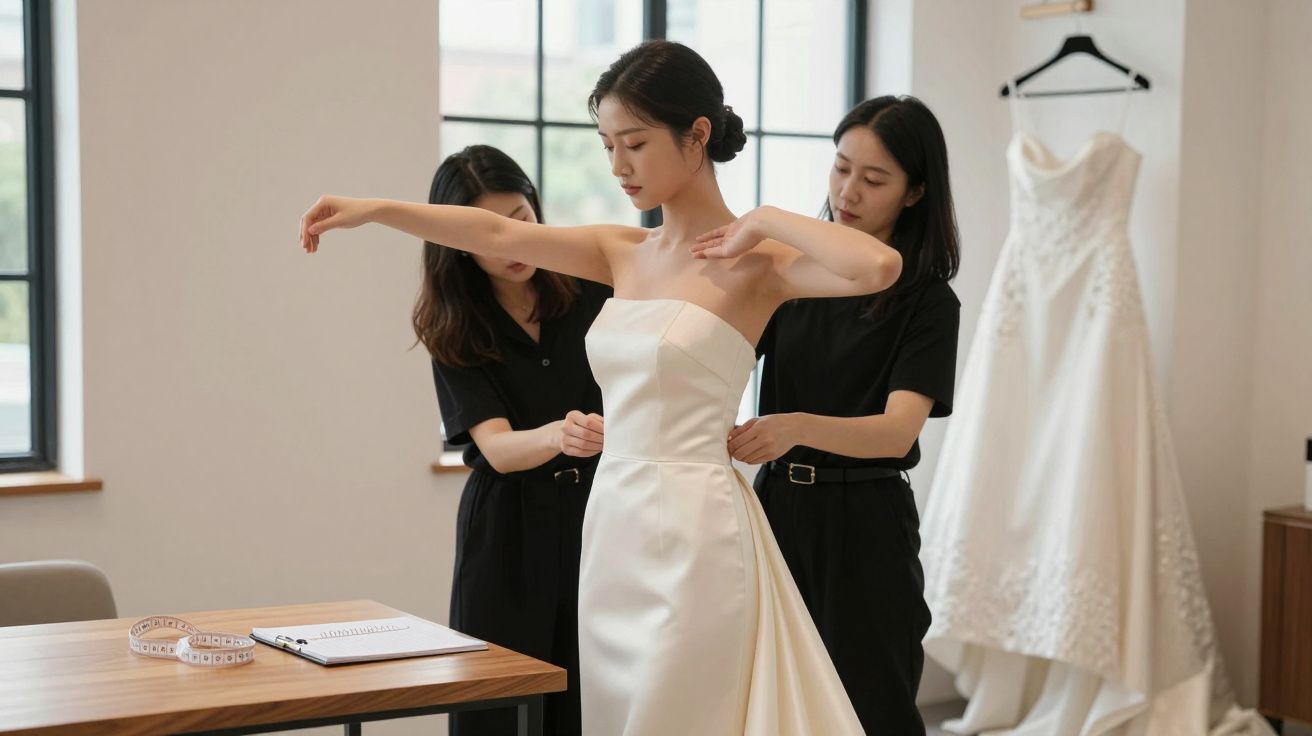
You can spot the difference between custom-made wedding dresses and boutique gowns in photos, but you feel it most when you move. It comes down to construction precision: the quiet, unglamorous accuracy inside the dress that decides whether you’re wearing it, or it’s wearing you. If you’re choosing what to spend your money on, this is the detail that pays you back all day.
There’s a particular moment it shows itself. You lift your arms to hug someone, you sit for the ceremony, you breathe after a big laugh, and nothing pulls, gapes, or shifts. The dress simply stays where it was meant to live.
The hidden line that changes everything: the balance
In bridal tailoring, “balance” is the way the bodice is built to sit on your body, not a standard mannequin. It’s how the front and back lengths, shoulder pitch, bust shaping, and waist position work together so the dress hangs straight, smooth, and stable.
Boutique gowns are made to a size chart, then altered to approximate you. Bespoke is drafted and built around you from the start, so the balance is engineered rather than corrected. That’s why two dresses can share the same silhouette, yet one looks calm and expensive while the other looks like it’s negotiating with gravity.
Here’s what balance quietly controls:
- Whether the waist seam sits at your actual waist (not a centimetre above, not a hopeful idea below).
- Whether the neckline stays flush when you inhale.
- Whether straps dig in, slide off, or simply behave.
- Whether the skirt falls from the right point, so the whole look feels “upright”.
What boutique alterations can fix - and what they can’t
A good alterations specialist can do a lot. Hem length, taking in a side seam, adding cups, adjusting straps, reshaping a sleeve: these changes can make a boutique gown feel far better than it did on the rail.
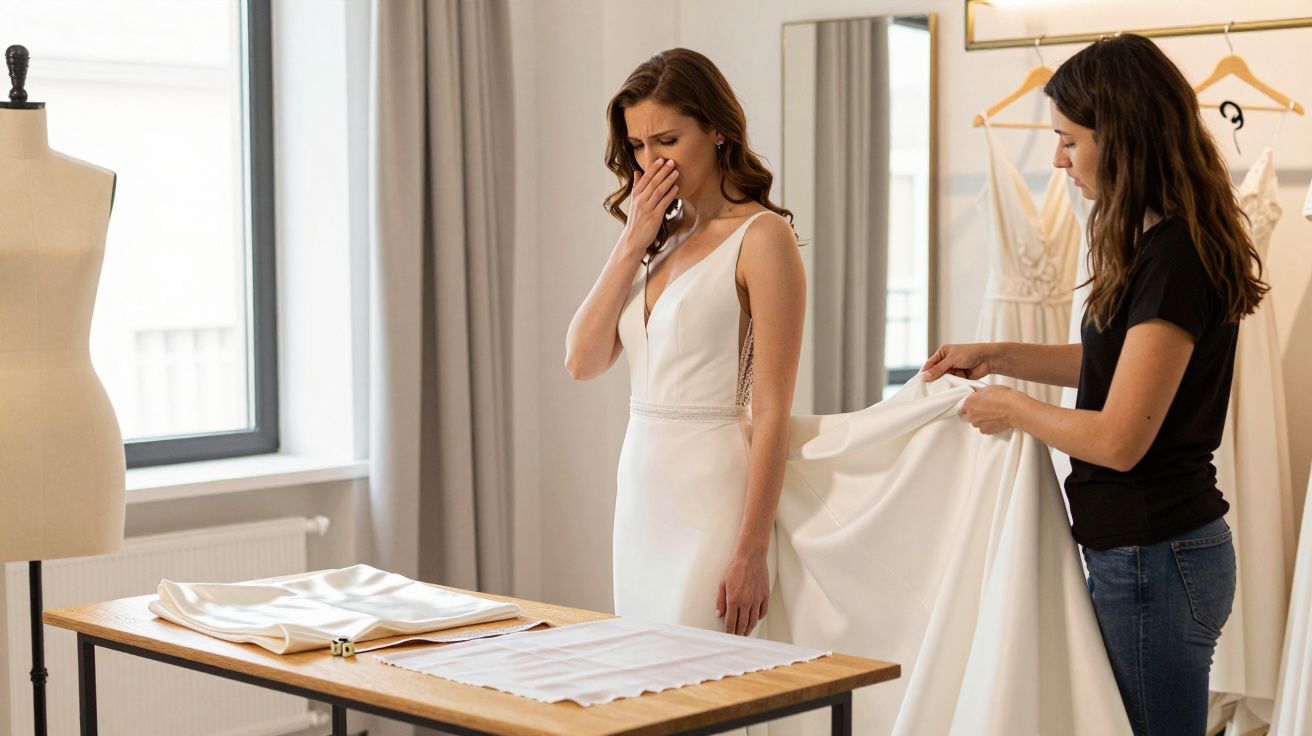
But there’s a line where you stop “altering” and start “rebuilding”. And most boutique gowns aren’t designed to be rebuilt because the internal structure is standardised and time-efficient.
Common boutique limits tend to show up in the same places:
- The armhole: you can’t always raise or reshape it without disturbing the sleeve, bodice, and lace motifs.
- The neckline: lowering is easier than raising; changing the shape may mean re-cutting layers you can’t replace.
- The torso length: if the bodice is too long or short for you, you may feel it all day, even if it looks fine for five minutes in a mirror.
- The bust point: moving where the dress “expects” your bust to be can be complex if the boning and seam lines are fixed.
It’s not that boutique is bad. It’s that it’s built for averages, and your body is not an average.
Inside a bespoke bodice: where the money actually goes
Bespoke isn’t just “more fittings” or “nicer fabric”. The difference is that the inside is treated like architecture, not packaging. That’s where construction precision becomes visible from the outside.
The parts you don’t see, doing the heavy lifting
A well-made bespoke bodice often includes:
- Internal corsetry (a separate inner layer that anchors the dress to you)
- Boning placement tailored to your curves and posture, not a generic pattern
- Waist stays that take weight off the neckline and shoulders
- Hand-set cups positioned to your bust shape rather than a standard apex point
- Layer management (lining, interlining, fashion fabric) cut so they don’t fight each other
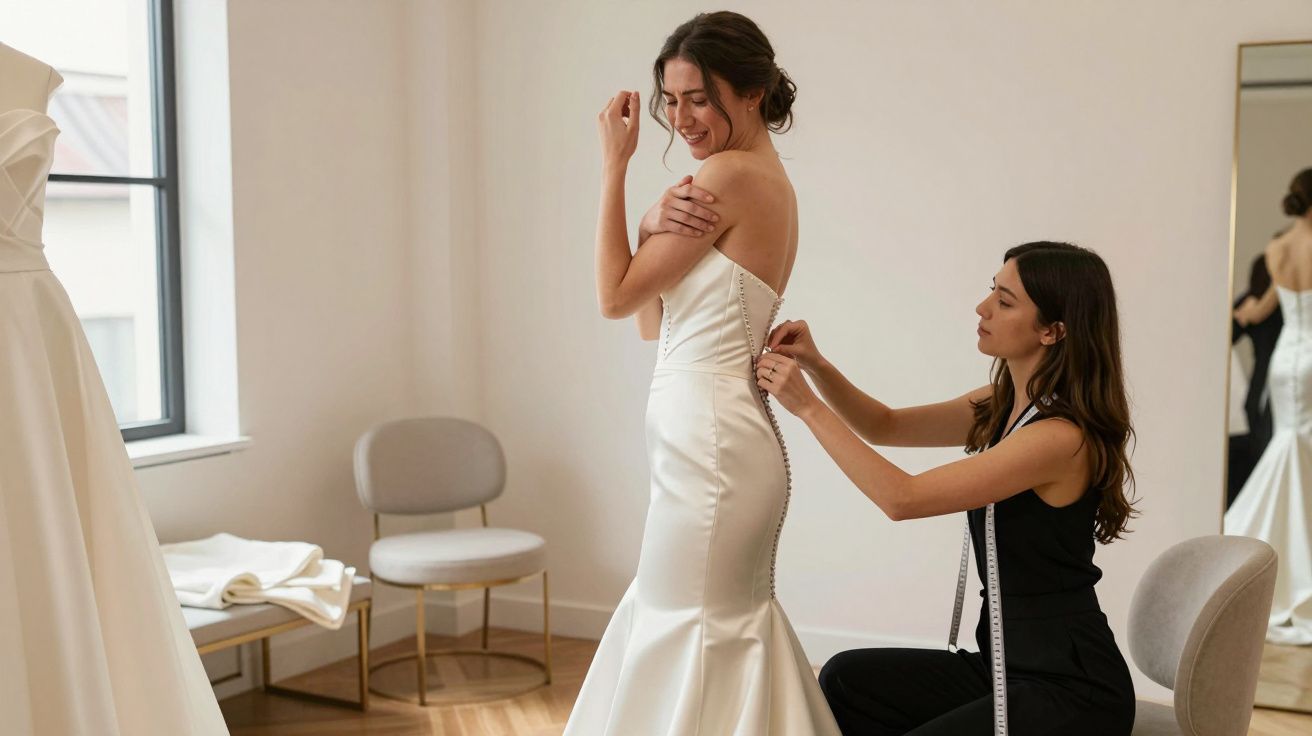
This is why a bespoke strapless dress can feel oddly secure, like it’s gently holding you in place rather than asking you to stand still all day.
A quick “movement test” you can do in the fitting room
If you’re trying on dresses and want a fast reality check, don’t just stand there like a statue under flattering lights. Give the dress a small, polite stress test.
- Raise both arms as if you’re hugging someone properly.
- Sit down as if you’re about to sign the register.
- Take a deep breath, then laugh (even a fake one works).
- Twist slightly at the waist as if you’re turning for a photo.
Notice what happens. If the bodice rides up, the neckline lifts away, the waist shifts, or you feel the need to “fix” yourself back into place, you’re seeing balance issues. In bespoke, those signals are used as instructions; in boutique, they’re often treated as the price of wearing the style.
Why it matters more than you think on the actual day
Most brides don’t regret a dress because the lace wasn’t French enough. They regret discomfort, fussing, and that low-level feeling of being slightly restricted in their own body.
When the balance is right, you gain things you didn’t realise you were budgeting for:
- You can eat without strategically holding your posture.
- You can dance without hitching the bodice up between songs.
- You can take photos without constantly adjusting straps or neckline.
- You look more like yourself, because you’re not managing the garment.
That ease reads as confidence on camera. It’s the difference between “wearing a stunning dress” and “being stunning in a dress”.
The simplest way to tell which route you’re on
If you want one clear distinction, make it this: boutique gowns are made, then fitted. Bespoke is fitted, then made.
That one sequence change is where construction precision has room to exist. It’s also why custom-made wedding dresses can look deceptively simple on the hanger yet feel extraordinary once they’re built on a body rather than a size.
If you’re deciding where to invest, ask less about the label and more about the inside: what’s supporting the bodice, where the weight is held, and whether the dress is balanced to you. The prettiest fabric in the world can’t compensate for a bodice that doesn’t know where it’s meant to sit.




Comments (0)
No comments yet. Be the first to comment!
Leave a Comment