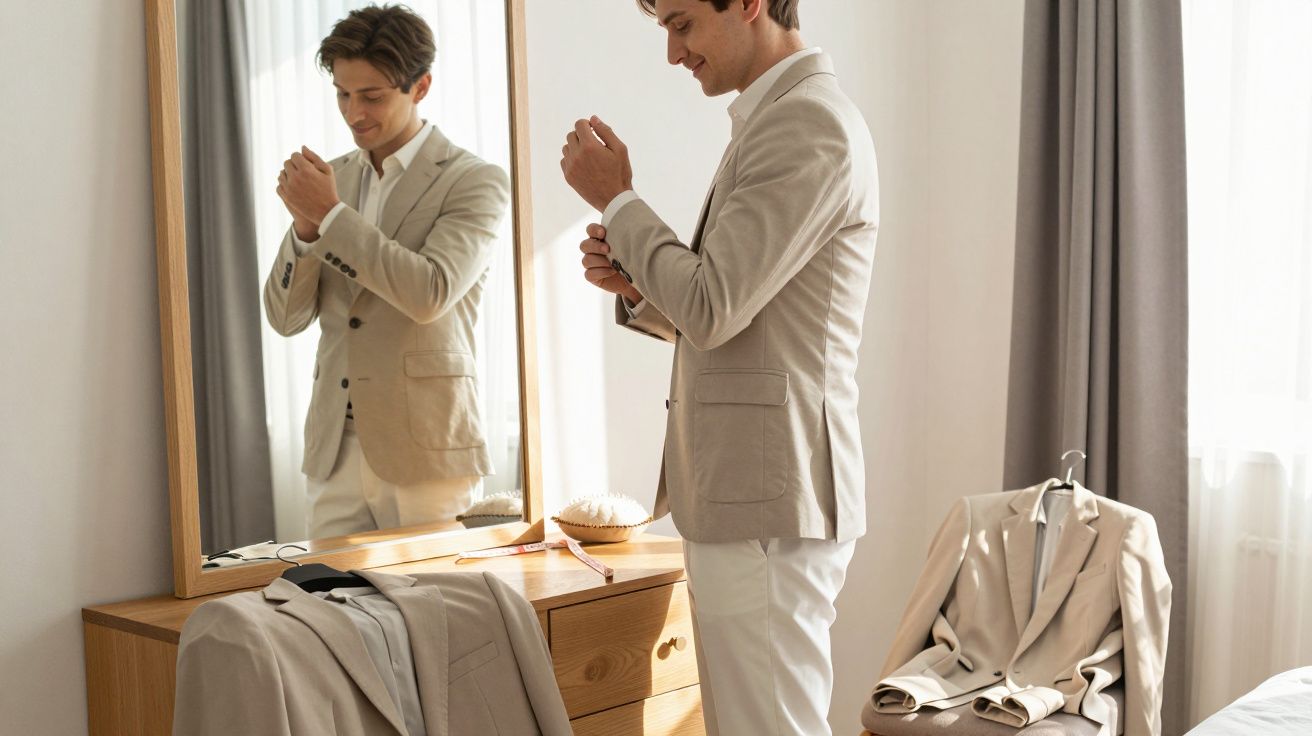
You notice it first in the photographs, then in the room. Couture tailoring makes a host look composed without looking “done”, because it builds visual harmony into the body of a suit, dress, or coat - and guests feel that ease even when they can’t explain it. It matters because what your friends register at a wedding, a dinner, or a work event isn’t your label; it’s whether your clothes sit like they belong to you.
I realised this watching two people greet the same crowd. One kept tugging at a cuff and rolling shoulders as if the fabric were negotiating with them. The other moved through hugs and handshakes like the garment had memorised their posture. Nobody praised “construction” or “balance”. They just kept saying, “You look great.”
The thing guests sense before they think
Most people are not reading your outfit like a pattern cutter. They’re reading signals: calm, confidence, proportion, ease. When clothing interrupts movement - collar biting, waistband climbing, sleeve twisting - guests pick up the friction, even if they’re too polite to name it.
That’s why couture tailoring lands so differently in person. The goal isn’t perfection on a hanger; it’s a quiet alignment between fabric and behaviour. When the garment follows your body, your face does less apologising.
The best compliment is not “nice suit”. It’s “you look well” - as if the outfit is part of your baseline.
Where the “can’t name it” difference actually lives
People assume tailoring is about taking something in at the waist. That’s the last mile. The real work is upstream: shaping the architecture so the eye moves smoothly, without snagging on odd angles.
Here’s what tends to create visual harmony, especially under real lighting and real conversation-distance:
- Shoulder line that matches your posture, not an idealised mannequin. A slightly forward shoulder needs a different balance than a square, upright stance.
- Neck and collar behaviour that stays close without choking. A collar that floats breaks the spell immediately.
- Sleeve pitch aligned to how your arms hang. If it’s wrong, you get diagonal drag lines when you reach for a glass.
- Waist shaping placed on your body, not where the brand decided the waist “should” be.
- Hem weight and drape that keeps the garment falling straight when you walk, sit, and stand again.
None of this is flashy. That’s the point. It’s engineering for comfort that reads as composure.
A simple test: the “hug, sit, stand” audit
If you want a quick reality check before an event, don’t stare in a mirror for half an hour. Do a three-minute loop that mimics what guests will actually see.
Three minutes, three moves
- Hug someone (or hug a pillow): does the back pull tight across the shoulder blades? Do the sleeves climb and stay there?
- Sit fully back in a chair: does the waistband cut in, does the jacket ride up, does the skirt twist?
- Stand and take five steps: does the hem settle back into place, or does it keep fighting?
If the garment returns to neutral quickly, that’s a tailoring win. If it holds onto tension like a grudge, guests will feel that restlessness even if they only clock it as “a bit uncomfortable”.
Why couture tailoring feels calmer than “just expensive”
Luxury can buy you beautiful cloth. Couture tailoring buys you behaviour: how the garment responds under pressure. That’s why two outfits can look similar in a photo and feel completely different at dinner.
A couture-level process tends to include fittings that adjust balance and structure in tiny increments - not because anyone is chasing vanity, but because millimetres change how the eye travels. When that travel is smooth, the person looks more at ease. When it’s choppy, the outfit reads as separate from the wearer.
Think of it like a well-cut room. You don’t praise the joins in the skirting boards. You just feel the space is calm.
The most common “almost right” tells (and what to ask for)
The frustrating part is that off-the-peg can be close enough to fool you at home, then fall apart under event conditions: warm rooms, long conversations, lots of movement.
Bring these to a tailor as questions, not demands:
- “Can we check the jacket balance?” If the front hikes up or the back collapses, the garment is tilting on you.
- “Are the shoulders sitting where my shoulders are?” Not where they’re meant to be.
- “Can you adjust sleeve pitch?” Particularly if you see twisting from elbow to cuff.
- “Can we clean up the neckline?” A small collar gap can make the whole look feel restless.
- “Is the hem weight right for this fabric?” Light cloth sometimes needs a different finish to hang cleanly.
You’re not chasing a sculpted silhouette. You’re chasing fewer micro-adjustments during the night.
A quick guide to spending effort where it shows
If you’re not commissioning anything bespoke, you can still borrow the logic of couture tailoring: prioritise the areas that control visual harmony.
| Priority area | Why guests notice | Quick fix |
|---|---|---|
| Shoulders + neck | Sets the whole frame | Choose the best shoulder fit; tailor the collar/neckline if possible |
| Sleeves + trouser/skirt length | Visible in movement and photos | Basic alterations, correct pitch where available |
| Waist/hip shaping | Affects posture and ease | Light shaping over aggressive cinching |
A final, slightly unfair truth: guests read “tailored” as “considered”. It’s not about looking formal. It’s about looking like you’re not negotiating with your clothes all night.
The quiet payoff
When couture tailoring is done well, it disappears. You stop thinking about the garment and start thinking about the room - the toast, the stories, the people you came to see. Guests can’t name why you look so put-together, but they feel the visual harmony in the same way they feel good lighting: flattering, steady, and strangely relaxing.
That’s the difference worth paying for, even if you only pay for a few strategic adjustments. The aim isn’t to impress. It’s to arrive already comfortable.





Comments (0)
No comments yet. Be the first to comment!
Leave a Comment