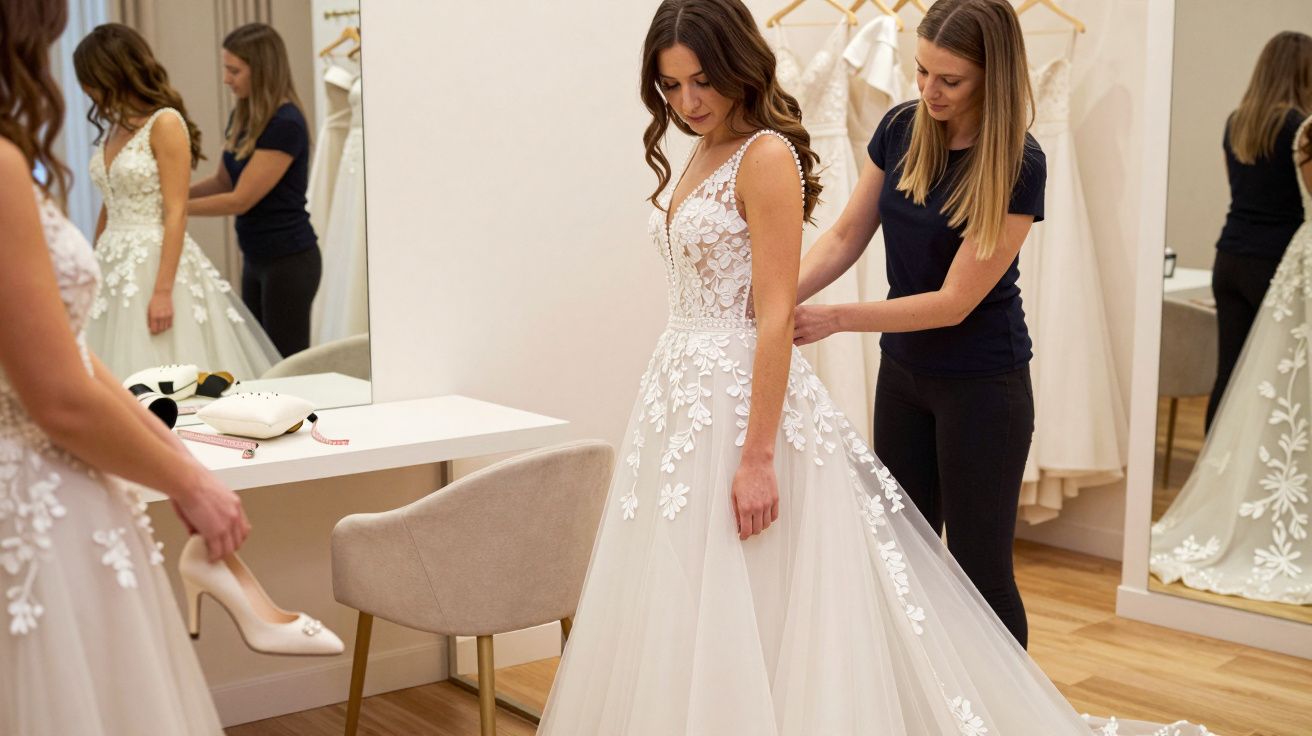
Wedding dress fittings are meant to calm you down, yet they’re often where the panic begins: a hem that suddenly looks “wrong”, a bodice that shifts when you sit, a strap that behaves perfectly-until it doesn’t. The tailoring step that prevents last-minute dress panic is booking final adjustments with enough runway to test, tweak and re-test the dress in real-life conditions. It matters because the problems that show up in the final fortnight are rarely dramatic defects; they’re small, fixable details that only reveal themselves when you move, sweat, eat, hug and dance.
Most brides don’t run out of time because they started late. They run out of time because they assumed the last fitting was the finish line, not the quality check.
The “nearly finished” trap
A dress can look immaculate on a pedestal and still misbehave on a body that breathes. Tailors pin and smooth; you stand still and glow; everyone relaxes. Then you collect it, take it home, try it on quickly, and realise the neckline sits differently without the seamstress’s hands guiding the fabric.
The trouble with last-minute dress panic is that it’s rarely about one big issue. It’s about five small ones stacking up: the cups feel slightly off, the bustle pulls, the hem catches, the waist digs after 20 minutes, the zip needs a second person with strong fingers. Each one is manageable-unless you discover them when there’s no appointment left to take.
The step: a “wear-test fitting” before the final fitting
The most effective move is simple: schedule a penultimate appointment that isn’t for perfection, but for behaviour. Think of it as a dress rehearsal that generates a punch list, so final adjustments are genuinely final.
At this fitting, you’re not asking, “Does it look right?” You’re asking, “Does it stay right?”
What to bring (so the fitting reflects real life)
If you arrive with random shoes and a different bra, you’re not getting a fitting-you’re getting a guess. Bring the items that change your posture, height, and how the dress anchors to you.
- Your wedding shoes (or same heel height and shape)
- Your planned underwear/shapewear
- Any accessories that touch the dress (strapless bra band, belts, jewellery that may snag)
- A photo of your hairstyle idea if it affects neckline/veil placement
- A trusted person who will actually help you practise the bustle and zip
If you’re changing shoes for the evening, mention it now. A hem can be safe for the ceremony and hazardous by the first dance.
What to do in the room: movement creates the truth
Most fit issues hide in movement, not mirrors. You’re allowed to be “difficult” here: sit, walk, twist, and repeat until the dress shows you what it will do on the day.
Try this quick sequence:
- Walk a straight line, then turn sharply (as if greeting guests).
- Sit fully back in a chair, then stand without using your hands.
- Raise both arms (as if hugging or holding a bouquet high for photos).
- Take five quick steps (as if you’re late), then stop abruptly.
- Do a slow “dance sway” for 60 seconds.
Pay attention to where you tug without thinking. Your hands will tell the tailor what your mouth forgets.
The three fixes that stop 90% of late surprises
Tailoring isn’t only about taking in and letting out. The calm comes from tiny structural choices that keep the dress stable when your body is busy being alive.
1) Waist anchoring, not waist squeezing
If the dress slides, it will feel too big even when it photographs fine. Ask whether discreet waist stays or internal hooks can take the strain off delicate outer fabric, especially on strapless or off-the-shoulder styles.
2) A bustle you can do in low light, with nervous hands
A complicated bustle is a beautiful theory and a stressful reality. Have the person who’ll do it practise at the fitting, then film it. If it needs twenty minutes and a degree in knot-tying, simplify it now.
3) Hem security for the way you actually walk
Floors vary. So do pavements, grass, stairs, and the way you shorten your stride in heels. Ask for a hem length that protects movement, not just a static “toe skim” in the fitting room. If you’re torn between two lengths, choose the one that reduces catching-your photos will still look elegant, and your stress will drop.
Timing: the calendar that keeps you out of trouble
People love a neat schedule; bodies love to change anyway. Bloating, posture shifts, gym routines, travel, stress-none of these are moral failures. They’re just reasons to keep your fitting plan realistic.
A useful rule of thumb:
- Wear-test fitting: about 4–6 weeks before the wedding (or earlier if you’re travelling)
- Final adjustments appointment: about 2–3 weeks before
- Collection: about 7–10 days before (enough time for a tiny emergency fix, not enough time for you to second-guess everything)
If your boutique is busy or you’re marrying in peak season, book these dates early. The panic often starts with, “They don’t have any slots.”
The conversation that makes tailors faster (and you calmer)
Tailors can fix almost anything, but they can’t read minds. Describe problems by sensation and situation, not by vague dislike.
Instead of “It feels wrong,” try:
- “When I sit, the bodice pushes up and I keep pulling it down.”
- “After ten minutes, the waist digs on my right side.”
- “When I turn, the strap twists and I lose support.”
- “The bustle pulls the skirt to one side when I walk.”
You’re giving them a map, not a mood.
“A final fitting isn’t for hope. It’s for proof.” That mindset changes everything in the room.
A quick checklist for the day you collect it
Before you leave the shop, do a two-minute sanity check. Not a full rehearsal-just enough to catch the obvious.
- Zip up and down once (slowly), checking it doesn’t snag
- Walk and turn
- Sit and stand
- Confirm bustle points and practice once
- Check you can breathe comfortably (and that you can raise your arms)
If something is off, say it there. Small fixes are easiest while the dress is still on you and the tailor’s tools are within reach.
FAQ:
- What if my weight changes after wedding dress fittings are finished? Tell your boutique as soon as you suspect a change. Minor shifts can often be handled in final adjustments, but some fabrics and designs have limited seam allowance.
- Is it normal to have more than one “final” appointment? Yes. Many brides do a wear-test fitting and then a true final fitting. It’s not fussiness; it’s preventing surprises.
- Can I do final adjustments without my shoes? You can, but it’s a common route to hem problems. If your exact shoes aren’t available, match heel height and toe shape as closely as possible.
- How do I avoid bustle disasters? Keep it simple, practise it at the fitting with the person who’ll do it on the day, and film the steps. If it feels hard in a calm room, it’ll be harder at the reception.
- Should I “hold off” on tailoring until closer to the wedding? Not usually. Start early, then refine. The goal is time for behaviour-testing, not a last-minute scramble.





Comments (0)
No comments yet. Be the first to comment!
Leave a Comment