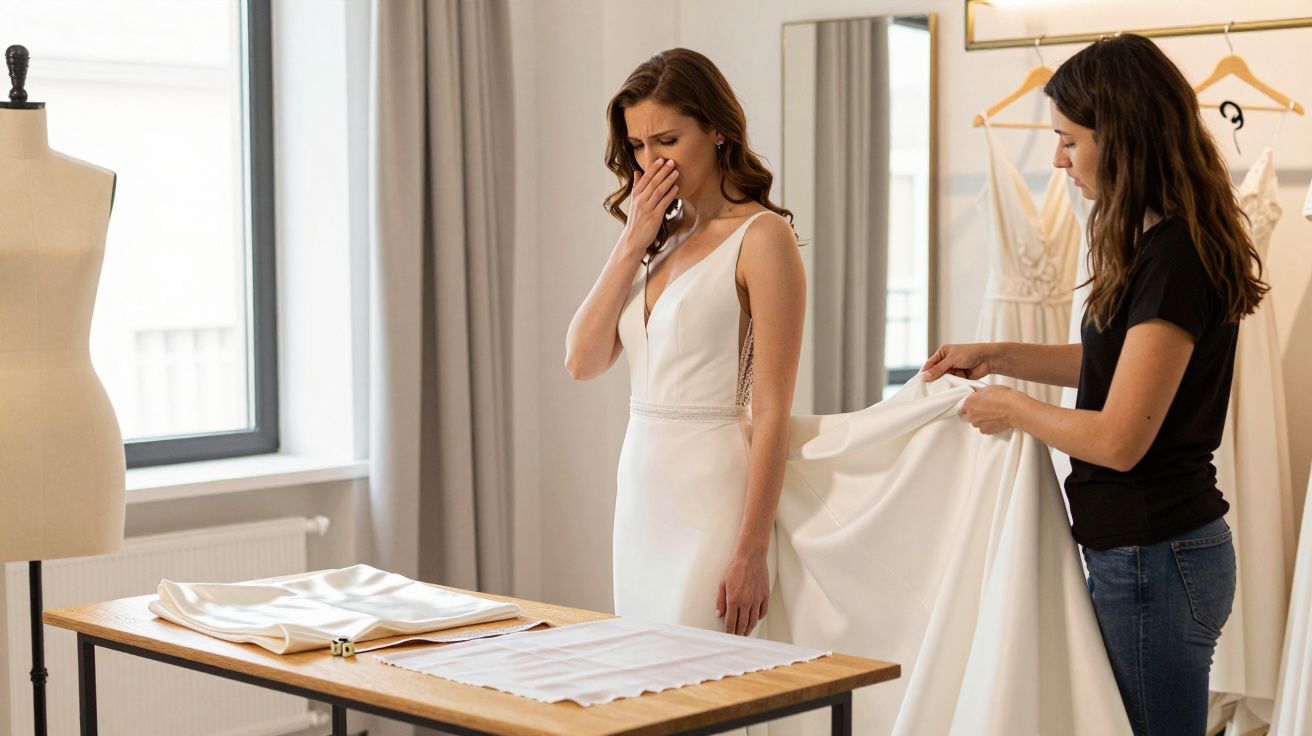
You don’t notice it in the photos, but you feel it by mid‑afternoon. Wedding dress fabrics and breathability end up deciding whether you’re floating through your day or counting minutes until you can peel yourself out of your bodice.
It’s rarely about “good” or “bad” fabric in the abstract. It’s about what sits against your skin for ten hours, what traps heat under layers, and what happens when you’re hugging relatives, dancing, and standing under lights that make everything warmer than it should be.
A lot of brides spend weeks choosing the silhouette and the neckline. Then they pick the fabric because it looks expensive in a fitting-room mirror, and only later realise comfort is mostly a physics problem.
The quiet comfort controller: airflow, not appearance
Most wedding dresses don’t feel uncomfortable at the start. They feel stiff, special, structured - the way formalwear is meant to feel. The problem is that your body warms up, your nerves kick in, and the room fills with people.
That’s when breathability stops being a nice-to-have and becomes the difference between “I’m fine” and “why am I sweating through my lining”.
Think of fabric like a crowd at a doorway. Some materials let air move through in tiny, constant exchanges. Others hold onto heat and moisture like they’re doing you a favour. The dress can look identical from the outside and behave completely differently on the inside.
Why some fabrics turn “bridal glow” into sticky panic
The main culprit isn’t always the outer layer you can see. It’s often the combination: outer fabric, lining, interlining, and whatever structure is keeping the dress upright.
Many classic bridal looks rely on materials that are either:
- tightly woven (less airflow),
- coated or treated (less moisture transfer),
- layered over synthetic linings (traps warmth),
- or heavily structured (creates pressure points and heat zones).
That’s why two satin dresses can feel worlds apart. One might be silk satin over a breathable cotton or silk lining. Another might be polyester satin over polyester lining with fused support - beautiful, but basically a warm sandwich.
And once you’re warm, your body does what it’s designed to do. It cools you with moisture. If the dress can’t move that moisture away, you don’t just feel hot - you feel damp, and damp makes everything itchier, tighter, and more irritating than it should be.
A simple way to think about wedding dress fabrics (without turning into a textile nerd)
When you’re shopping, you don’t need to memorise fibre science. You need a few practical categories that map to real comfort.
Fabrics that usually breathe better (especially in spring/summer weddings)
These tend to allow more airflow and handle long wear more kindly:
- Silk (especially silk crepe, silk chiffon, silk organza): breathable and temperature-friendly, though it depends on weave and layers.
- Cotton blends (sometimes used in linings): often underrated; can feel dry and calm on skin.
- Viscose/rayon linings (good quality): not perfect, but often more breathable than straight polyester linings.
The catch is that breathability can be ruined by what’s underneath. A light silk outer over a non-breathable lining can still feel clammy by dinner.
Fabrics that often trap heat (even when they look “light”)
These aren’t automatically wrong, but they need smart construction:
- Polyester satin and mikado: holds structure well, photographs beautifully, and can run warm.
- Heavily beaded lace/tulle: beads and dense appliqué reduce airflow and add weight; friction rises as the night goes on.
- Neoprene-like “scuba” crepe (more fashion than bridal): smooth and sleek, but not a friend to airflow.
It’s not a moral judgement. It’s just what happens when you wrap a moving, warm body in low-porosity layers for a full day.
What to ask at your fitting (the questions that actually change comfort)
Most people ask about bustle points and boob tape. Fair. But comfort usually lives in the unseen parts: linings, seams, and how the dress manages heat.
Bring these up directly:
- “What is the lining made of?” Ask for the fibre, not just “it’s lined”.
- “How many layers are there from skin to outer fabric?” Especially in skirts and bodices.
- “Is there boning, and where?” Boning plus low breathability can feel like a radiator cage by hour six.
- “Can we swap the lining for something more breathable?” This is sometimes possible, especially in bespoke or alterations.
- “Where will this touch when I sit?” Heat and friction show up first at the waistline, underarm, inner arm, and upper thighs.
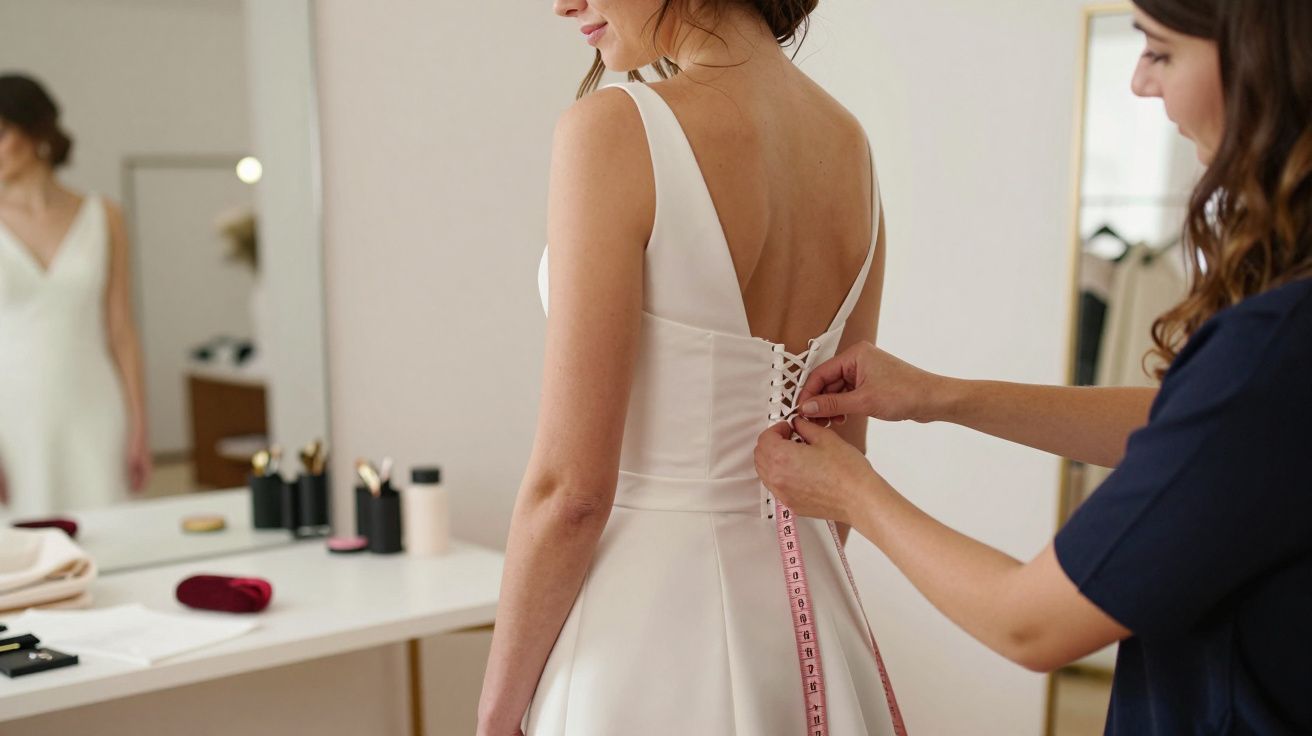
A seamstress hears these questions and immediately knows you’re planning for the whole day, not just the aisle.
The underrated factor: structure creates heat pockets
Even breathable fabrics can feel oppressive if the dress is engineered like armour. Corsetry, inner cups, heavy interfacing, and multiple layers can block the little air exchange you rely on to stay comfortable.
Common “hot spots” are predictable:
- under the bust and along the bra line,
- the waist seam (especially with fitted bodices),
- inner elbows and underarms (if sleeves are fitted),
- the top of the skirt where layers sit over the hips.
If you’ve ever taken off shapewear and felt relief like opening a window, you already understand the principle. Pressure plus low airflow equals discomfort that builds quietly.
A quick reality check: your venue is part of the fabric choice
A satin ballgown in a draughty church is a different experience from the same dress in a July marquee. Air conditioning, crowd density, and even lighting matter more than people expect.
If you want a simple rule you’ll actually remember: match the breathability to the heat you can’t control.
- Outdoor summer ceremony + dancing + close crowd: prioritise airflow in lining and bodice.
- Cool season + formal venue: you can get away with denser weaves and more structure.
- Destination humidity: treat synthetics with caution unless you know the lining is kind.
The cheat-sheet brides actually use when deciding
Here’s the blunt version that saves regret later.
| If you want… | Look for… | Watch out for… |
|---|---|---|
| Cool, dry comfort | breathable lining + fewer layers | synthetic lining under “nice” outer fabric |
| Soft movement | crepe, chiffon, lighter lace | heavy beading that locks fabric down |
| Structured, clean silhouette | mikado/satin with smart venting/lining | stiff bodice with low airflow all day |
One small test that tells you more than a mirror
In your fitting, do a two-minute wear test that mimics real life. Sit down properly. Lift your arms like you’re hugging someone. Take ten slow breaths. Then notice what happens at the waist and underarms.
If you feel heat building immediately, it won’t improve at hour seven. You can sometimes adjust fit and lining to fix this, but you need to spot it early - before the dress is finalised and the day is locked in.
FAQ:
- Can lace be breathable? Yes, depending on the lace density and what sits underneath. Lace over a breathable lining can feel fine; lace over multiple synthetic layers can feel surprisingly warm.
- Is silk always cooler than polyester? Often, but not always. Weave, thickness, and lining matter. A heavy silk satin with a dense lining can feel warmer than a lighter, well-constructed synthetic.
- What’s the biggest comfort mistake with wedding dress fabrics? Choosing by outer layer only. The lining and internal structure usually control how the dress feels by late afternoon.
- Can alterations improve breathability? Sometimes. Swapping lining fabric, reducing layers in specific areas, adjusting boning placement, or adding small design changes can help, depending on the dress construction.



Comments (0)
No comments yet. Be the first to comment!
Leave a Comment