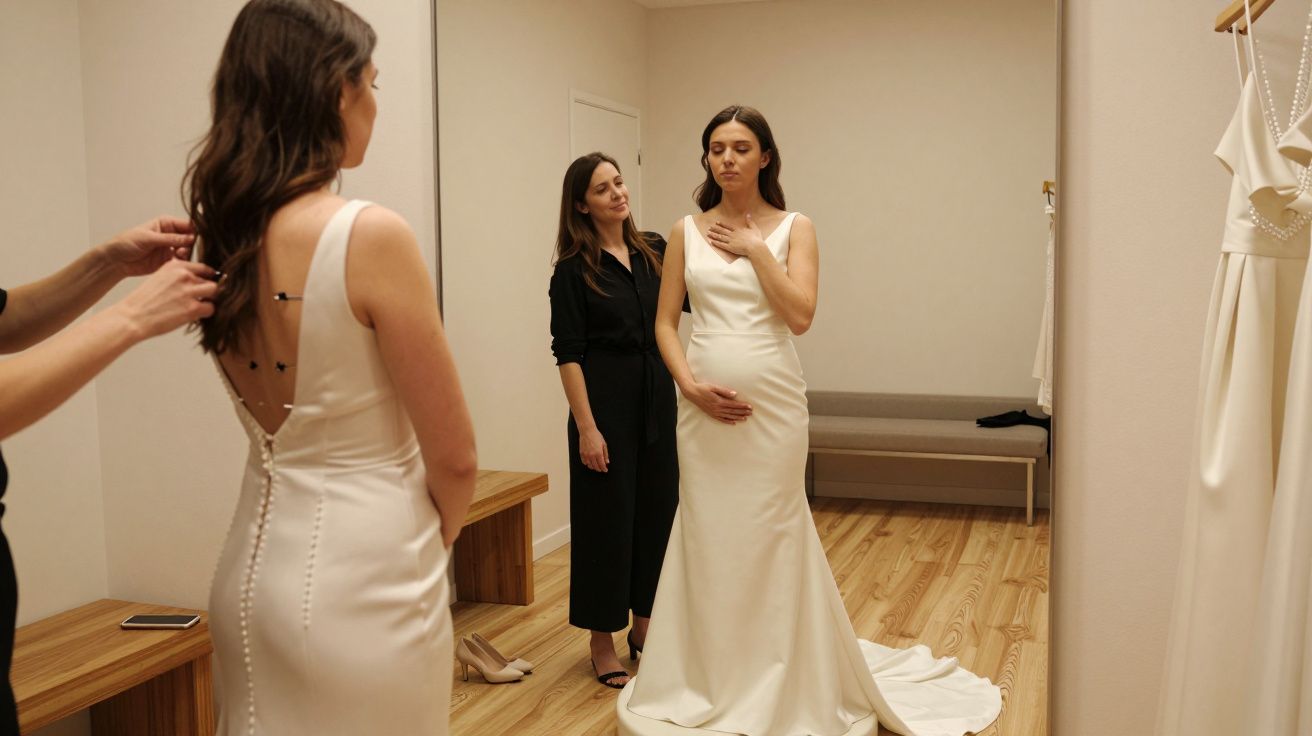
Brides rarely say it out loud, but bridal dress anxiety can show up the moment you step into a boutique and a stranger starts clipping fabric to your back. It tangles with self-image in a very specific way: not “Do I like this dress?” but “Do I deserve to look like a bride in it?” It matters because the dress is public, photographed, and remembered - and your nervous system knows that long before your rational brain catches up.
I first heard the fear in a fitting room in Manchester, under flattering lights that still felt like a spotlight. A friend stared at her reflection and went quiet, then finally said, “What if I pick the wrong version of me?” Not the wrong neckline. Not the wrong train. The wrong self.
Outside the curtain, everyone was excited, ready with opinions. Inside it, she was negotiating with a body she’d lived in for years, now being measured in pins, seams and angles.
The fear most brides don’t admit isn’t about the dress
It’s about being seen in it. The unspoken panic is that the dress will reveal something you’ve spent years trying to manage: your stomach, your arms, your height, your scars, your softness, your shape when you sit down. You’re not just choosing fabric - you’re choosing evidence.
There’s a particular kind of pressure that comes with wedding shopping because it’s framed as “fun”. If you feel dread, you assume you’re ungrateful, dramatic, difficult. So you smile, you take the photos, you nod at “snatched” and “tiny waist”, and you quietly file away the thought: What if I look like I’m playing dress-up?
And because the day is loaded, the dress becomes a proxy for everything else. Family dynamics. Money. Time. The life change. Your old insecurities turning up early, like a guest who arrives before the chairs are out.
How bridal dress anxiety hooks into self-image
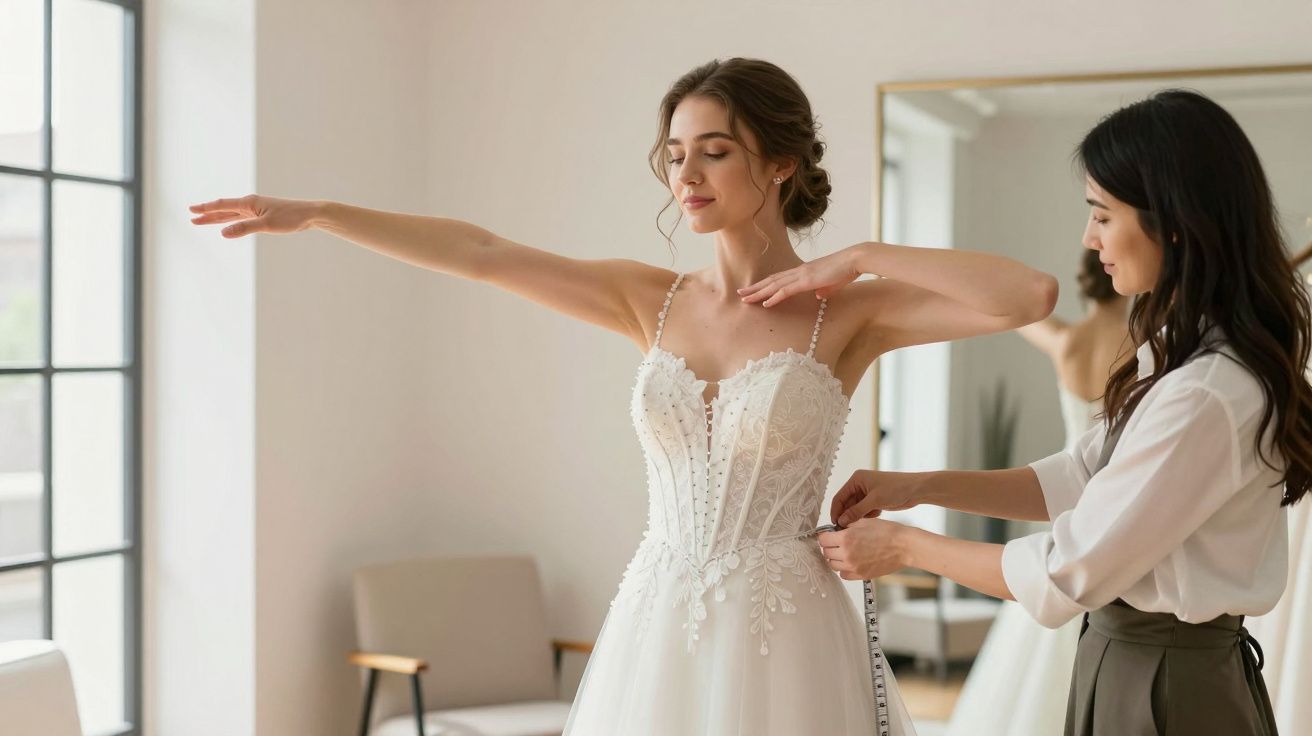
Bridal shopping is a perfect storm: mirrors, labels, fit issues, and a timeline. Most people don’t stand on a pedestal under bright lights while someone assesses their body for structure and “support”. Most people don’t bring an audience.
Your brain starts scanning for threats: angles, bulges, “problem areas”, the imagined reaction of future photos. It’s not vanity; it’s vigilance. If your self-image has been bruised by dieting culture, past comments, comparison, or simply years of being observed, a wedding dress can feel like a final exam.
Common thought loops sound like this:
- “If I loved my body, I’d feel happy right now.”
- “If I choose comfort, I’ll look frumpy.”
- “If I choose something fitted, I’ll hate every photo.”
- “If I cry, I’ll ruin the moment for everyone.”
None of these thoughts are about lace. They’re about safety, belonging, and permission.
What a good fitting should feel like (and what’s a red flag)
A good bridal appointment has a softer energy than people expect. You should feel guided, not handled. You should feel like the dress is being adjusted to you, not you being corrected to match the dress.
Green flags:
- The stylist asks how you want to feel (held, light, sleek, relaxed) before pulling gowns.
- There’s neutral language about your body: “support”, “structure”, “movement”, not “flaws”.
- You’re encouraged to sit, walk, lift your arms, breathe - real-life checks.
- They offer sizing options without drama, and without announcing numbers.
Red flags:
- “This will hide…” as the opening line for every suggestion.
- Pushing shapewear as a requirement, not an option.
- Rushing you into photos when you’re not ready.
- Treating discomfort as the price of being “bridal”.
You’re allowed to want to look incredible. You’re also allowed to want to feel like yourself.
A tiny pre-appointment ritual to lower the volume
This isn’t about forcing confidence. It’s about giving your nervous system a cue: we’re safe; we’re choosing, not being judged.
Try this in the car, the loo, or the changing room before you step out:
- Put one hand low on your belly and one on your chest.
- Inhale through your nose for a count of four.
- Exhale for a count of six, like you’re fogging a mirror gently.
- Do six rounds, then think: “I’m here to feel, not to perform.”
If you start spiralling in front of the mirror, add one practical anchor: feel your feet inside your shoes. Press your toes down. Notice the floor holding you. Your body stops being an object and becomes a place you’re standing.
How to talk about it without sounding “difficult”
Most brides try to manage everyone else’s experience - mum’s feelings, friends’ excitement, the stylist’s schedule - while their own self-image is taking hits. The simplest fix is a small script, said early.
Pick one of these and use it exactly as-is:
- “I’m prone to getting in my head about my body. I’d like neutral language today.”
- “Photos make me spiral - can we wait until I say I’m ready?”
- “I need to be able to sit and breathe. Comfort is part of the brief.”
- “If I go quiet, I’m processing. Please don’t fill the silence with fixes.”
Let’s be honest: nobody says this perfectly the first time. But one boundary at the start can save you an hour of swallowing feelings and calling it “fine”.
What changes when you name the fear
Bridal dress anxiety shrinks when it’s spoken plainly, because it stops masquerading as a fashion problem. You stop thinking you’re failing at being a bride, and start seeing what’s actually happening: an old self-image storyline trying to hijack a new moment.
You may still have complicated feelings. You may still cry in a fitting room. That doesn’t mean you’ve chosen wrong, or that you’re not ready for marriage, or that your body is the issue. It means you’re human in a highly concentrated spotlight, learning to be seen with kindness.
And when the right dress comes - not perfect, not magical, just right enough - the relief often isn’t “I look thin.” It’s quieter than that: “I can breathe. I can move. I recognise myself.”
| Point clé | Détail | Intérêt pour le lecteur |
|---|---|---|
| The real fear | Being seen, not just “choosing wrong” | Helps you name what’s happening |
| Self-image triggers | Mirrors, audience, time pressure | Normalises the spiral |
| Practical reset | 4–6 breathing + simple scripts | Gives you something to do, not just think |
FAQ:
- Can I bring fewer people to my appointment without offending anyone? Yes. Frame it as focus, not rejection: “I love you, but I shop better with one calm person - can I show you pictures after?”
- Should I avoid mirrors or photos if they trigger me? You don’t need to avoid them entirely. Delay photos until you feel steady, and use one full-length mirror rather than multiple angles at once.
- Is shapewear necessary for a wedding dress? No. It’s optional. Choose it only if it increases comfort and support, not as a punishment or requirement.
- What if I don’t get the ‘this is the one’ moment? That’s normal. Many people choose a dress the way they choose a home: it feels right, workable, and like you can live in it.
- When should I get extra support for bridal dress anxiety? If it’s affecting sleep, eating, or daily mood, or if fittings trigger panic or obsessive checking, consider speaking to a therapist or GP alongside dress shopping.



Comments (0)
No comments yet. Be the first to comment!
Leave a Comment