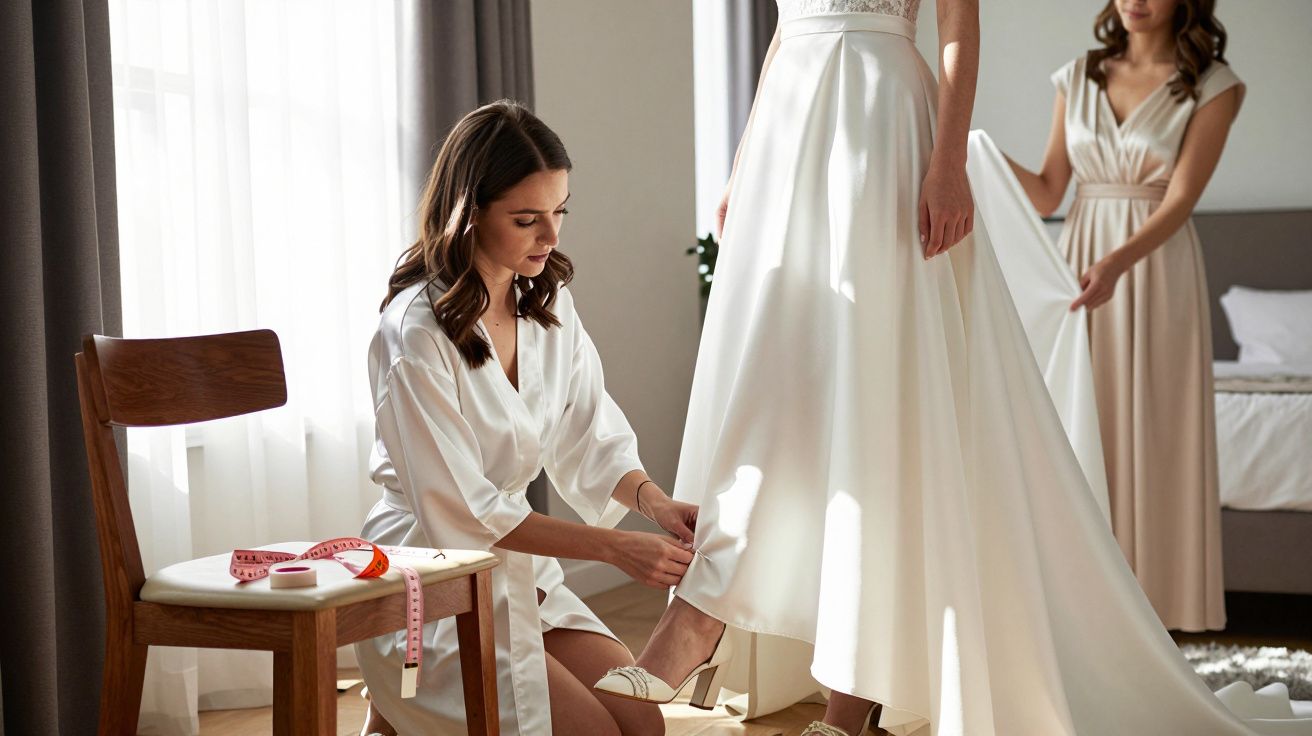
Some wedding mornings run perfectly-until the zip won’t budge, the straps sit wrong, or the hem suddenly feels a mile too long. That’s where emergency bridal alterations come in: fast, targeted fixes for last-minute issues, usually done in hours rather than weeks, and often on-site or close to the venue. It matters because the difference between “I’ll just hold it” and “I can breathe, walk and dance” is usually a handful of stitches in the right place.
You don’t plan for a broken hook-and-eye or a bodice that shifts after a nervous breakfast. But dresses move differently once they’re steamed, once you’re wearing the right bra, and once you’re actually standing up in shoes on real flooring, not a carpeted fitting room.
The moment you realise you need a fix
It’s rarely dramatic at first. It’s the slight drag on the aisle runner, the cup that collapses when you lift your arms, the bustle that looked fine in the fitting and now refuses to stay up.
Then it becomes practical: you can’t sit comfortably in the car, you can’t walk without lifting the skirt, you can’t stop thinking about the neckline instead of the vows.
A good emergency alteration doesn’t “redo” your dress. It removes the one thing that’s stealing your attention.
What counts as an emergency bridal alteration (and what doesn’t)
An emergency service is built for adjustments that are small in area but big in outcome. The work is usually about stabilising, shortening, securing or reshaping what’s already there-without needing new lace ordered or major pattern changes.
Typical “yes, we can” fixes include:
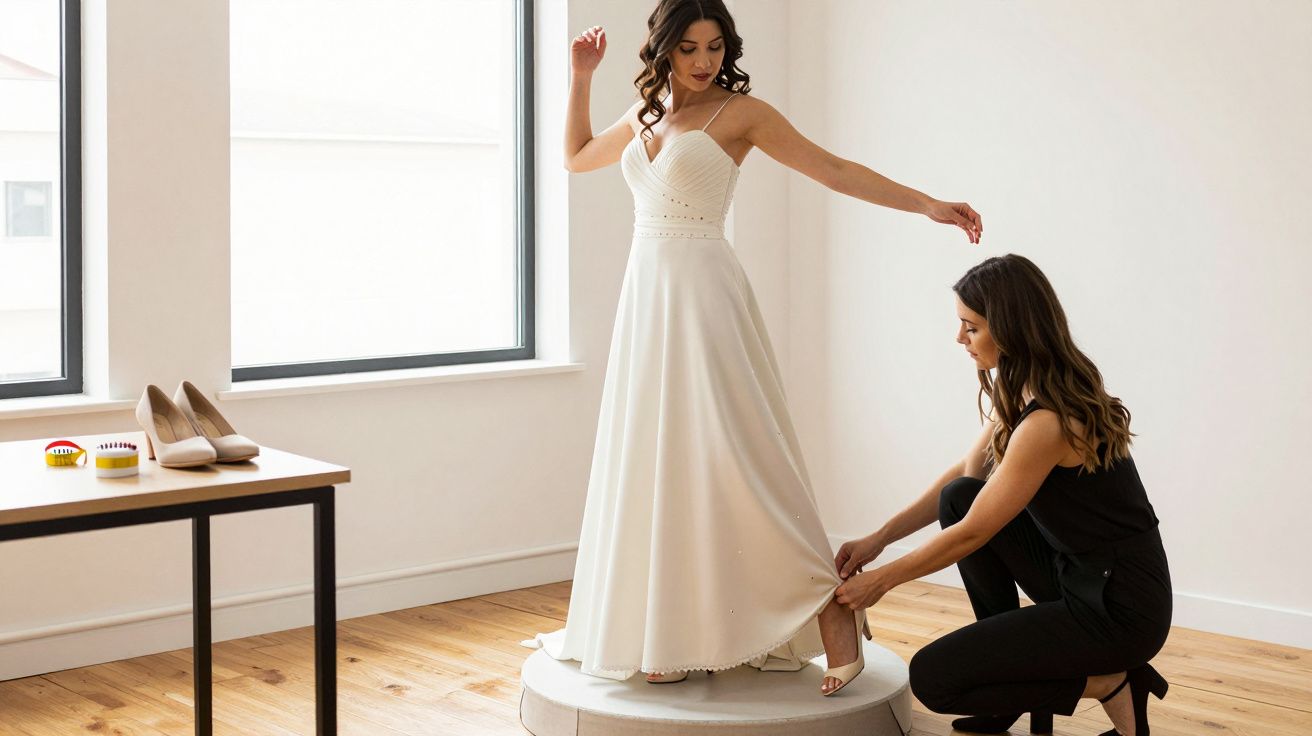
- Hem rescue: quick lift, temporary or permanent, for shoes you didn’t end up wearing.
- Zip and closure repairs: stuck zips, popped seams, broken hooks, missing eyes.
- Strap and shoulder tweaks: tightening slipping straps, adding discreet keepers, rebalancing one side.
- Bodice stability: taking in a touch at side seams, adding modesty tacks, stopping gaping at the bust.
- Bustle triage: reinforcing buttons/loops, retying points, adding an extra anchor so it holds through photos.
- Pinning that becomes sewing: turning a “we’ll just safety pin it” moment into something you can trust.
What usually isn’t realistic on the day: significant resizing (multiple sizes down), major neckline redesigns, rebuilding corsetry, or anything requiring matching fabric that has to be sourced.
A quick reality check: time vs result
If you’re deciding whether to push for a fix or change your plan (different shoes, different bra, different underskirt), it helps to think in outcomes.
| Problem | Quick fix that works | If there’s no time |
|---|---|---|
| Hem catching underfoot | Lift and level hem; temporary hand tack | Change shoes; remove bulky underskirt |
| Bodice slipping down | Tighten at sides; add stay/keeper | Add fashion tape; choose a more supportive bra |
| Bustle failing | Reinforce points; add extra tie | Carry dress; plan fewer “up” shots |
The last-minute issues that cause the most stress
Some problems are predictable, which is why they’re so frustrating when they still happen.
1) Shoes change everything
Swap from a 7 cm heel to a 3 cm block (or trainers for comfort) and the hem becomes a tripwire. Add a thicker sole than your fitting shoes and the front can suddenly skim the ground.
2) Weight, water, nerves-and the dress reacts
Bloating, a different strapless bra, a slightly tighter waist from stress: it doesn’t take much for a fitted bodice to sit a centimetre lower or twist. That’s enough to make you tug at it all day.
3) Bustles are brilliant… until they’re not
Bustles are small engineering projects. Buttons pop, loops stretch, ribbons get tied wrong by a well-meaning helper. The fix is often simple, but it needs someone who knows where the load should sit.
4) Fastenings fail at the worst time
Hooks and eyes are tiny, under huge tension, and often installed where sweat and movement are constant. A single broken eye can make a zip feel “too small” when the fit is actually fine.
How a same-day seamstress actually approaches the dress
The best emergency work looks calm because it is methodical. A good alteration specialist will check how the dress behaves in motion, not just in front of a mirror.
Expect a quick sequence:
- Confirm the goal: walk comfortably, sit, lift arms, keep neckline in place.
- Fit check with underwear and shoes: no guessing; the base layers matter.
- Mark, then test: pin/clip first, take two steps, sit, turn, breathe.
- Sew with reversibility in mind: secure enough to last, but mindful of delicate fabrics and lace placement.
The aim is not “perfect atelier finishing”. It’s a reliable fix that photographs well and survives hugging, stairs and the dance floor.
What to do the instant something feels wrong
If you’re reading this in a robe with a dress hanging nearby, keep it simple. Your job is to stop the problem getting worse.
- Don’t force a zip. If it’s stuck, forcing it can tear the seam or split the teeth.
- Don’t keep retying the bustle. Repeated tugging can weaken the attachment point.
- Change one variable at a time. Shoes, then underskirt, then bra-so you learn what’s actually causing the issue.
- Take clear photos. Front/side/back, plus a close-up of the problem area; it speeds up help dramatically.
Your “bridal emergency kit” that actually gets used
Skip the novelty items. Bring the things that buy you time.
- Safety pins in two sizes
- Fashion tape (skin-safe)
- Small sewing kit with strong thread (not just white)
- Tiny scissors and a seam ripper
- Stain remover pen and a white cloth
- Spare hook-and-eye set
Finding help fast (without making it worse)
If you can, contact your original alterations shop first-they already know the dress. If you can’t, look for a bridal alterations specialist, not a general dry cleaner, and be specific about timing, location and fabric.
When you message or call, have these details ready:
- Designer/brand and fabric type (lace, crepe, satin, tulle)
- What’s wrong, when it started, and what you’ve already tried
- Photos and a 10-second video walking in it
- Your timeline: “I need to leave at 1pm” is more useful than “ASAP”
- Whether you can travel, or need someone to come to you
The fix nobody expects-until it saves the day
Most brides don’t remember the exact stitch that kept the bodice steady or the extra loop that made the bustle behave. They remember how it felt when the dress stopped being a problem and went back to being part of the celebration.
If you’re dealing with last-minute issues, you’re not failing at planning. You’re just meeting the reality that dresses are worn by humans, on real days, under real pressure-and sometimes they need a final, sensible tweak to match.
FAQ:
- Can emergency bridal alterations be done at the venue? Often, yes-especially for hems, straps, closures and bustle fixes. It depends on access, lighting, and whether the fabric needs a machine stitch or can be safely hand-sewn.
- Will a same-day fix look obvious in photos? If it’s done well, usually not. Emergency work prioritises clean lines and stability; most fixes sit inside seams, under lace, or within the bustle where they won’t show.
- What if my dress feels too tight on the day? Stop forcing the fastening and check basics first (bra, shapewear, bloating, posture). A seamstress may be able to release a small amount at seams or adjust closures, but major resizing is rarely possible in hours.
- Is it better to safety pin or sew? Pins can save you in the moment, but sewing is more secure for movement and hugging. If the area is under tension (bodice, zip, straps), stitching is typically safer than relying on pins alone.


Comments (0)
No comments yet. Be the first to comment!
Leave a Comment