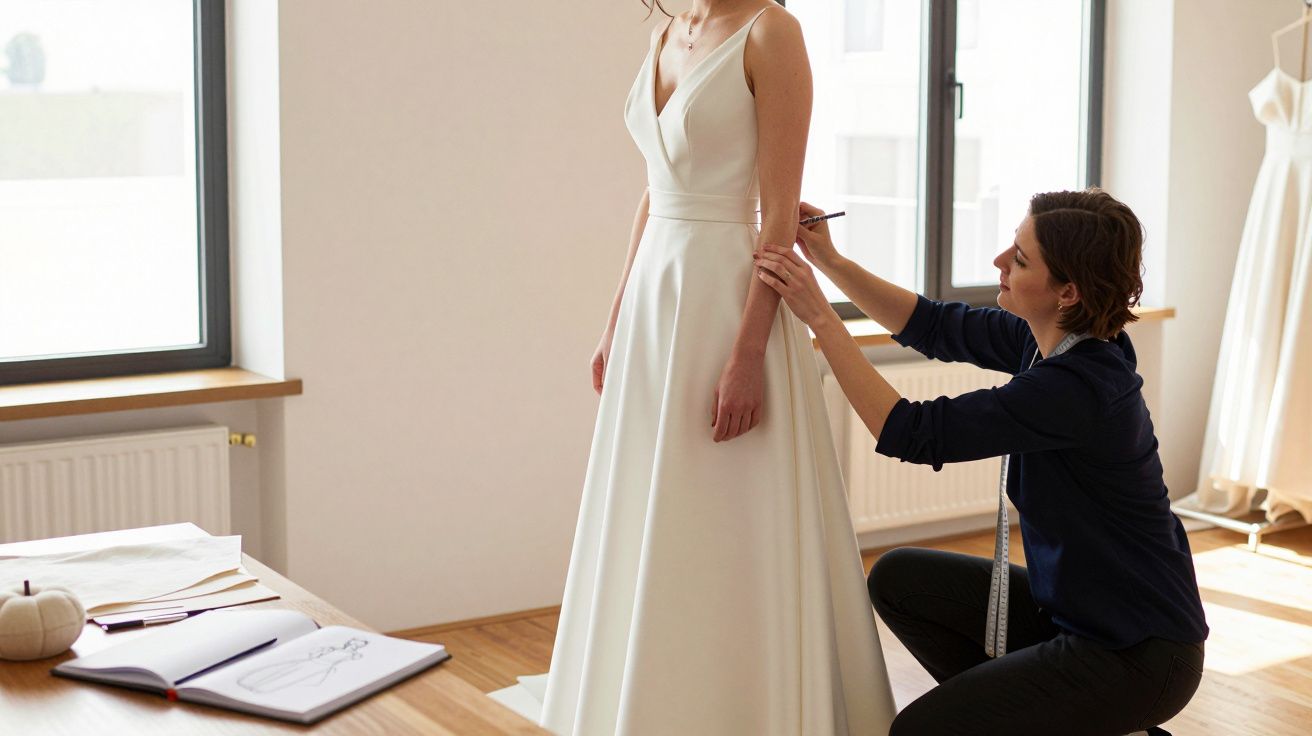
A bridal appointment can feel deceptively similar everywhere: a rail of gowns, a pedestal, a fitter with pins. Yet couture wedding dresses live or die by a fit philosophy that treats your body as the starting pattern, not a set of measurements to “make work”. It matters because the difference shows up later-when you sit, breathe, hug, and move through a long day without thinking about your dress.
I watched a bride ask the question that changed the whole room. Not “Can you take it in?” or “How many fittings do I get?” but something quieter, sharper. The atelier didn’t rush to reassure her. They asked her to walk.
The fitting question that tells you what you’re buying
Ask this, early-ideally before you fall in love with lace:
“Are you fitting me to the dress, or building the dress to my posture and movement?”
Custom often means a dress in your size, adjusted to your measurements. Couture means the dress is drafted and refined around how you carry those measurements-shoulder pitch, ribcage shape, hip rotation, where you naturally hold tension, how you stand when you’re relaxed rather than posed.
When a house answers well, they don’t just say “both”. They explain where they start and how they decide what to change.
The quiet logic behind couture fit philosophy
A body isn’t a static set of numbers. It’s a pattern of habits: one shoulder slightly forward, a pelvis that tilts, a foot that turns out, a breath that lifts the sternum. Good fit accounts for that, so the gown doesn’t fight you all day.
Couture wedding dresses tend to treat the first fitting like a diagnostic, not a confirmation. They’re checking balance lines: does the side seam hang straight when you drop your shoulders? Does the waist stay at the waist when you inhale? Does the bodice stay anchored when you raise your arms?
Custom, even very good custom, can still rely on the base block and “correction” thinking: alter here, shave there, shorten, take in. It can look perfect on the stand and feel busy on the body.
What you should see in the first fitting (and what you shouldn’t)
In a couture-leaning fitting, you’ll notice the room doing less selling and more observing. The fitter will look at you from angles you didn’t know mattered, then mark changes that aren’t about tightness so much as hang.
Look for these tells:
- They ask you to walk, sit, lift your arms, and turn-without the “bridal pose”.
- They talk about posture, balance, and distribution, not just inches and centimetres.
- They pin along structural points (neckline, armhole, waist stay), not only side seams.
- They adjust the internal architecture: boning placement, waist tapes, support layers.
Things that should make you pause:
- “It will drop once it’s finished” said too early and too often.
- Most changes suggested are simply taking in or letting out, with little mention of posture.
- You’re told to “stand up straight” as the solution to gaping, pulling, or shifting.
- The dress feels secure only when you hold your breath.
Let’s be honest: almost any gown can be made to look right for a photo. The question is whether it still behaves after three hours, two hugs, and dinner.
Couture vs custom: the practical differences that show up later
The distinction isn’t snobbery; it’s workflow.
Couture is built around iterative refinement: toile (mock-up) work, pattern adjustment, and multiple rounds of testing the garment on you. Custom is often built around efficient personalisation: a chosen style, sized close, then altered for fit and length.
Here’s how that difference usually lands in real life:
| What you feel on the day | More typical of couture | More typical of custom |
|---|---|---|
| Bodice stability | Anchored without constant readjustment | Secure, but can shift with movement |
| Comfort over hours | Pressure distributed, less “pinch point” | Comfort varies; tight areas may emerge |
| Movement (arms, sitting) | Designed into pattern and structure | Often solved with last-stage alterations |
A quick script you can use in the appointment
If you want to sound like someone who understands fit philosophy-without sounding difficult-use simple prompts. Then listen for specifics, not reassurance.
- “Where will you add support: inside the bodice, or by tightening the outer layer?”
- “If the neckline gapes when I move, what’s your first fix: reshape the armhole, or take in the side seam?”
- “Will there be a toile, or a test fitting to confirm posture and balance before final fabric is committed?”
- “How do you handle asymmetry-do you pattern for it, or pad it out?”
A strong atelier will answer calmly, and often show you. A weak one will default to vague promises, or steer you back to how pretty it is on the stand.
Common pitfalls (and the small fixes that prevent them)
Most bridal fit problems aren’t dramatic. They’re small, cumulative annoyances that you only notice once you stop posing.
- A bodice that rides up: often a balance issue, not a size issue. Look for waist stays and internal anchoring.
- Wrinkles that point to the bust or hip: can signal the pattern wants a different angle, not more taking in.
- Straps that dig in by the evening: support is missing elsewhere, so straps become the load-bearer.
- “It feels fine unless I sit”: the skirt-to-bodice relationship needs checking; sometimes the waistline is fighting your natural bend.
The best fittings treat these as information. The worst treat them as you being fussy.
When “custom” is absolutely the right choice
Not everyone needs couture processes to get a brilliant result. Custom can be perfect when the base style already suits your body and you’re working with a skilled alterations specialist.
Custom is often the smarter route if:
- You have a firm budget and want predictable timelines.
- You’ve found a silhouette that already sits correctly at the neckline and armhole.
- You’re comfortable with minor compromises in movement for a specific look.
- You need flexibility for weight changes and prefer adjustability (corsetry, lacing, adaptable seams).
The point isn’t to “upgrade”. It’s to buy the level of engineering your day requires.
FAQ:
- Is couture always more comfortable than custom? Not automatically. Couture tends to aim for comfort through structure and balance, but a poorly executed couture build can still feel restrictive. Judge by how the bodice behaves when you move.
- Do I need a toile for a good fit? Not always, but it’s a strong sign of couture-style thinking, especially for complex bodices or unusual proportions. A toile reduces surprises in the final fabric.
- What’s the biggest red flag in a fitting? Being told posture is the fix for a garment problem. A good fitter may guide posture for assessment, but the dress should ultimately accommodate your natural stance and breathing.
- Can alterations make a standard gown feel couture? They can improve it dramatically-adding internal support, reshaping necklines, correcting balance-but there are limits if the original pattern and structure aren’t designed for your movement.



Comments
No comments yet. Be the first to comment!
Leave a Comment