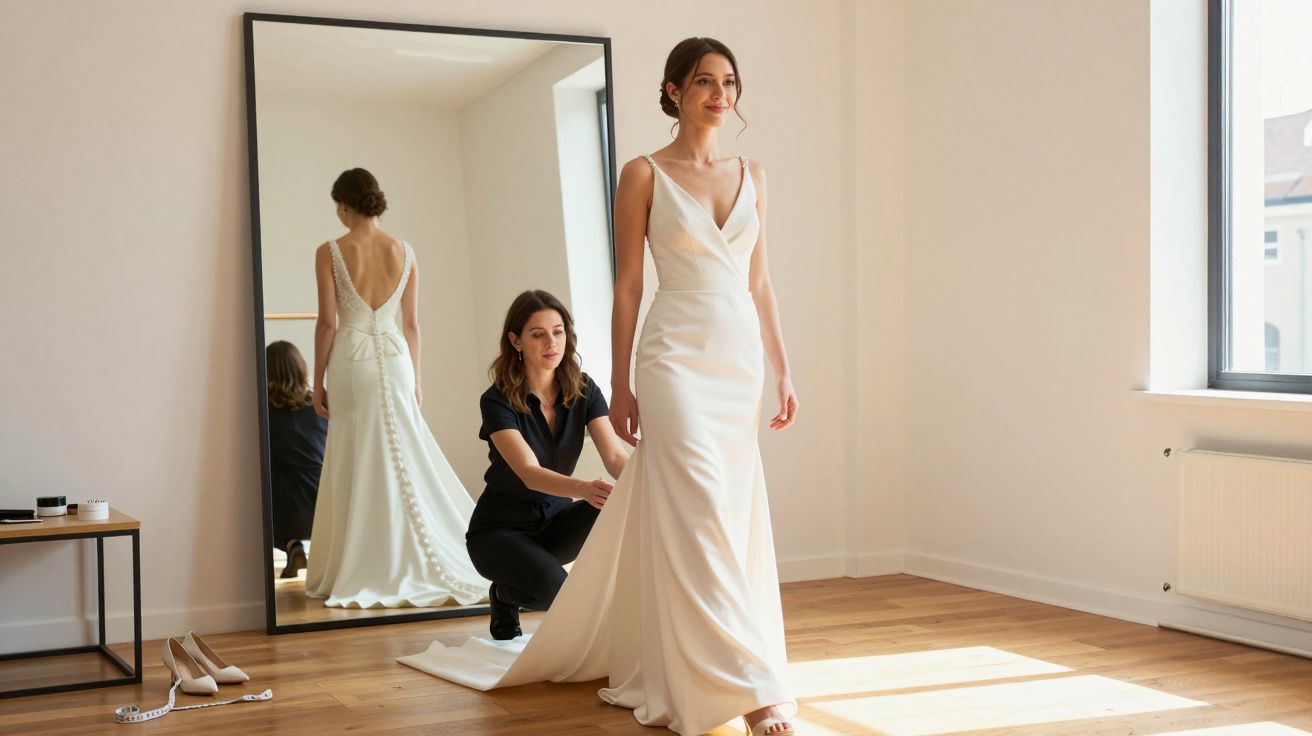
Brides rarely expect bridal dress alterations to affect their headspace, but they often do - especially when the goal is movement confidence rather than a “perfect” photo. The shift usually arrives during a fitting, in a shop mirror, when a dress that looked beautiful on a hanger suddenly feels safe to walk in. It’s not about vanity; it’s about whether you can move like yourself when every eye is on you.
One seamstress will ask you to do something that feels oddly practical for a wedding: take three normal steps, turn, and sit down. If you can’t do those without gripping the skirt or holding your breath, your confidence on the day will leak away in tiny, exhausting ways.
The one alteration that changes everything: a bustle that’s built for walking
Most people think of a bustle as a way to “get the train off the floor for the reception”. The difference-maker is a bustle designed for stride, balance and weight distribution - not just for lifting fabric.
A well-planned bustle changes how the dress behaves from the waist down. It pulls the train into a position that keeps the hem from hooking your heel, stops the skirt from dragging backward, and lets your hips move without feeling like you’re towing something.
A bustle isn’t just a fastening. Done properly, it’s a walking system.
In fittings, you’ll see the shift immediately. Brides who were shuffling start taking longer steps. Shoulders drop. The face changes, because the brain stops running risk-calculations about tripping.
What “walking confidence” actually depends on
The confidence isn’t magic. It’s mechanics. The moment a dress stops interfering with basic movement, your posture and pacing return.
A bustle that supports movement confidence tends to fix four common problems at once:
- Heel-catch: the train slides under the shoe at the worst possible moment (often mid-aisle).
- Back-drag: fabric pulls backwards, shortening your stride and tipping you slightly forward.
- Side-sway: weight sits unevenly, so turns feel clumsy and wide.
- Hand occupation: you keep one hand glued to the skirt, so you can’t relax, wave, hold flowers, or take someone’s arm naturally.
The practical test is simple: if you can walk at your normal pace without thinking about the dress, the alteration is doing its job.
The bustle options - and why “prettiest” isn’t always best
There are several bustle styles, and the names get thrown around casually. What matters is not the label but how it behaves when you walk.
| Bustle type | Best for | Watch-outs |
|---|---|---|
| American (over-bustle) | Lighter trains, simpler skirts | Can sit high and bounce if not supported well |
| French (under-bustle) | Fuller skirts, smoother silhouette | Needs strong attachment points to avoid sagging |
| Ballroom bustle | Very long/heavy trains | Can feel bulky; requires careful hem control |
A seamstress who prioritises movement confidence will often blend techniques: more than one pickup point, a hidden support, sometimes an extra tie that stops the train “swinging” with each step. Brides often hear “It’ll be fine” - but the better phrase is “Let’s make you forget it’s there.”
What changes in the fitting: a quick scene most brides recognise
It’s usually the second fitting. You’ve got your shoes on. You’re trying to picture the aisle, but you’re mostly watching the floor.
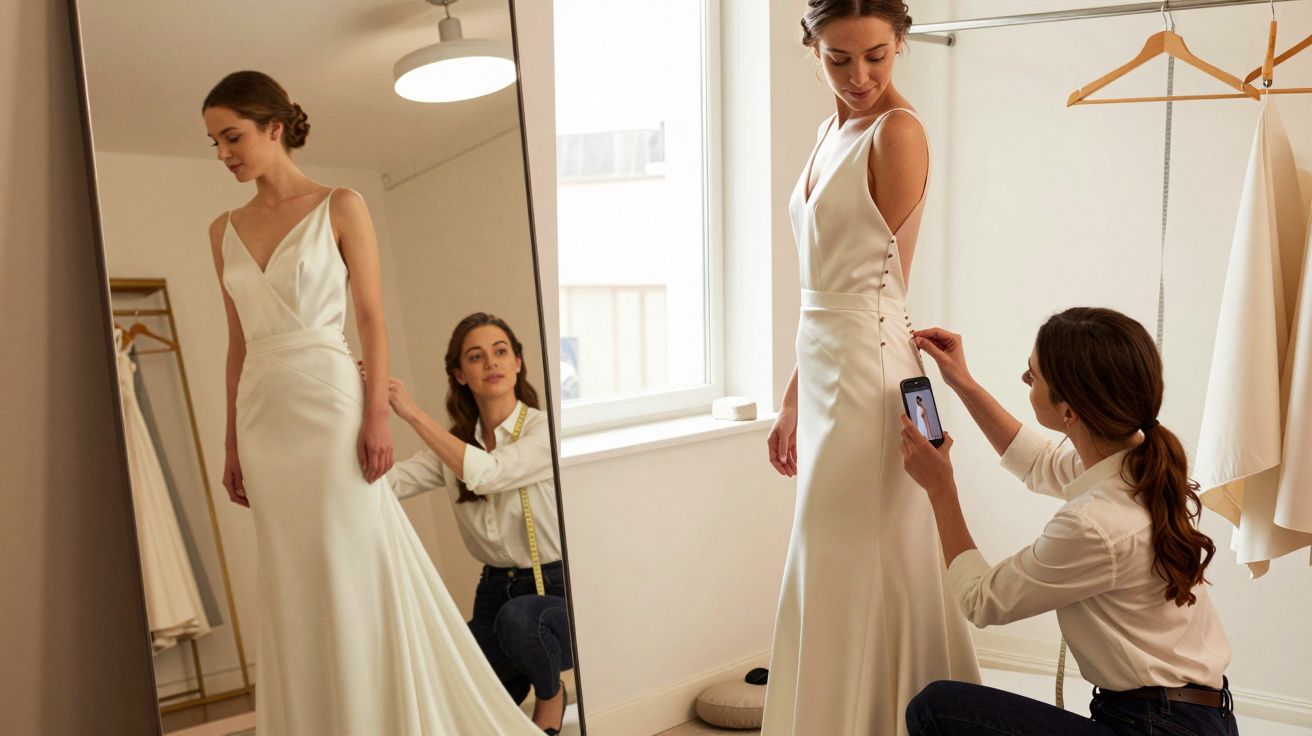
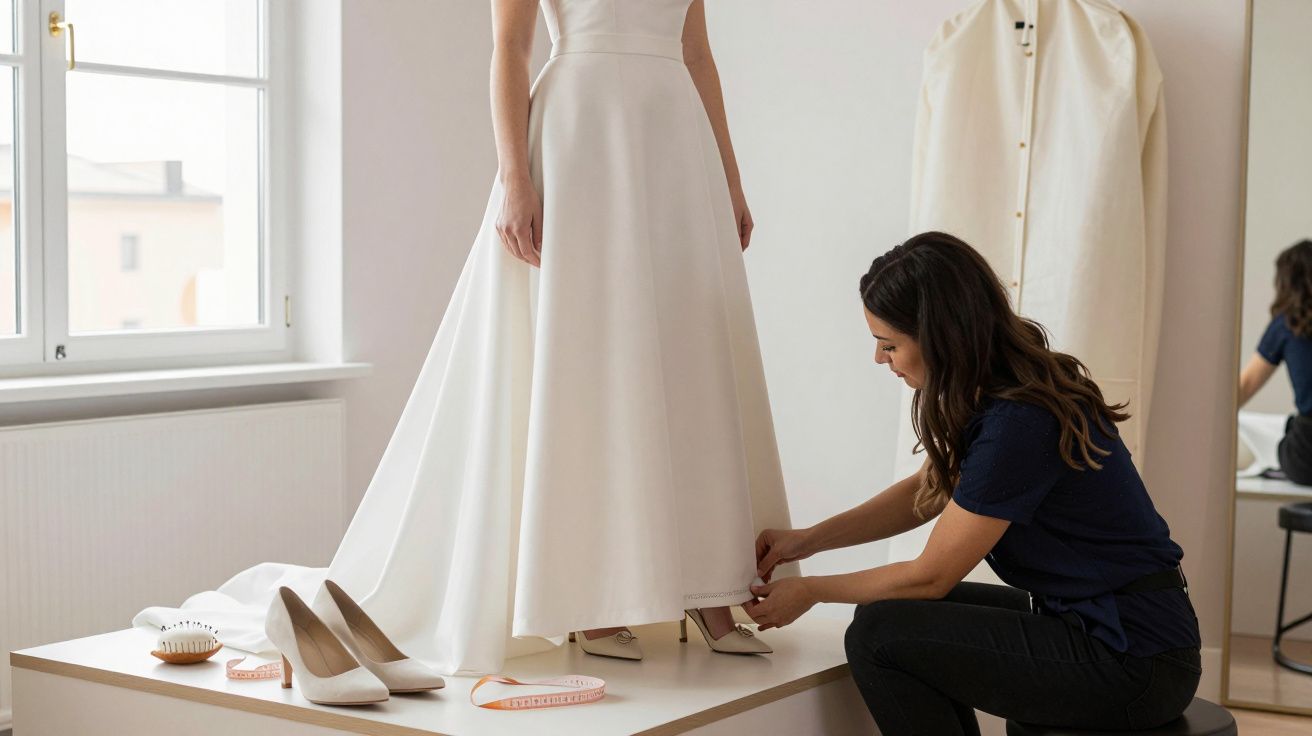
You take a few steps and the back of the dress tugs. You shorten your stride. Your hands go out automatically, like you’re on a bus that’s braking. Then the seamstress pins the bustle points, lifts the train into place, and asks you to walk again.
Suddenly your feet land normally. You can turn without the skirt lagging behind you. You stop staring down, and you start looking ahead - which is what everyone will remember.
How to ask for the right thing (and avoid the common “pretty but impractical” bustle)
A bustle can look lovely and still fail you the minute you move. The trick is to request a bustle tested in motion, not just pinned for a photo.
Bring these prompts to your alterations appointment:
- “Can we do a walking test with the bustle up - steps, turn, and sitting?”
- “Will this bustle keep the hem off my heels, even when I walk faster?”
- “Where is the weight sitting when the train is lifted - does it pull at the waist?”
- “Can you add a wrist loop as a backup for tight spaces and stairs?”
- “How many bustle points will I have, and can someone learn it quickly?”
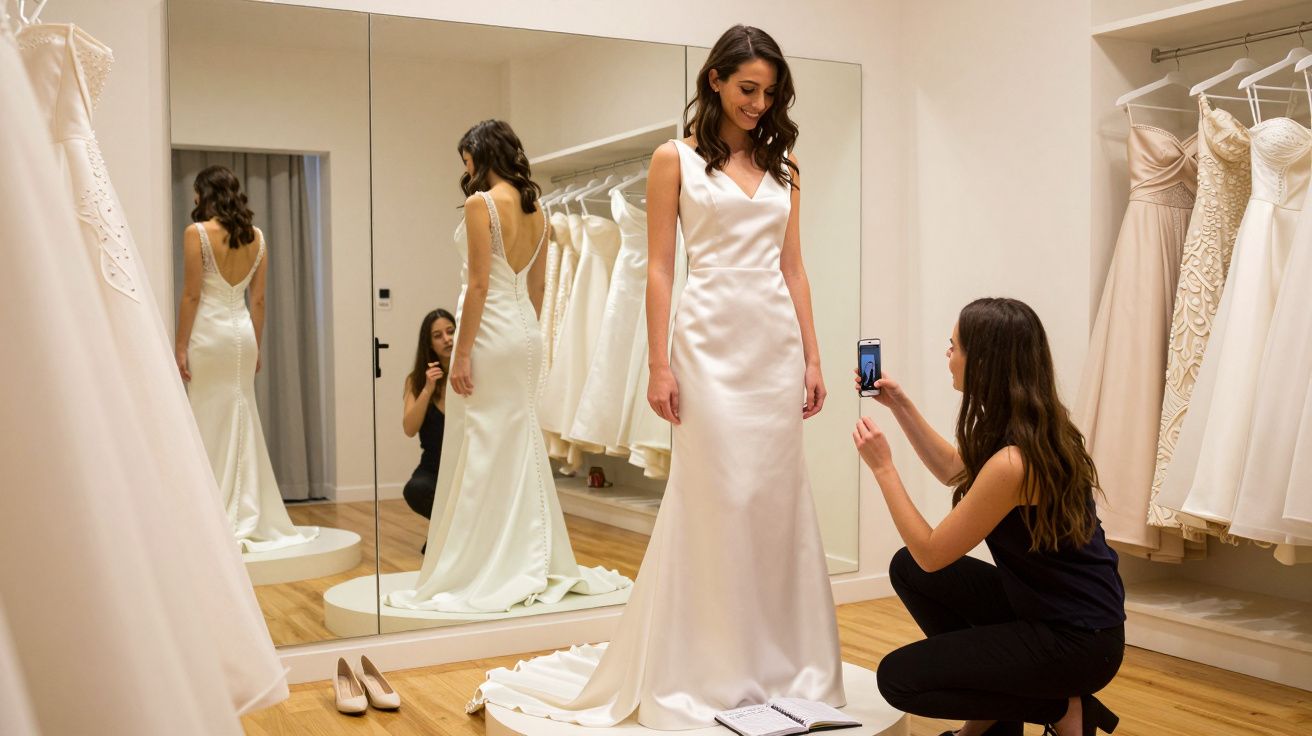
If you can, bring the person who will bustle you on the day. Most bustle stress comes from confusion, not fabric.
A simple checklist for the day itself
Once the bustle is done, make sure you know how it behaves in real wedding conditions:
- Walk on carpet and a hard floor (both feel different).
- Try it with your bouquet in one hand.
- Take a step sideways, like you might for photos.
- Practise one set of stairs, even if your venue is “mostly flat”.
If your bustle only works when you move carefully, it will fail when you’re laughing, greeting people, or rushing to the loo.
The quiet confidence payoff
Brides often describe the result as relief, but it shows up as confidence. You stop thinking “Don’t trip” and start thinking “I’m here.” You can take someone’s arm without bracing. You can walk to music without counting your steps.
That’s why this one alteration matters. Bridal dress alterations are at their best when they disappear - when movement confidence becomes the default, and you get to feel present rather than managed by your own clothing.
FAQ:
- Do I always need a bustle? If your dress has a train and you plan to walk, dance, or mingle, a bustle is usually the simplest way to prevent heel-catch and dragging. Very short trains or tea-length dresses may not need one.
- How many bustle points is “normal”? It depends on fabric weight and train length. Light trains may need 1–3 points; heavier or longer trains often need more to distribute weight and stop swinging.
- Can a bustle be added without changing how the dress looks in photos? Yes. A good bustle can be designed to sit neatly, keep lines clean, and still prioritise walking comfort. Ask to see it from the side and back in motion, not just standing still.
- Who should learn to bustle it on the day? Ideally one specific person (plus a backup). Have them record a quick video at the fitting so it’s repeatable under time pressure.



Comments (0)
No comments yet. Be the first to comment!
Leave a Comment