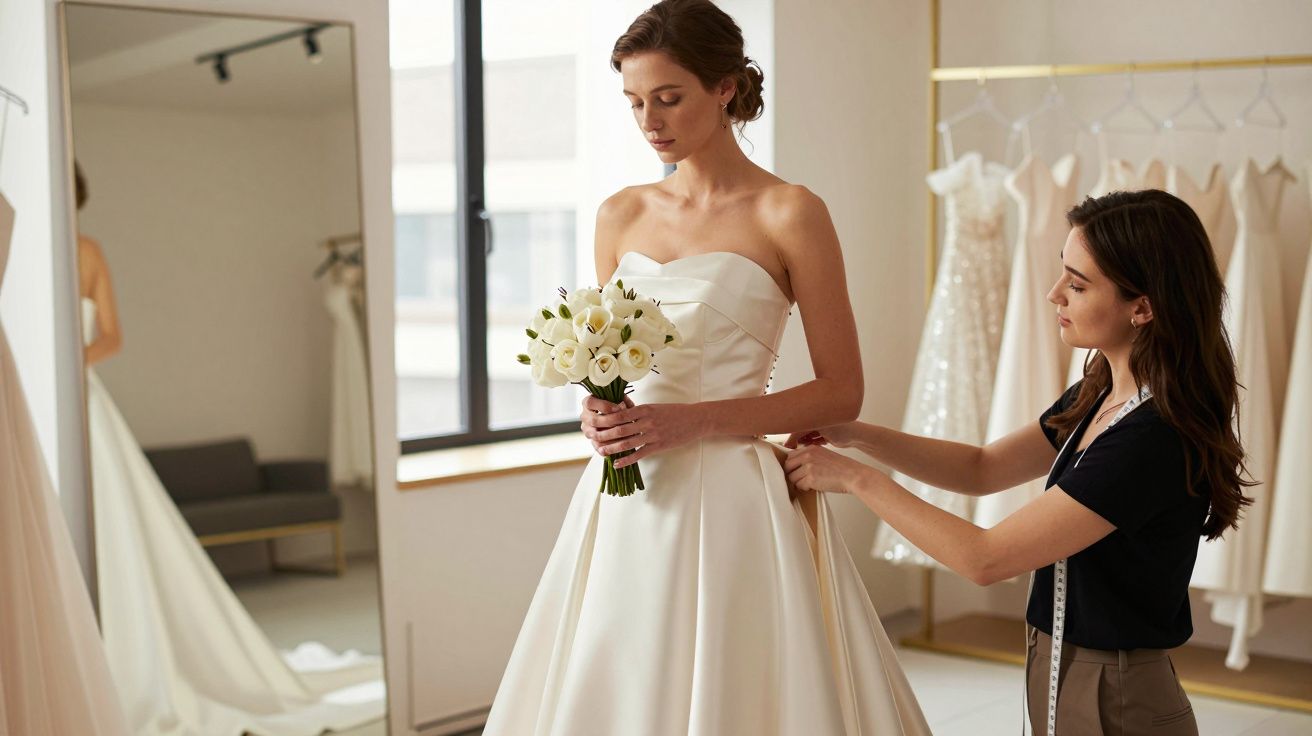
You don’t realise how much you’re bracing until you’re standing at the front, holding a bouquet, and your shoulders creep up like they’re trying to hide. In wedding dress construction, one small internal modification can change that entire feeling by giving your torso a clearer “home base” for balance control during the ceremony. It matters because posture isn’t just about photos; it affects breathing, comfort, and how steady you feel when emotions (and cameras) are pointed straight at you.
Outside the fitting room, the advice is usually about straps, shapewear, or “just relax”. Inside the dress, the real lever is often structure: where the weight sits, where it’s anchored, and whether the bodice supports you or quietly asks your muscles to do all the work.
The modification: a hidden waist stay that takes the load off your shoulders
A waist stay is an internal ribbon (often grosgrain) that sits at your natural waist and fastens snugly, like a discreet belt sewn into the bodice. It doesn’t replace the zip or buttons; it works underneath them, taking the dress’s downward pull and redirecting it to the pelvis rather than the collarbones.
When it’s done well, you feel it immediately. The dress stops “hanging” from the top edge, your ribcage has space to lift, and your arms move more freely because you’re not using your shoulders as suspension points.
The quiet surprise is what it does to stance. Once the weight is centred, you stop gripping the floor with your toes, and your head stacks more naturally over your spine. That’s balance control, but achieved through build, not willpower.
Why posture changes when weight distribution changes
Most ceremony posture issues in gowns come from micro-compensation. If the skirt is heavy, or the bodice is firm but not anchored, your body makes tiny adjustments all day:
- shoulders tighten to stop slipping
- chest collapses slightly to “hold” the neckline
- lower back arches to counter a forward-pulling skirt
- knees lock to feel stable during long still moments
A waist stay interrupts that chain. It gives the body a stable reference point at the waist, so the upper body can soften without the dress shifting. It’s less “stand up straight” and more “the dress stops asking you to brace”.
How it’s built (and why it’s not just a ribbon)
In wedding dress construction, the difference between a helpful waist stay and an annoying one is placement, fastening, and integration.
A solid version usually includes:
- Grosgrain ribbon (firm, doesn’t stretch much)
- Anchoring stitches into seam allowances or the internal bodice structure (boning channels, inner corset, or reinforced lining)
- A secure closure (hooks and bars are common; some use lingerie-style hooks)
- Clean positioning at the true waist, not the high waist or hips unless the dress is designed that way
The best stays feel snug but not restrictive. You should be able to inhale fully. If you can’t, it won’t improve posture; it will just relocate discomfort.
Who benefits most (and who needs a different fix)
This modification shines when the gown has weight, height, or slippage potential-think fuller skirts, heavier fabrics, beading, or strapless and off-the-shoulder necklines. It’s also useful for people who feel “pulled down” by the dress after an hour, even if it fits perfectly at the start of the day.
It’s not always the right answer, though. If your bodice is twisting, collapsing, or gaping, that’s usually a pattern/fit issue: boning placement, cup shaping, or uneven tension in seams. A waist stay can help stability, but it can’t correct a bodice that’s fundamentally fighting your body.
A good alteration conversation sounds like evidence, not vibes:
- “The neckline feels secure, but the weight drags after 20 minutes.”
- “I keep lifting the bodice with my arms.”
- “I feel stable walking, but standing still I start to sway.”
Those are classic signs the load isn’t anchored where your body wants it.
A simple at-home check before you ask for it
Before your next fitting, do a two-minute test in the gown (or sample) with your usual shoes.
- Stand still, bouquet-height hands, and take three slow breaths. Notice if your shoulders rise.
- Relax your arms and gently turn your head left and right. Notice if the bodice shifts.
- Shift weight from one foot to the other. Notice if you grip with toes or lock knees to feel steady.
- Lift the skirt slightly with one hand, then let it drop. Notice whether the bodice follows the weight.
If the dress “tugs” your upper body when the skirt settles, you’re a prime candidate for an internal anchoring solution.
What to ask your seamstress (in plain language)
You don’t need technical vocabulary. You need clarity about outcome and comfort.
- Ask for an internal waist stay that “holds the dress at my waist so it doesn’t hang from the neckline”.
- Ask where it will attach (inner corset, lining, seam allowances) and how it will fasten.
- Ask to try it sitting and breathing before anything is final.
- If your dress is strapless, ask whether the stay will work with (or replace) any existing inner corset.
A good maker will also warn you about what it can’t do. That’s a green flag.
Common mistakes that sabotage the effect
The modification is small, but the details matter.
- Too high: it rides up and feels like it’s cutting the ribs, making posture worse.
- Too loose: it does nothing; the dress still drags.
- Attached to weak fabric: it pulls the lining instead of supporting the gown.
- Fastening placed awkwardly: it digs in when you sit or twists during walking.
If you feel a constant urge to adjust, the stay isn’t doing its job. The goal is that you forget it’s there-because your body stops negotiating with the dress.
A small structural change, a calmer version of you
There’s a particular kind of ease that shows up when your gown is properly anchored. You stop “performing posture” and start inhabiting it. Your chest opens because it can, your shoulders drop because they’re no longer working, and standing still becomes something you can do without effort.
On the day, that reads as confidence. In the body, it reads as stability. And it begins with a hidden piece of wedding dress construction doing what good structure always does: quietly carrying the weight, so you don’t have to.
| Sign you need it | What it usually means | Likely benefit |
|---|---|---|
| You keep lifting the bodice | Dress is hanging from the top edge | Weight transfers to waist |
| Shoulders creep up in photos | You’re bracing for stability | Neckline feels calmer |
| You sway when standing still | Centre of mass feels “floating” | Better balance control |
FAQ:
- Will a waist stay change how the dress looks from the outside? Not usually. It’s internal, and the visible closure still does the aesthetic work; the stay just carries the load underneath.
- Is it only for strapless gowns? No. It’s common in strapless styles, but it can help any dress where weight or movement makes the bodice shift.
- Will it feel tight during dinner? It shouldn’t. A well-fitted stay allows full breathing and sitting; if it digs in, the placement or tension needs adjusting.
- Can it be added late in alterations? Often yes, as long as there’s stable internal structure to anchor it to. Ask at your next fitting and plan at least one re-try-on after it’s installed.


Comments (0)
No comments yet. Be the first to comment!
Leave a Comment