You can spend months choosing a gown and still be surprised by what people remember afterwards. Bridal dress details land differently because a wedding is a high-emotion day, and guests’ visual memory tends to cling to a handful of crisp, repeatable images: the first look, the walk down the aisle, the hug you gave your mum, the twirl on the dance floor.
Most guests aren’t analysing construction or couture references. They’re collecting snapshots, and the details that read clearly from a few metres away - or in a phone photo - are the ones that stick.
The moment guests “clock” your dress
There are three points when people really register the dress: when you appear (entrance), when you move (aisle, stairs, dancing), and when you’re close enough for texture (greetings, table photos). If a detail performs in all three, it becomes part of the story people tell later: “The back was incredible,” or “Her sleeves looked like something from a painting.”
It’s worth planning your dress like it’s going to be seen in motion, in mixed lighting, and from slightly imperfect angles. Because it will be.
The top bridal dress details guests always notice
1) The neckline and what it does to your face
Guests look at your face first, but the neckline frames it like a picture frame you chose on purpose. A sweetheart neckline reads romantic; a square neckline reads clean and modern; an off-the-shoulder line often feels instantly “bridal” even on a simple fabric.
If you’re on the fence, try this: take two quick mirror selfies from chest-up in different necklines and don’t overthink it. You’ll usually see which one makes your shoulders sit better and your expression look more relaxed.
2) The fabric finish (because it catches light before it shows detail)
Satin announces itself under chandeliers. Crepe photographs like quiet confidence. Mikado holds shape and looks expensive even when it’s minimal. Lace is the opposite: it’s detail-rich, but from a distance it reads as a soft pattern unless the motif is bold.
Guests may not know the fabric name, but they’ll remember the effect: “It glowed,” “It looked so sleek,” “It had that matte, elegant thing.”
3) The waistline and the “line” of the dress
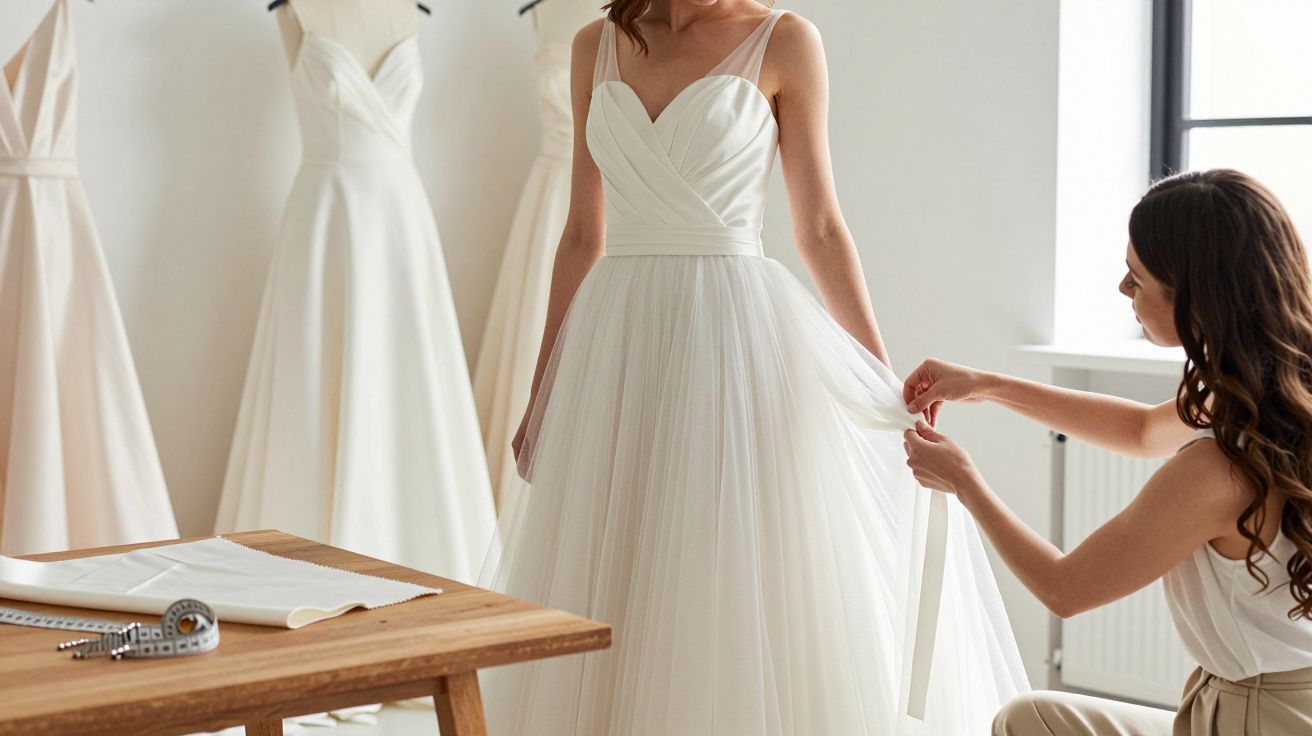
People notice proportion faster than embellishment. A defined waist gives that classic bridal silhouette; a dropped waist feels fashion-forward; an empire line can look ethereal and gentle, especially in outdoor light.
This is also where comfort shows. If you’re constantly tugging or holding your breath, guests won’t think “poor fit” - they’ll just sense you’re not fully at ease in your own skin.
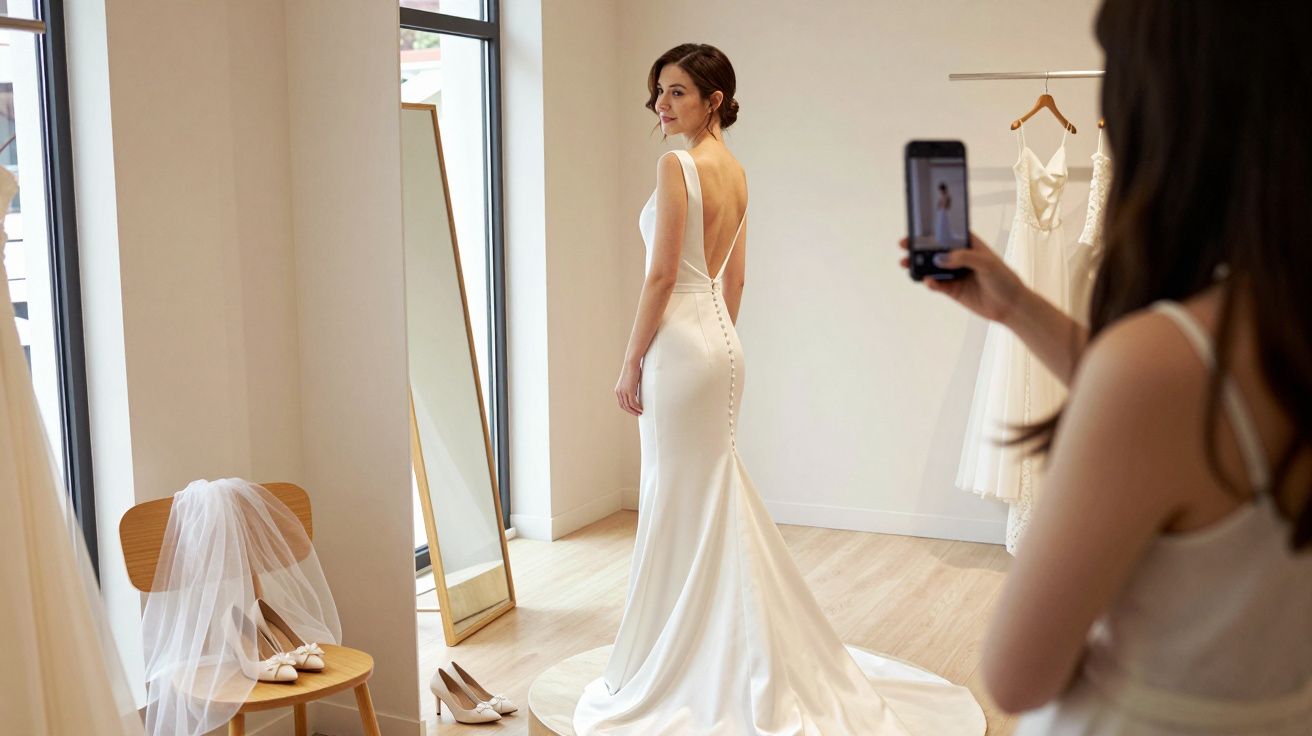
4) The back of the dress (because you spend half the day facing away)
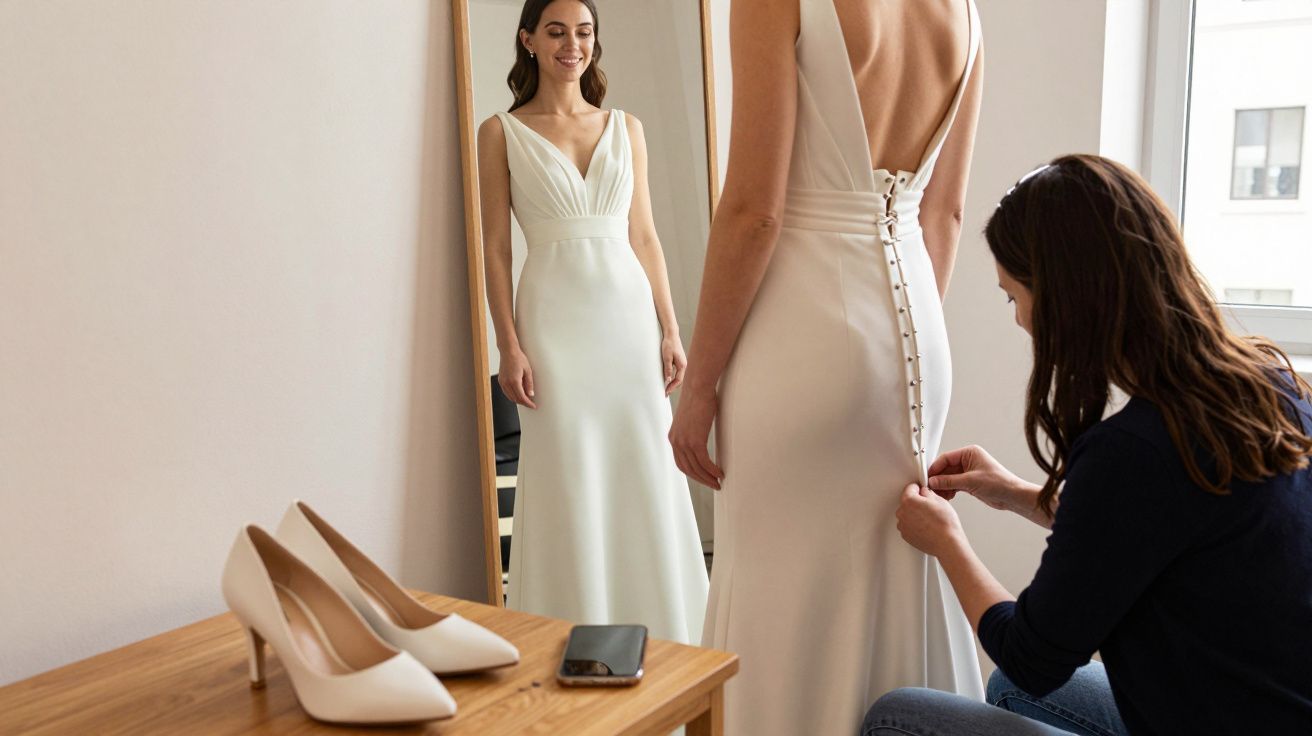
The aisle view is mostly your back. So are many candid photos: hugging, chatting, leaning in, signing the register. A low back, illusion back, button row, or sculpted corset lacing reads dramatically without needing sparkle.
A simple rule that works: if your dress is quiet from the front, consider giving the back a “moment”. If the front is already detailed, keep the back clean so it doesn’t fight for attention.
5) Sleeves that move (or don’t)
Sleeves are instantly noticeable because they change the outline of your whole upper body. Puffy sleeves read playful and editorial; fitted lace sleeves read timeless; detachable sleeves read “two looks” without a full change.
What guests notice most is the practical side: can you hug people easily, lift a glass, dance, and raise your arms without the sleeve riding up or twisting? The sleeve that behaves becomes invisible in the best way.
6) Texture details: lace motifs, beading, pearls, appliqué
Up close, this is the detail guests touch with their eyes. The key is clarity: one strong motif or a consistent texture photographs better than lots of tiny, scattered elements that can turn into visual noise.
If you love sparkle, check it under both daylight and warm indoor light. Some beading looks luminous in the evening and slightly busy at noon; others do the opposite.
7) The train (and how you manage it)
A train is pure ceremony: it changes your pace, your posture, your presence. Guests notice length, yes, but they notice management more: a good bustle, a smooth flip over the arm, a bridesmaid who knows what she’s doing.
If you’re having an aisle moment, practise walking and turning with the train once before the day. It’s the difference between “floating” and “fighting the fabric”.
8) The hemline in photos (especially if you’re outdoors)
On grass, hems pick up moisture and dirt. On steps, they catch. In group photos, an uneven hemline is one of the first things the camera reveals, even if no one said a word in real time.
This isn’t about perfection; it’s about avoiding distractions. Get the length set for the shoes you’ll wear most, and if you’re changing into trainers later, accept that it’s for dancing - not for portraits.
A quick way to choose details that will actually read on the day
Think of your dress as having three “read distances”:
- Across the room: silhouette, neckline, sleeves, train.
- At arm’s length: fabric finish, lace pattern, buttons, corsetry.
- In photos: contrast, shine level, clean lines, back detail.
Pick one hero detail that reads across the room, one that rewards close-up, and let the rest support it. That’s usually when the dress feels memorable without feeling fussy.
The common mistake: adding detail where guests won’t see it
It’s tempting to pour budget into intricate work that only shows in perfect studio lighting. If you love it, that’s enough - but if your goal is “guests will notice”, prioritise the areas that live in real moments: neckline, waist, back, and anything that moves.
A tiny crystal scatter on the skirt can be beautiful. But the button-back you see as you walk away? That’s the thing people describe over pudding.
Checklist: what to test before you commit
- Walk up and down stairs (or a small step) in the dress.
- Sit down, stand up, hug someone, lift your arms.
- Take one photo in daylight and one in warm indoor light.
- View yourself from behind in a mirror, not just the front.
- If there’s a train, ask to try a bustle or discuss one clearly.
That half-hour of testing saves you a whole day of adjusting.
FAQ:
- Do guests really notice the difference between satin and crepe? They usually can’t name it, but they notice the effect: satin reflects light and reads more “glam”, crepe reads more matte and modern in photos.
- What detail is most remembered in photos? The silhouette and the back. They’re visible in group shots, aisle photos, and most candid moments.
- If I want a simple dress, how do I make it memorable? Choose one strong, clean statement: a sharp neckline, an architectural sleeve, a low back, or a beautiful train, then keep everything else restrained.




Comments (0)
No comments yet. Be the first to comment!
Leave a Comment