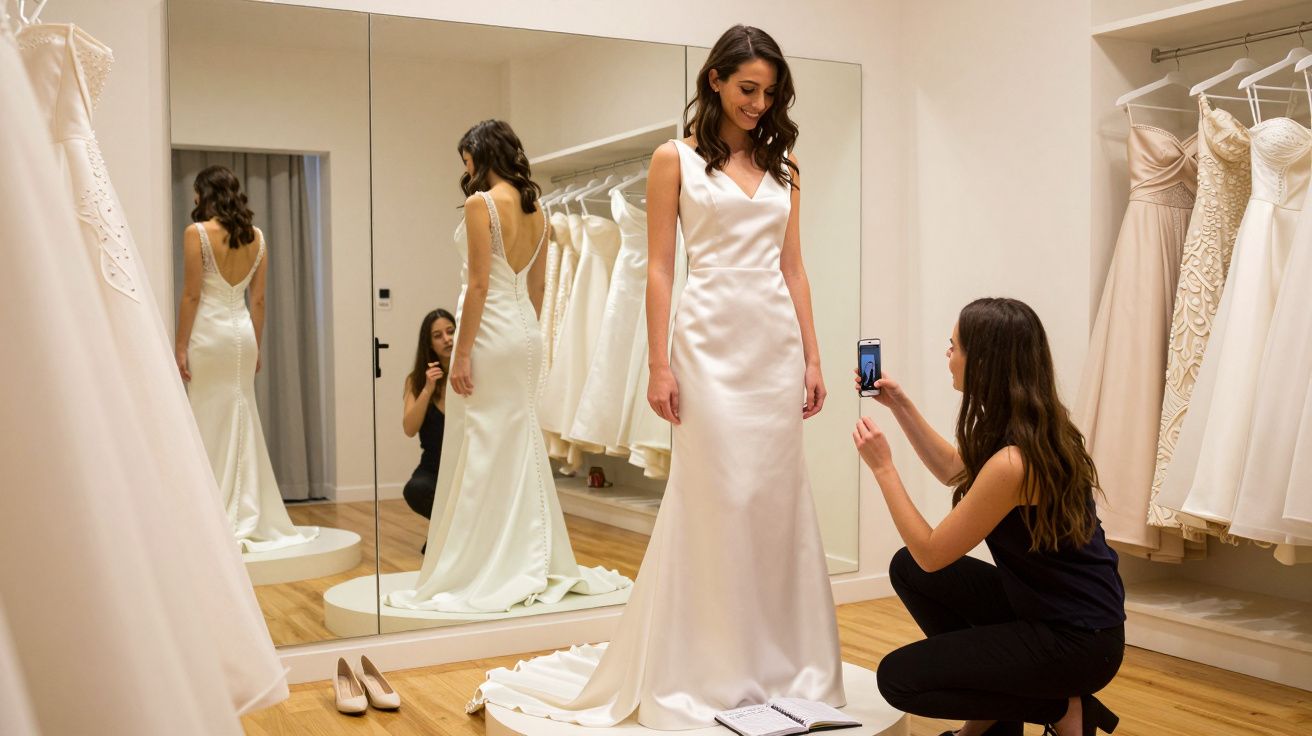
It usually happens under bright shop lights, with your hair clipped up and a seamstress kneeling at your hem: the wedding dress fitting is technically perfect, but your chest tightens anyway. Emotional comfort is the part nobody pins in place, yet it decides whether you walk down the aisle feeling like yourself or like you’re borrowing someone else’s life. If you’re confused by the mismatch-right size, wrong feeling-there’s nothing “ungrateful” about that. It’s data.
I’ve watched brides turn slowly on a little platform, the satin behaving, the bodice sitting flat, the straps not budging. Friends nod, phones come up, someone says, “That’s it.” And the bride smiles with her mouth only, the way you do when you don’t want to ruin the room.
Sometimes the dress doesn’t feel wrong in an obvious way. It feels quietly wrong-like a shoe that technically fits but makes you think about your feet all day.
What a “perfect fit” can miss
Fit is measurable: bust, waist, hip, hem, balance, strain lines, whether you can sit without the zip pleading for mercy. The problem is that a wedding dress can hit every measurement and still miss the wearer, because bodies aren’t mannequins and weddings aren’t photo shoots. A fit can be clean and still feel like armour.
The most common mismatch isn’t size. It’s sensation and identity: the neckline that makes you self-conscious when you hug people, the fabric that scratches where you didn’t know you were sensitive, the sleeves that look romantic but make you move like you’re trying not to knock over a candle. Under pressure, those tiny irritations become all you can hear.
There’s also the context nobody tries on properly. You don’t just stand in a wedding dress. You sit in it, eat in it, sweat in it, dance in it, go to the loo in it, and get photographed from angles you can’t control. A gown that fits your body may not fit your day.
The “pin-and-spin” illusion: why fittings can lie
A fitting room is a controlled environment. The mirrors are flattering, the lighting is kind (or at least consistent), and there’s a team holding your reality together with clips and optimism. The dress is often pinned to a future version of you: altered, steamed, strapped, taped, and paired with shoes you haven’t actually worn for six hours.
It’s also a performance, even when everyone is lovely. You want to be easy. You want to be decisive. You want to feel the milestone the way you think you should. Let’s be honest: nobody walks into a fitting feeling completely neutral.
A seamstress can remove wrinkles. She can’t remove dread. When the garment fits but your nervous system doesn’t settle, that’s not vanity; that’s information your body is giving you in the only language it has.
“If you keep adjusting the dress and you still can’t breathe, it might not be the dress that needs adjusting.”
A quick diagnostic: is it discomfort, or is it misalignment?
Before you assume you need a whole new gown, separate the fixable from the fundamental. Here’s a small, practical checklist you can run in ten minutes, preferably when you’re alone with a mirror and not trying to manage everyone else’s feelings.
- Physical sensation: Is anything scratching, digging, slipping, or restricting your breath? If yes, that’s alteration territory.
- Movement test: Can you sit, lift your arms, hug someone, and take a full step up a stair? If you avoid movements, you’ll avoid moments.
- Heat and weight: Does the fabric feel heavy in a way that makes you tired rather than supported?
- Self-recognition: When you look at yourself, do you think “that’s me” or “that’s a bride costume”?
- Silence vs relief: When you imagine changing into something else, do you feel guilty-or relieved?
If most of your answers are about sensation and movement, you can usually solve it. If most of your answers are about identity and relief, listen closely.
The Comfort Reset: small changes that restore emotional comfort
Start with the cheapest, least dramatic adjustments first-the ones that change how you feel without rewriting the whole plan. Think of it as teaching the dress to work with your body, not against it.
1) Adjust contact points, not the whole silhouette
Underarms, neckline edges, waist seams, strap placement: these are where comfort is won or lost. A millimetre shift at the shoulder can change your posture; a softer lining at the armhole can stop you thinking about your skin every time you move.
2) Treat support like architecture
A bodice that “fits” may still make you feel exposed if the support is wrong. Cups, boning placement, waist stay, and strap tension should make you feel held without feeling trapped. The goal is not maximum snatch; it’s calm.
3) Try the dress with the real-life pieces
Bring the shoes you’ll actually wear. Bring the bra or shapewear you’ll actually tolerate. If you’re changing your underwear strategy every fitting, you’re fitting a moving target. Emotional comfort improves when the variables stop sliding around.
4) Practise one awkward thing on purpose
Do the hug. Do the sit. Do the bathroom plan (even if it’s just a dry run with a friend and laughter). Confidence isn’t a mood; it’s evidence.
When it’s not the dress: the pressure around it
Sometimes the gown feels wrong because it’s carrying other people’s expectations like hidden weights. A dress chosen to keep the peace can fit beautifully and still feel like a compromise you’ll be photographed in for decades. A dress chosen too early-before you knew the venue, the season, or your own boundaries-can feel like a decision made by a past version of you.
And sometimes you are simply overstimulated. Wedding planning turns preference into identity, and every choice starts to feel like a referendum on your taste, your body, your family, your future. In that state, even a perfect dress can feel like too much.
If you suspect that’s the case, try this: imagine the same gown on a normal Saturday, in normal lighting, with no audience. If your body softens, it’s probably stress. If it still feels like a costume, it’s probably not your dress.
The decision that saves you: alter, accessorise, or walk away
There isn’t a morally correct outcome here. There’s only the outcome that lets you show up as yourself.
- Alter if the issue is contact, movement, support, or small proportion tweaks.
- Accessorise if the dress feels close-but-not-you: different neckline styling with a topper, a softer veil, a bolder shoe, a different bouquet scale. Sometimes “wrong” is just “unfinished.”
- Walk away if you feel dread, disconnection, or ongoing relief fantasies-even after realistic fixes. Sunk costs are loud, but your wedding day is louder.
A fitting is meant to make the dress conform to you. If you’re the one contorting-physically or emotionally-take that seriously. The point isn’t to look like a bride. It’s to feel like yourself, in public, on a day that will already ask a lot of your nervous system.
| Point clé | Détail | Intérêt pour le lecteur |
|---|---|---|
| Fit vs feeling | Measurements can be perfect while the body still resists | Stops you blaming your body for a valid reaction |
| Comfort reset | Focus on contact points, support, and real-life testing | Fixes many “wrong” feelings without a new dress |
| Clear choices | Alter, accessorise, or walk away based on symptoms | Reduces spiralling and decision fatigue |
FAQ:
- How do I know if it’s just nerves? If the discomfort fades when you’re alone, well-rested, and not performing for anyone, it may be stress. If the “wrong” feeling is consistent across fittings and you keep imagining escaping the dress, it’s likely misalignment.
- Can a seamstress fix a dress that feels emotionally off? She can often fix the physical triggers that create emotional discomfort-scratching, slipping, pressure, exposure. But she can’t turn a style that isn’t you into a style that is.
- What should I bring to a wedding dress fitting to test properly? Your real shoes (or same heel height), the underwear/shapewear you’ll actually wear, and one trusted person who won’t audition for director.
- Is it wasteful to change your mind after alterations start? It can cost money, yes, but it isn’t “wasteful” to prioritise feeling steady on an important day. Make the next decision with clarity rather than guilt.
- What’s one simple sign the dress is right? You stop monitoring yourself. Your shoulders drop, you move normally, and your attention shifts from the dress to the moment.






Comments (0)
No comments yet. Be the first to comment!
Leave a Comment