
Most people see a dress and judge the fabric, the neckline, the hem. In the workroom, couture tailoring is the part that makes those visible choices behave, so the original design intent survives a real body, real movement, and real light. It matters because the difference between “pretty on a hanger” and “right on a person” is usually hidden in seam allowances, canvas, and millimetres.
A sketch can promise ease, authority, softness, or drama. The tailoring is where that promise gets tested, adjusted, and finally proven.
Why the design doesn’t read until it’s tailored
A toile can show proportion, but it can’t fully show weight and collapse. Once you introduce the actual cloth, gravity joins the conversation: a bias panel drops, a shoulder line creeps, a waist seam starts to torque. Tailoring is how you steer those forces back toward what the designer meant.
Fit is not the same as shape. Fit is “it closes and you can breathe”. Shape is what the garment communicates from three paces away. A dress can fit and still look wrong if the internal structure is absent or misplaced.
A garment can’t express design intent if the architecture under the fabric is guessing.
The quiet toolkit that makes the silhouette honest
Couture is famous for handwork, but the real signature is control. Control comes from a small set of decisions repeated patiently: where to support, where to release, where to let the cloth speak.
Structure that doesn’t announce itself
Good support is often invisible from the outside. The goal isn’t stiffness; it’s a predictable fall that holds from morning to night.
- Canvas and underlining to stabilise areas that must stay clean (bodice fronts, waist, lap-like necklines).
- Boning and inner corselets to carry weight without relying on straps or a tight outer shell.
- Stay tape and selvedge strips to stop necklines and waist seams from stretching out of character.
- Hem weights and strategic interfacing to make a skirt hang as designed, not as the fabric feels like today.
A common mistake is adding structure everywhere. Overbuilt dresses lose their point: they look “done to” rather than designed.
Seams as steering, not just joining
In couture, seams are levers. Move one by 3–5 mm and the whole front can look calmer, longer, sharper, or more sensual, depending on the brief.
- Princess lines can be shifted to visually narrow or broaden a torso.
- Darts can be rotated to change where fullness reads, without changing the size.
- Side seams can be balanced so the dress doesn’t twist when the wearer walks.
That’s why a fitting isn’t only about comfort. It’s about whether the silhouette still tells the same story from every angle.
The fitting process that reveals what the sketch couldn’t
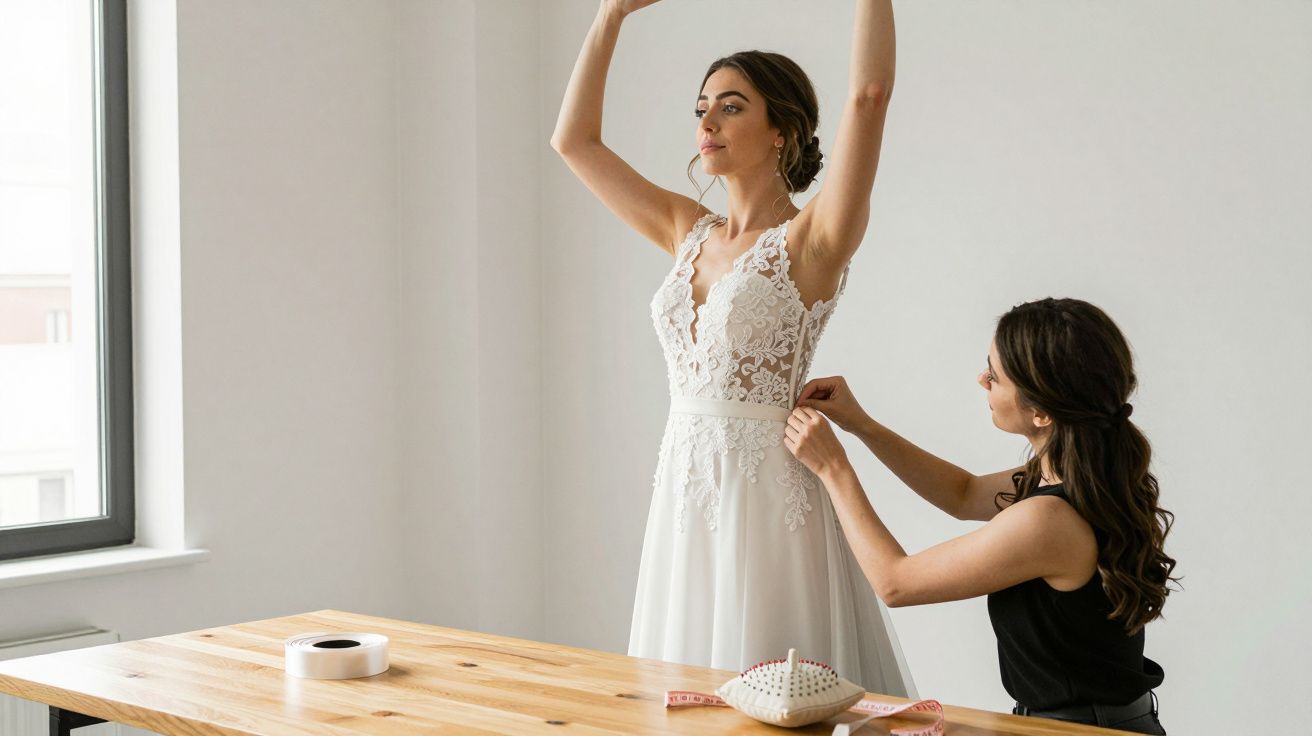
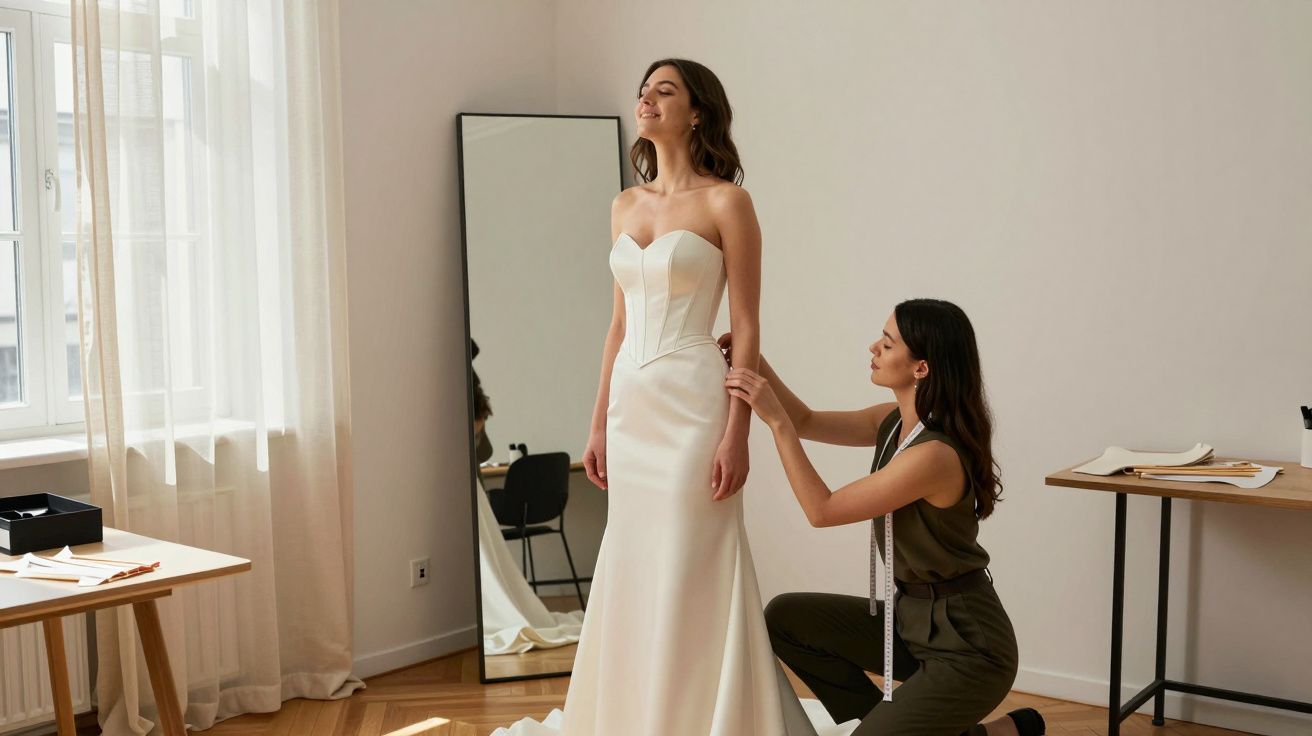
There’s a rhythm to couture fittings: observe, pin, mark, unpick, rebuild. The pace looks slow, but it prevents the fast errors that show up later as puckers, drag lines, and a neckline that won’t sit.
What a tailor reads at the first fitting
The garment gives signals immediately. A wrinkled diagonal line is a sentence: it says where the tension is coming from and where it wants to go.
Look for these tells:
- Horizontal pulls across the bust: not always “too small”; often missing support or incorrect dart apex placement.
- Back waist ripples: imbalance between front and back length, not a “posture problem”.
- Neckline gaping: stretch, grain issues, or insufficient stay, especially on curves and bias.
- Skirt twisting: grain drift, uneven seam allowances, or an internal layer fighting the outer.
A skilled tailor treats these as information, not flaws. The question is always: what adjustment best protects the design intent?
Second fitting: where the dress becomes itself
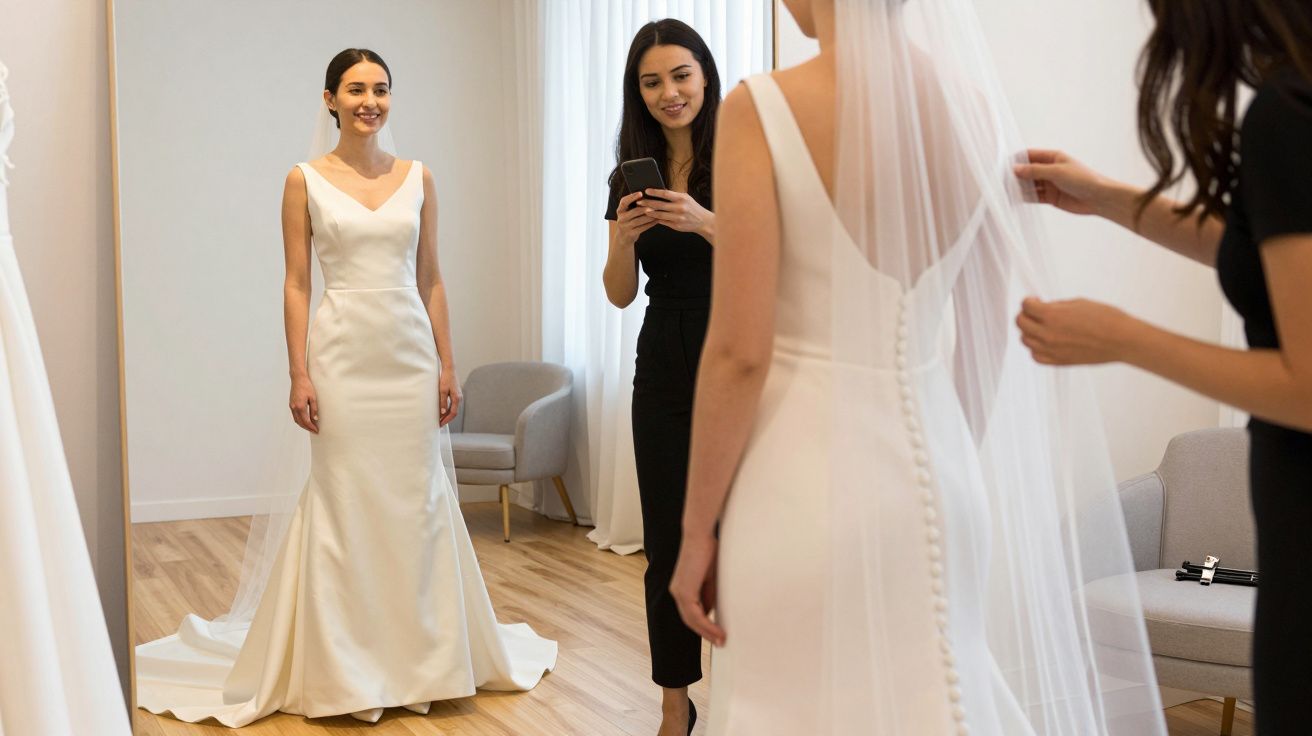
After corrections, the dress starts behaving. The wearer can move, sit, lift arms, and the garment returns to its line. This is also where finishing choices stop being decorative and start being structural: the placement of hooks, the tension of a waist stay, the softness of a facing edge.
The moment a dress “clicks” is usually the moment its internal work finally matches its exterior idea.
Three common places tailoring changes the entire look
The shoulder line
Shoulders decide authority. If the shoulder seam sits back, the front collapses; if it sits forward, the back rides up. A tiny shift can make the neckline look refined instead of fussy and can stop the bodice from creeping.
The waist and the anchoring
Many dresses fail because the waist has no anchor. A waist stay or inner belt can hold the garment in place so the outer fabric can drape cleanly, rather than clinging and sliding with every step.
The hem and the hang
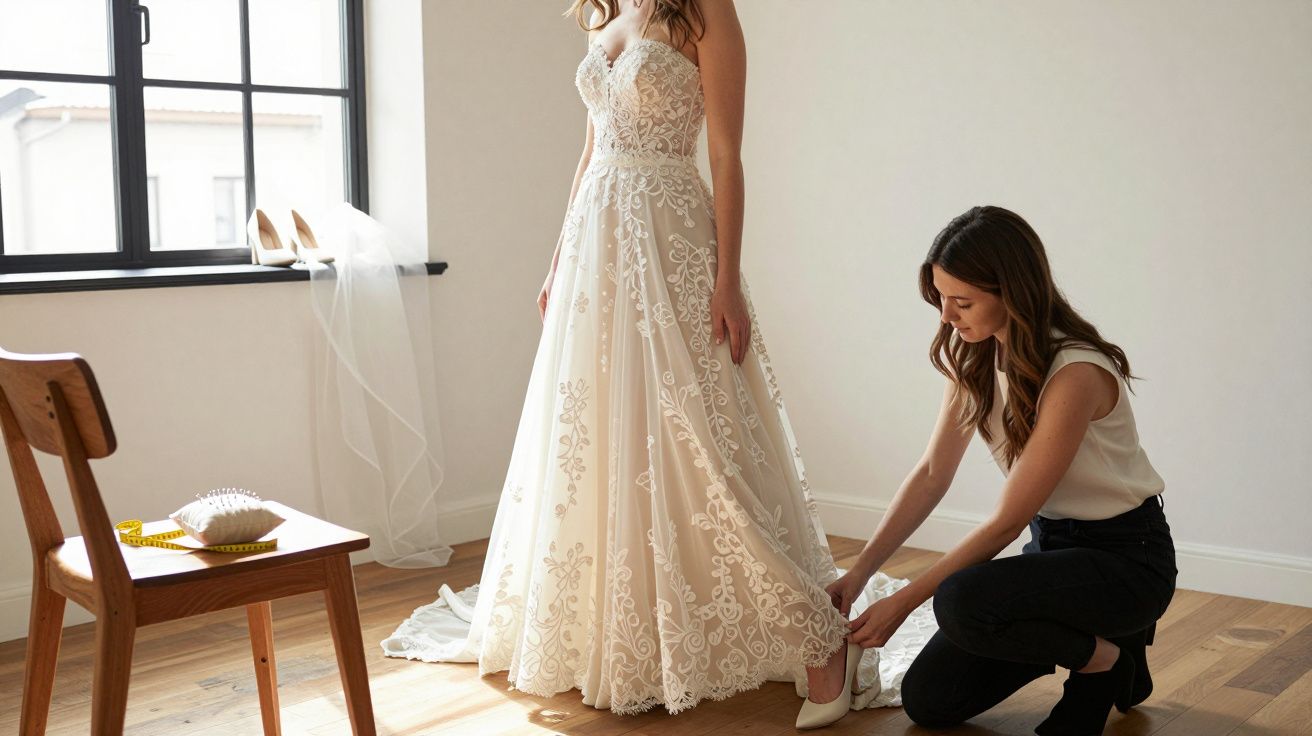
A hem is not “one length all around” on a living body. Couture hems are levelled on the wearer, then weighted and finished to keep that level during motion. This is where a skirt becomes elegant rather than merely long.
A quick checklist when you’re judging workmanship
You don’t need to see inside a dress to ask the right questions. Whether you’re commissioning, buying vintage, or assessing alterations, focus on the points that protect the silhouette.
- Does the neckline stay put when the wearer walks and turns?
- Do seams hang vertically, or do they spiral?
- Is there a clean transition over the bust and hip, without strain lines?
- Does the dress return to shape after sitting down?
- Do closures feel supportive (hooks, tapes, stays), not just functional (a zip that hopes for the best)?
If the answer is “mostly”, the tailoring is doing its job. If the answer is “only when standing still”, the design is still fighting physics.
The point: tailoring is where meaning becomes visible
Fashion language is built from line, proportion, and movement. Couture tailoring is the translation layer that turns an idea into a dependable shape, so the dress reads the way it was meant to read, not the way fabric happens to fall. When it’s done well, you don’t notice the work-you just see the design, clearly, on a real person.


Comments (0)
No comments yet. Be the first to comment!
Leave a Comment