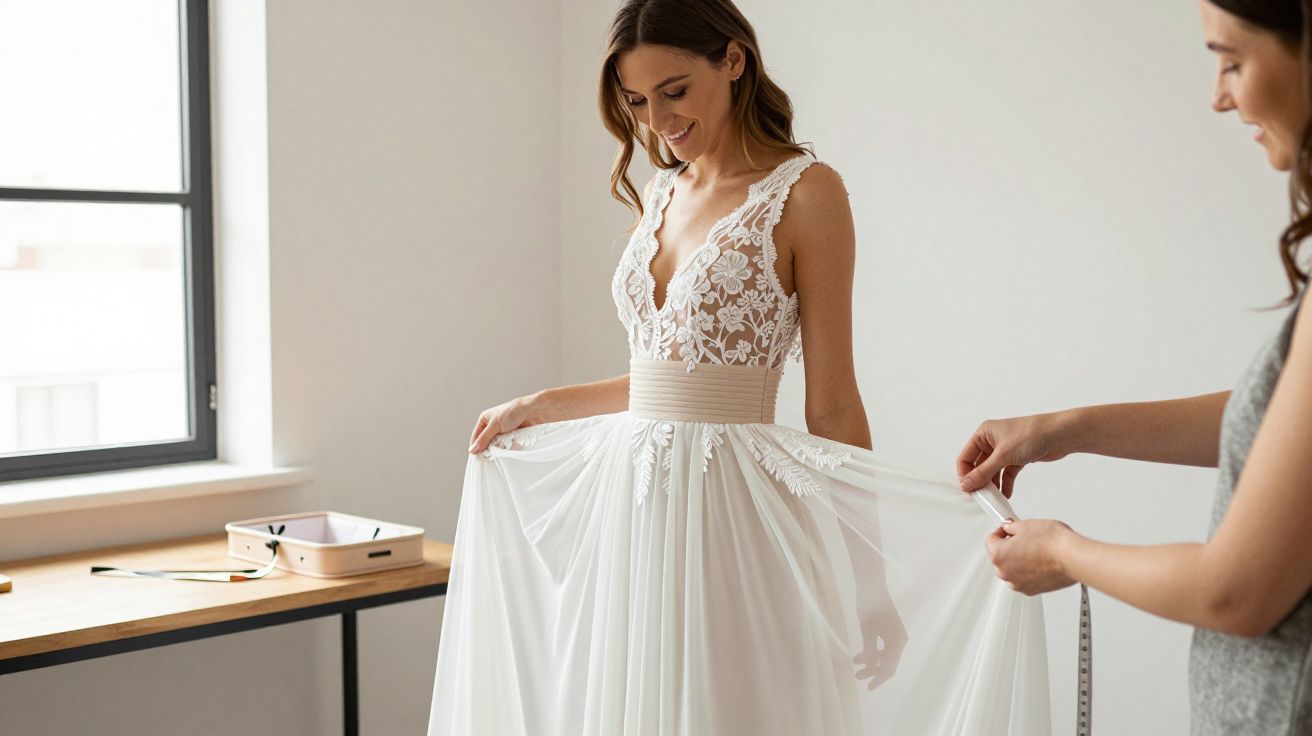
Boho wedding dresses often arrive on a rail looking like the easiest thing in the room: soft chiffon, relaxed lace, a skirt that moves when you breathe. But that effortless look is usually built on hidden structure-quiet engineering that stops “floaty” becoming “floppy” the moment you walk, hug, sit, dance, or hit a gust of British weather. If you’re choosing a dress for a long day with photographs at every angle, understanding that unseen work can save you from a silhouette that collapses by the first canapé.
There’s a particular kind of surprise brides have in fittings: the dress looks simple on the hanger, then a seamstress starts pinning, and suddenly the inside resembles a small architecture project. Nobody sells the romance of boning channels and stay tape, yet that’s often what makes “boho” read as intentional rather than unfinished.
The myth of “natural drape”
We’ve all seen it online: a model in a field, hair loose, gown skimming the body like it’s barely there. It’s easy to assume the fabric is doing all the work, that the dress is just a pretty layer you slip on and forget about.
In real life, fabric is bossy. Chiffon clings when it’s humid, lace stretches where you don’t want it, and a bias-cut skirt can grow longer during the day like it’s quietly changing its mind. A truly wearable boho gown anticipates all of that, then hides the solutions so you still get the unstudied look.
Let’s be honest: nobody wants to feel “corseted” at a barefoot wedding theme. But you also don’t want to spend your ceremony pulling up a neckline that’s drifting south.
What “hidden structure” actually means in a boho dress
Hidden structure isn’t one thing; it’s a toolkit. The point is to support the dress without making it look supported.
Here’s what that can include, tucked between lining layers and seam allowances:
- Internal corsetry or bust support: light boning, foam cups, or an inner bodice that takes the weight off delicate lace.
- Waist stay (grosgrain ribbon): a firm ribbon inside that anchors the dress at your waist so the outer layers don’t creep.
- Underlining: a supportive fabric layer behind lace or tulle so the outer layer doesn’t bag out over time.
- Stabilising tape: sewn into necklines, shoulder seams, and waist seams to stop stretch and rippling.
- Strategic seam placement: extra seams disguised as style lines so the dress can be shaped without looking “tailored”.
A designer might call it “soft structure”. A seamstress might call it “the bit that stops this dress misbehaving”.
“If it looks like it’s just floating, that’s usually because something underneath is holding it steady.”
Why boho styles need more tailoring than you’d think
The paradox is that the looser and more “carefree” the aesthetic, the more precision you need to stop it reading as sloppy. Minimalist satins show every bump; boho lace shows every collapse.
Common boho design choices create specific technical problems:
- Low backs look gorgeous, but remove the place you’d normally anchor support. That often means an internal bodice that sits higher than the back appears to.
- Sheer bodices can’t show bulky construction, so support must be thinner, cleaner, and perfectly finished.
- Flutter sleeves and off-shoulder straps are prone to sliding unless the bodice fit is immaculate and stabilised.
- Soft skirts (chiffon, georgette) reveal uneven hemming and can drop on the bias after hanging.
This is why two dresses can look similar on Pinterest, yet one feels secure and photographs beautifully while the other looks tired by the speeches.
The fitting room moment: where the “effortless” look is engineered
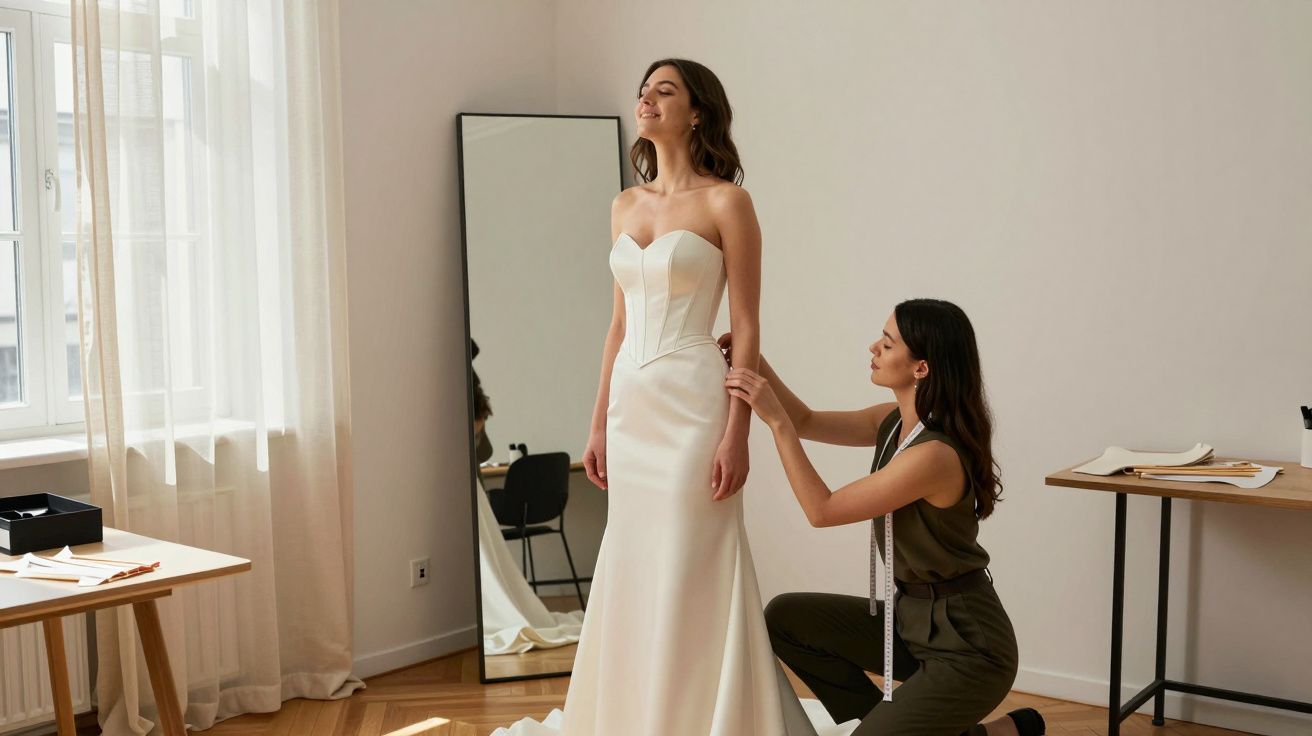
If you’ve ever stood on a plinth while someone pins your side seams, you’ll know the emotional whiplash: you came for a vibe, and you’re getting geometry. But fittings are where the boho illusion is protected.
A good bridal fitter is usually doing some version of this checklist:
- ensuring the bust is supported without tightening the whole torso;
- checking the waistline stays put when you raise your arms (hello, hugging);
- making sure lace motifs align so alterations don’t look like “repairs”;
- balancing the skirt so it hangs evenly after the dress has had time to drop.
And because boho dresses often use delicate fabrics, the work has to be cleaner. You can’t hide a bulky dart under heavy satin; you have to make the shaping disappear.
The unglamorous reason your dress costs what it costs
A lace bodice that looks like it was draped in five minutes may require hours of handwork: reapplying lace after taking in seams, invisibly blending motifs, and finishing edges so nothing scratches or catches. This is slow tailoring, not showy tailoring, which is exactly why it can be easy to underestimate.
How to spot good hidden support before you buy
You don’t need to be a seamstress to check whether a dress is secretly well-built. You just need permission to look inside.
Try these practical tells:
- Lift the skirt slightly and look for a separate lining/underlining layer (more layers often means more control).
- Feel the bodice: does it have a firm inner layer, or is it just lace and hope?
- Check the seams at the waist: is there structure, or does it ripple already on the hanger?
- Move your arms: if straps or sleeves shift dramatically in the shop, they’ll shift more on the day.
- Ask what can be altered: some delicate sheer styles have limits, and you want to know them early.
Questions that tend to get revealing answers: - “Is there an inner bodice, or is support coming from the outer layer?” - “Is there a waist stay?” - “What happens to the lace pattern if it’s taken in?”
The bigger picture: comfort, photos, and the long British day
Boho weddings often involve real movement: outdoor ceremonies, uneven ground, wind, dancing that turns into jumping, and a lot of being lifted into hugs. The hidden structure is what keeps the dress looking calm while life happens around it.
It also changes how you feel in your own skin. When the bodice is doing its job, you stop thinking about it. And that’s the whole point of the aesthetic: not “relaxed because it’s flimsy”, but relaxed because it’s reliable.
| What you see | What’s often underneath | Why it matters |
|---|---|---|
| Sheer lace bodice | Inner bodice, cups, light boning | Support without visible bulk |
| Low back | Higher internal frame, waist stay | Stops front collapsing or sliding |
| Floaty skirt | Underlining, balanced hem, weights | Movement without twisting or dropping |
A quick reality check before alterations
Alterations on boho gowns can be deceptively complex because you’re preserving softness while changing structure. If you’re budgeting, assume the labour isn’t just “take it in”; it may include lace removal and reapplication, rebuilding support, and re-heming after the dress has hung.
Small choices can reduce drama later: - book fittings early enough for the dress to hang and drop before final hemming; - wear the exact underwear and shoes you’ll use on the day (support and length depend on them); - if you’re changing the neckline or back, ask how that affects the internal support plan.
FAQ:
- Do boho dresses always have boning? Not always, but many have some form of internal support (boning, inner bodice, cups, or stabilising tape) to keep the shape stable while the outer layer stays soft.
- Will hidden structure make the dress feel tight? It shouldn’t. Good structure can actually feel more comfortable because it distributes weight and stops you constantly adjusting straps or necklines.
- Why are alterations on lace boho dresses expensive? Lace often needs to be unpicked and re-applied by hand so motifs still match and seams disappear. That time is the cost.
- How do I know if a low-back boho dress will stay up? Look for an inner bodice/waist stay and test movement in the shop: raise your arms, sit, and walk. If it shifts now, it’ll shift more later.
- Can a seamstress add more support if I need it? Often yes-cups, an inner layer, a waist stay, or discreet boning can be added-but the options depend on fabric transparency and how the dress is constructed.





Comments (0)
No comments yet. Be the first to comment!
Leave a Comment