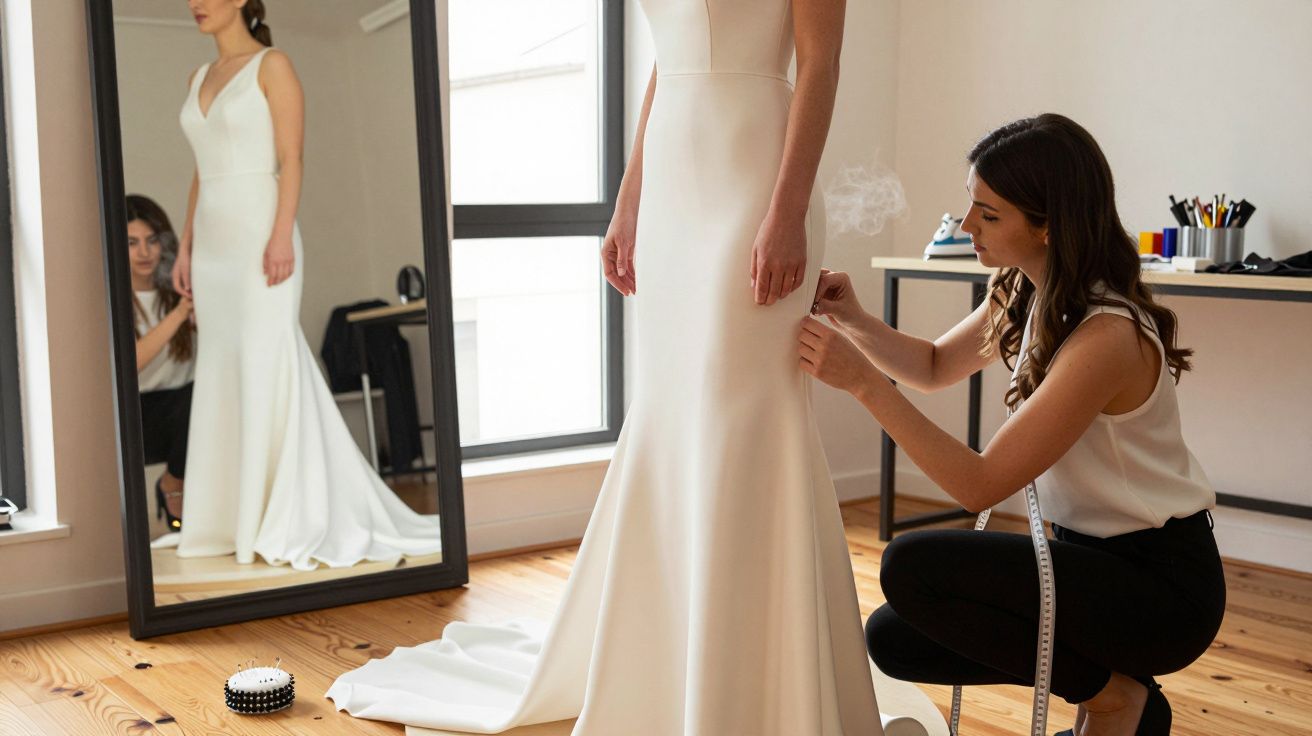
Minimalist wedding dresses look like the easy option: clean lines, no lace, no beading, no drama. But that simplicity is exactly why precision tailoring matters more here than almost anywhere else-because there’s nothing to distract the eye if the fit is even slightly off. If you’re choosing one for your ceremony, this is the bit worth understanding before you fall in love with a photo.
I’ve watched brides step into a sleek crepe column and say, “It’s just plain-surely it’s simple to alter.” Then the pinning starts. The mirror goes quiet. Suddenly everyone is talking about millimetres, grainlines, and how the fabric “falls” rather than sits.
The illusion of “simple”: when there’s nowhere to hide
On an embellished gown, your gaze bounces. Lace motifs break up the surface; sparkle pulls attention to the bodice; a textured skirt forgives a slightly imperfect seam. On a minimalist dress, the dress is the seam.
That’s why the smallest issues show up loudly:
- A dart that points a touch too high reads as a dent.
- A waist seam that’s half a centimetre off-centre looks twisted in photos.
- A hem with a tiny ripple becomes the whole story once you start walking.
It isn’t that minimalist gowns are badly made. It’s that they’re visually unforgiving, like bright daylight on a bare wall.
Fabric doesn’t “forgive” the way you think it will
Minimalist styles often use satin, crepe, silk, mikado, or heavy jersey-beautiful, but each with its own temperament. Some show every needle mark; some stretch and then don’t quite recover; some shine in a way that highlights any bump in the understructure.
A common surprise is how alteration work leaves traces. Unpicking stitches can create faint lines on satin. Pressing can change the sheen. Even re-stitching along the same path can look like a shadow, especially under flash photography.
“With minimalism, you’re not altering a dress so much as re-drawing a silhouette. The fabric remembers everything.”
The tailor isn’t just making it smaller. They’re trying to keep the surface pristine while re-engineering what’s underneath.
Seam placement becomes the design (so moving it is risky)
Many minimalist wedding dresses rely on extremely deliberate seam architecture: princess lines that lengthen the torso, a side seam that’s positioned to slim the waist, a neckline that balances shoulder width. When you change sizing, you risk changing that architecture.
Here’s the awkward truth: some alterations that are routine on other gowns can be expensive or ill-advised on a minimalist one.
- Taking in at the side seams can pull the seam forward, changing symmetry.
- Reducing a structured bodice may require rebuilding internal boning/cups.
- Lowering a back can destabilise the whole bodice if it was designed to “hang” from that point.
- Shortening straps sounds easy until it changes where the bust sits and how the neckline lies.
The dress can still be altered. It just needs a plan that respects the original geometry.
Fit is felt in motion, not just in the mirror
Minimalist gowns are often cut to skim, which means comfort and movement matter more than you’d expect. Sitting, turning, hugging, lifting your arms for the first dance-this is where a “looks fine” fitting can fail.
Common movement issues that show up later:
- The skirt climbs when you walk because the hip is too tight.
- The bodice gapes when you lift your arms because the armhole is wrong.
- The neckline shifts during the day because the dress is relying on friction, not structure.
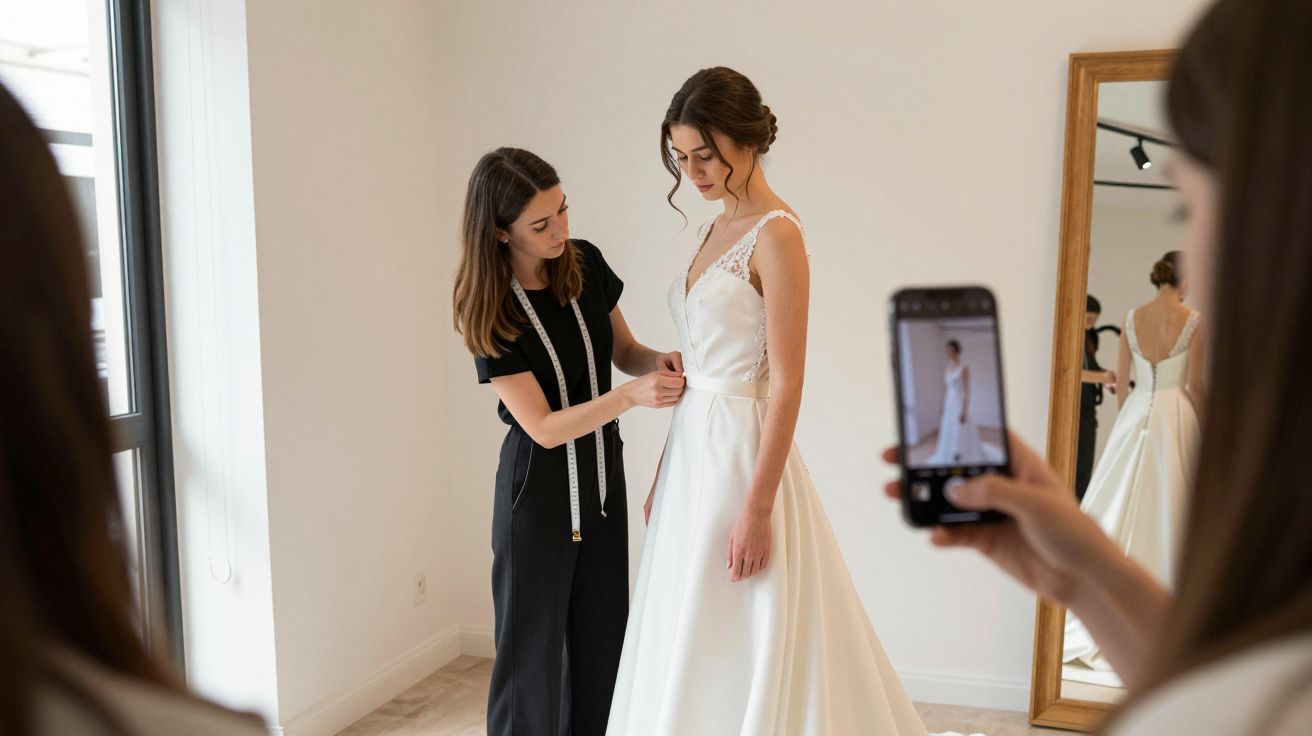
A good fitter will make you move on purpose: sit, step, breathe in deeply, raise both arms, twist at the waist. The goal isn’t stiffness; it’s stability.
What makes a tailor say, “This one needs time”
A few details tend to make minimalist alterations more complex, even when the dress looks straightforward on the hanger.
Invisible zips and clean closures
An invisible zip on thick crepe or satin needs to lie perfectly flat. If the fabric ripples, it shows; if the seam allowance is bulky, it shows; if the zip tape stretches, it shows. And once you move a zip, you often have to re-balance the entire back seam so it doesn’t torque.
Bias cuts and drapey panels
Bias-cut minimalism is glorious and also slightly wild. Fabric cut on the bias relaxes over time, which can change length and fit between fittings. Tailors often want the bride to hang the dress for a set period (sometimes days) before hemming, because hems can “drop” unevenly.
Slippery linings and internal structure
Many minimalist dresses have discreet support: waist stays, inner corsetry, cups, boning, sometimes an under-bodice you don’t notice until it’s being adjusted. Altering the outer layer without matching the internal layer leads to drag lines and puckering.
How to set yourself up for success (before the first fitting)
You don’t need to become a tailoring expert. You just need to arrive with the right expectations and a few practical decisions made early.
- Bring the shoes you’ll actually wear (or the same heel height).
- Choose your underwear/shapewear before alterations begin; changing it later changes the fit.
- Budget time for more than one fitting, especially for satin or bias cuts.
- Ask what can be done cleanly versus what can be done technically-those aren’t always the same thing.
If your dress is truly minimalist, you’re paying for quiet perfection. The work is meant to disappear.
A quick checklist: “good fit” in a minimalist gown
- The front hangs straight with no diagonal pull lines.
- The waist stays put when you lift your arms.
- The zipper area lies smooth and flat with no rippling.
- The hem looks level while you walk, not just when you stand still.
- You can sit comfortably without the skirt riding up dramatically.
| Detail you notice | What it often means | What a tailor might do |
|---|---|---|
| Diagonal lines across hips | Too tight or uneven shaping | Rebalance side seams/darts, add ease |
| Ripples by the zip | Zip tension or bulk | Reset zip, adjust seam allowance, press correctly |
| Neckline gaping | Armhole/strap balance | Recut/reshape armhole, adjust strap position |
FAQ:
- Are minimalist wedding dresses always harder to alter? Not always, but they’re less forgiving. If the fabric is shiny or the design relies on clean seams, small changes are more visible and take more care.
- How many fittings should I expect? Commonly two to three. Bias-cut dresses or tricky fabrics may need an extra appointment to let the garment settle before final hemming.
- Can a tailor fix wrinkles and drag lines completely? Often, yes-but it depends on whether the issue is sizing, posture balance, or fabric behaviour. Some lines disappear with rebalancing; others are the nature of the cloth.
- What’s the biggest mistake people make with a minimalist gown? Assuming it’s “just taking it in”. The best results come from treating it like sculpture: tiny adjustments, tested in movement, with careful pressing and finishing.




Comments (0)
No comments yet. Be the first to comment!
Leave a Comment