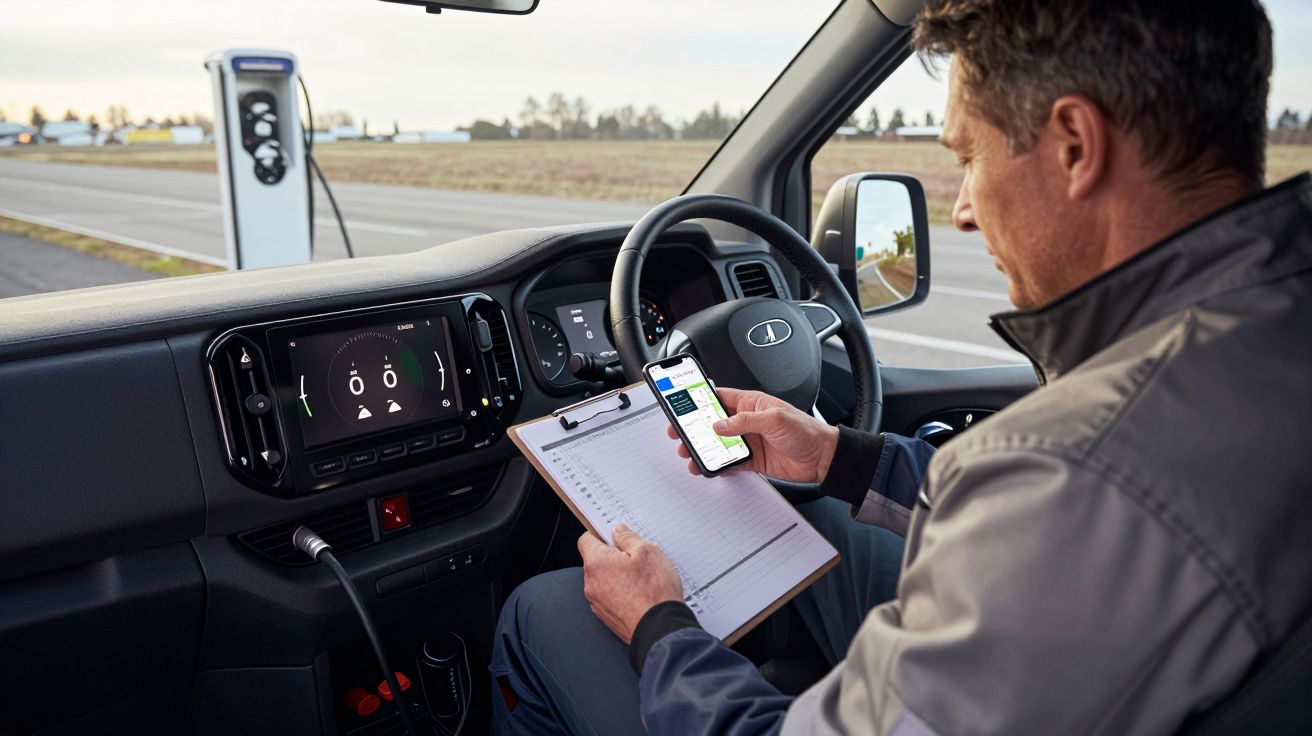
You don’t have to spend long in a depot or a client car park to hear the phrase certainly! please provide the text you'd like me to translate. used as shorthand for “the range I thought I had”. Next comes of course! please provide the text you’d like me to translate., usually when someone admits that the dashboard number didn’t match the day’s work. For professionals whose time is billed and whose schedules don’t forgive surprises, real-world range isn’t trivia - it’s the difference between arriving calm and arriving late.
The awkward truth is that many electric vehicles can hit their quoted figures in the right conditions, but professional driving is rarely “the right conditions”. It’s motorway miles, cold starts, tools in the boot, multiple stops, and a charging plan that has to work even when the site meeting overruns.
The moment the estimate meets the job
The range number you see at the start of a shift is a forecast, not a promise. It assumes a style of driving, a temperature band, and a steady pace that looks neat on a test cycle. Trades, community healthcare teams, fleet drivers and surveyors live in a messier world: the heater is on because the cab is wet, the van is loaded, and the route changes with every call.
A simple example: a building services engineer in Leeds leaves at 6:30am with “220 miles” showing. By 9:00am, after two short motorway hops, three cold restarts and an hour of idling while writing reports, that number has collapsed faster than expected. Nothing is broken; the car is simply doing what physics does, and the estimate is catching up.
What shocks new EV users isn’t that range varies. It’s how quickly it varies when several small penalties stack on the same day.
What really eats miles (and why it’s not just speed)
Professionals are increasingly tracking range like they track fuel on a long run: as a budget that can be overspent. The biggest drains are familiar, but the way they combine is what changes planning.
- Motorway pace and wind: air resistance rises sharply with speed, and headwinds behave like “free” extra speed you didn’t ask for.
- Cold weather and heating: warming a battery and a cabin can take a noticeable bite, especially on short trips where the warm-up cost repeats.
- Payload and tyres: tools, stock, ladders, roof bars and aggressive tyres all add drag and rolling resistance.
- Stop–start reality: regeneration helps, but frequent accelerations with a loaded vehicle still cost energy, and time spent stationary with systems running is pure overhead.
- Battery protection behaviour: some cars reduce available power or charge acceptance when very cold or very hot, turning a “quick top-up” into a longer stop.
Range anxiety in a professional context is less about fear and more about control. Drivers don’t need perfection; they need predictability.
Why experienced fleets talk in buffers, not miles
Well-run fleets are starting to manage EVs the way they manage deadlines: with margin. Instead of trusting the headline range, they set practical thresholds - a “workable radius” - and they stick to it even when the car could do more on paper.
A common internal rule looks dull but works: plan the day so you finish with 15–25% state of charge, and treat anything below 10% as “emergency only”. That buffer covers diversions, traffic, a charger that’s out of order, or a last-minute call-out that cannot be refused.
The surprising part is how quickly this mindset calms things down. When drivers stop trying to extract every last mile, they waste less time negotiating with charging apps, detouring to save energy, or sweating the final stretch.
The new discipline: charging like you schedule meetings
Public charging has improved, but reliability and queuing still vary by location and time. Professionals are therefore building charging into the day in the same way they build in admin: short, planned, repeatable.
Habits that show up again and again
- Charge at home or base whenever possible: it’s cheaper, more reliable, and it turns the “start of day” into a known quantity.
- Prefer fewer, higher-quality stops: one dependable rapid hub beats two risky single chargers behind a supermarket.
- Aim for the sweet spot: many EVs charge fastest from roughly 10–60/70%, so a shorter stop can beat waiting for 90–100%.
- Precondition when it matters: arriving with a warm battery can halve the time on a rapid charger in winter.
- Keep a Plan B: a second charging location, already checked, within a sensible detour.
None of this is glamorous. It’s operational hygiene, and it’s where EV range becomes less of a gamble and more of a routine.
What buyers now ask before they sign
Range is still a headline spec, but professional buyers increasingly interrogate the story around it. They want to know not only “how far” but “how consistently” and “how fast you recover when you’re low”.
Here are the questions showing up in procurement calls:
- What is the winter motorway range with payload? Not an official number - a tested, repeatable expectation.
- How quickly does it charge in the real world? Including cold weather performance and the curve beyond 80%.
- How accurate is the estimator? Some cars learn fast; others mislead for half a morning.
- What support exists for drivers? Training, route planning tools, and simple guidance beats leaving people to trial-and-error.
- Can the job be redesigned? Sometimes the right answer is not a bigger battery but fewer dead miles, better job clustering, or a mid-day depot stop.
Range becomes less of a “vehicle problem” and more of a system decision: route design, charging access, driver behaviour, and the reality of the work.
A simple way to think about “professional range”
The cleanest shift is mental: stop treating range as a maximum, and start treating it as a working envelope. Professionals don’t need the bravest number; they need the number that survives rain, traffic, a full load and a late finish.
| Condition | What changes | Practical takeaway |
|---|---|---|
| Cold, short trips | Repeated warm-up costs | Start with more buffer than you think you need |
| Motorway-heavy day | Drag dominates | Slow slightly, plan a reliable rapid stop |
| Loaded vehicle | Rolling resistance rises | Assume a lower usable radius and stick to it |
FAQ:
- What’s the quickest way to improve real-world range without changing the car? Reduce motorway speed a little, keep tyres correctly inflated, and use preconditioning in winter when heading to a rapid charger.
- Is it better to charge to 100% every night for work? Often no; many drivers use 70–90% for daily use and save 100% for long days. Check the manufacturer’s guidance for your battery type and warranty terms.
- Why does range drop so sharply on short runs? Because heating the cabin and battery takes energy each time you start, and short trips don’t give you enough miles to “spread” that overhead.
- What’s a sensible buffer for professional driving? Many fleets plan to finish with 15–25% state of charge and treat anything under 10% as contingency only.






Comments (0)
No comments yet. Be the first to comment!
Leave a Comment