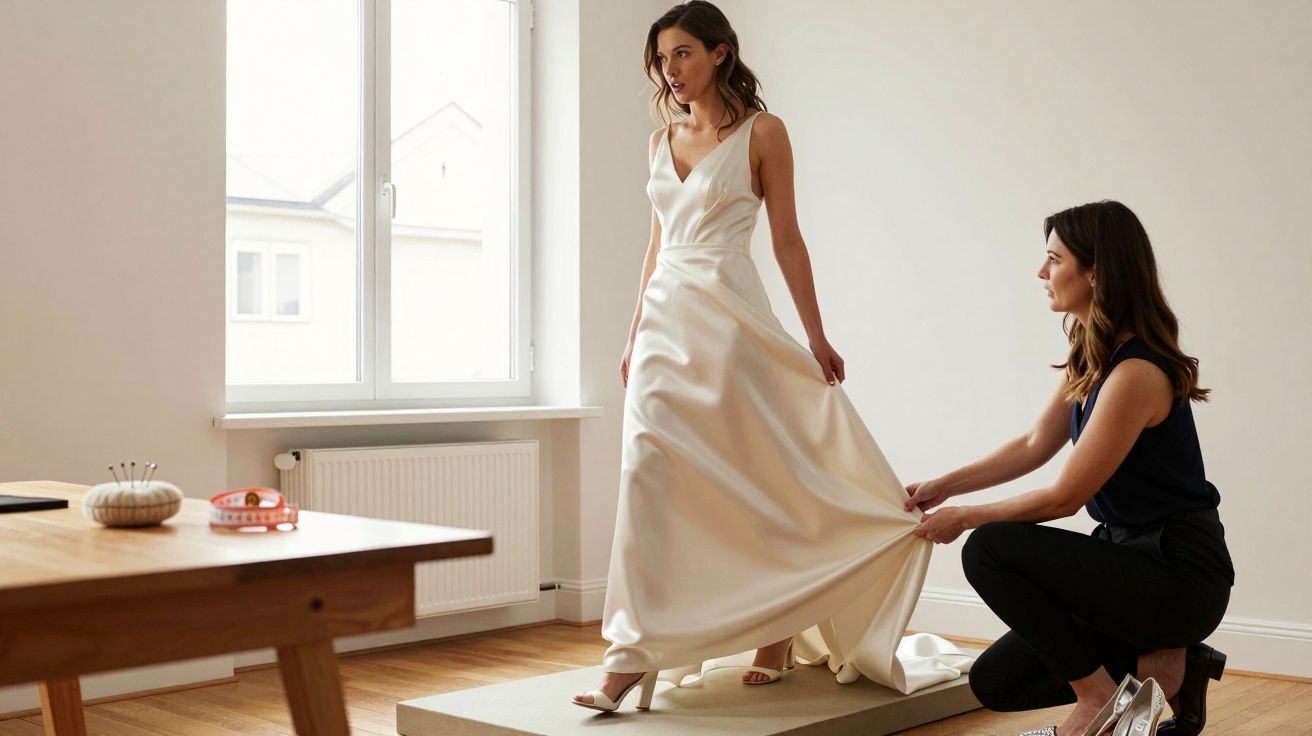
I watched a bride step off the fitting platform and laugh, half delighted and half stunned, as her skirt seemed to change its mind mid-step. Silk wedding dresses do that: they reward you with light and liquid shine, but they also respond to fabric movement in ways you can’t fully predict until they’re on a body that breathes, sits, walks, and hugs.
It’s why people book “a couple of fittings” and end up needing four, sometimes five. Not because anyone has failed, but because silk is honest. It shows everything, including the parts of the day you haven’t practised yet.
The surprise isn’t the seamstress. It’s the physics.
Silk doesn’t behave like a polite, stable cloth that stays where you pin it. It shifts under tension, relaxes with warmth, and drapes according to how you stand when you’re trying not to cry. The moment you move, the dress tests the pattern.
In the workroom, the toile (the practice version) can look perfect. In silk, perfection becomes a moving target. What sits flat at the front can torque slightly when you raise your arms; what looks balanced in a mirror can pull off-grain when you turn to greet someone behind you.
That’s the heart of it: you don’t wear silk in stillness. You wear it through a whole day of motion.
Why silk “grows” and shifts between appointments
Most brides expect alterations to be arithmetic: take in 1cm here, shorten 2cm there, finished. With silk, you also have time in the equation. The fabric can relax on the hang, soften where it’s handled, and respond to steam in a way that subtly changes length and fall.
A few common culprits show up again and again:
- Bias and drape effects: if any part is cut on the bias for that fluid look, it can drop more than expected.
- Heat and humidity: bodies are warm; venues are unpredictable; silk responds.
- Handling and wear: each fitting is a little bit of real life-silk learns from it.
- Interfacing decisions: too soft and it collapses; too firm and it fights the line.
None of this is dramatic in isolation. Add it together and you get a dress that needs to be met where it is, not where it was two weeks ago.
The “walking test” reveals what mirrors hide
In a fitting room, you mostly stand. On a wedding day, you sit, climb into a car, lean across tables, dance, and do that sideways shuffle through a row of chairs. Silk translates all of it into tiny pulls and releases.
That’s where fabric movement turns into practical tailoring questions:
- Does the neckline stay flush when you exhale?
- Does the waist seam stay level after five minutes of walking?
- Do straps creep outward as your shoulders relax?
- Does the skirt twist slightly when you pivot?
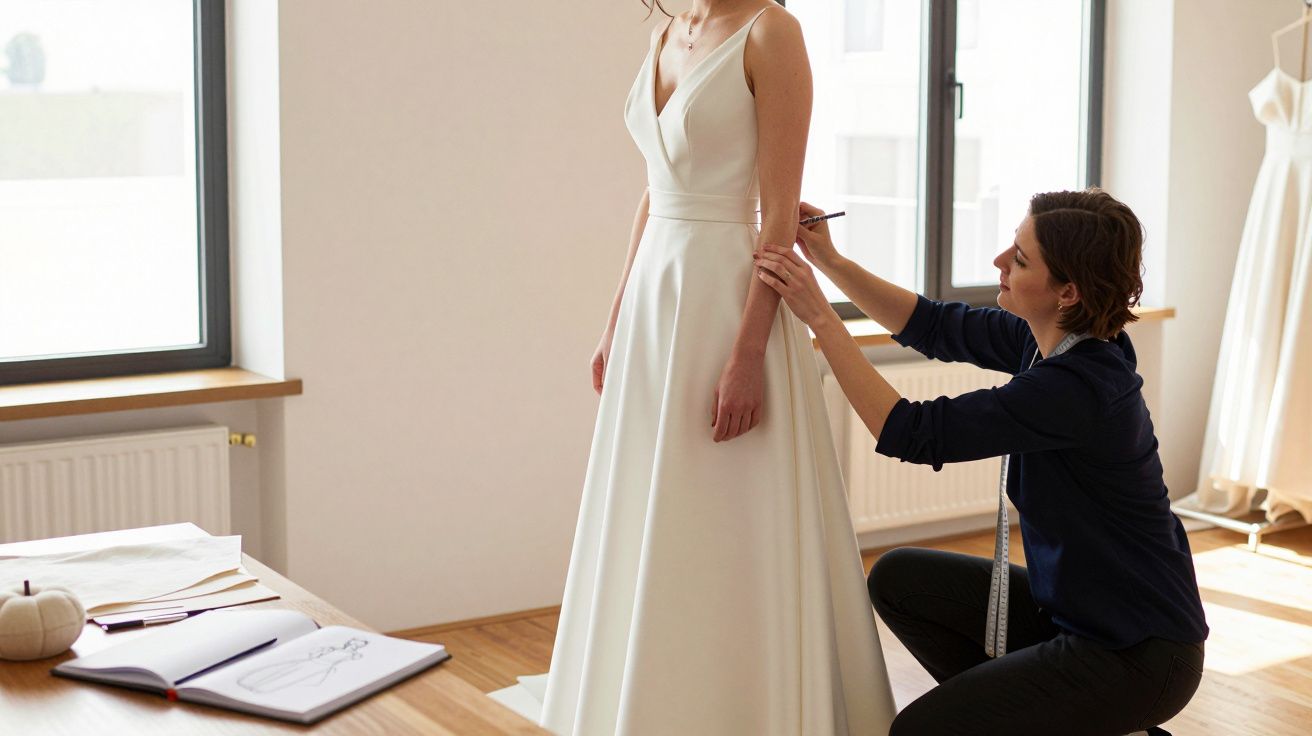
A seam that’s fine in a static fitting can start “talking” the moment you move. Extra fittings are often just the process of listening and answering-small adjustments, tested in motion, then re-tested.
Silk is less forgiving, so the margin for error is smaller
Silk shows ridge lines from seam allowances. It can highlight a stitch that would disappear on lace or tulle. Even minor changes-like moving a dart point-can alter how light plays across the bodice.
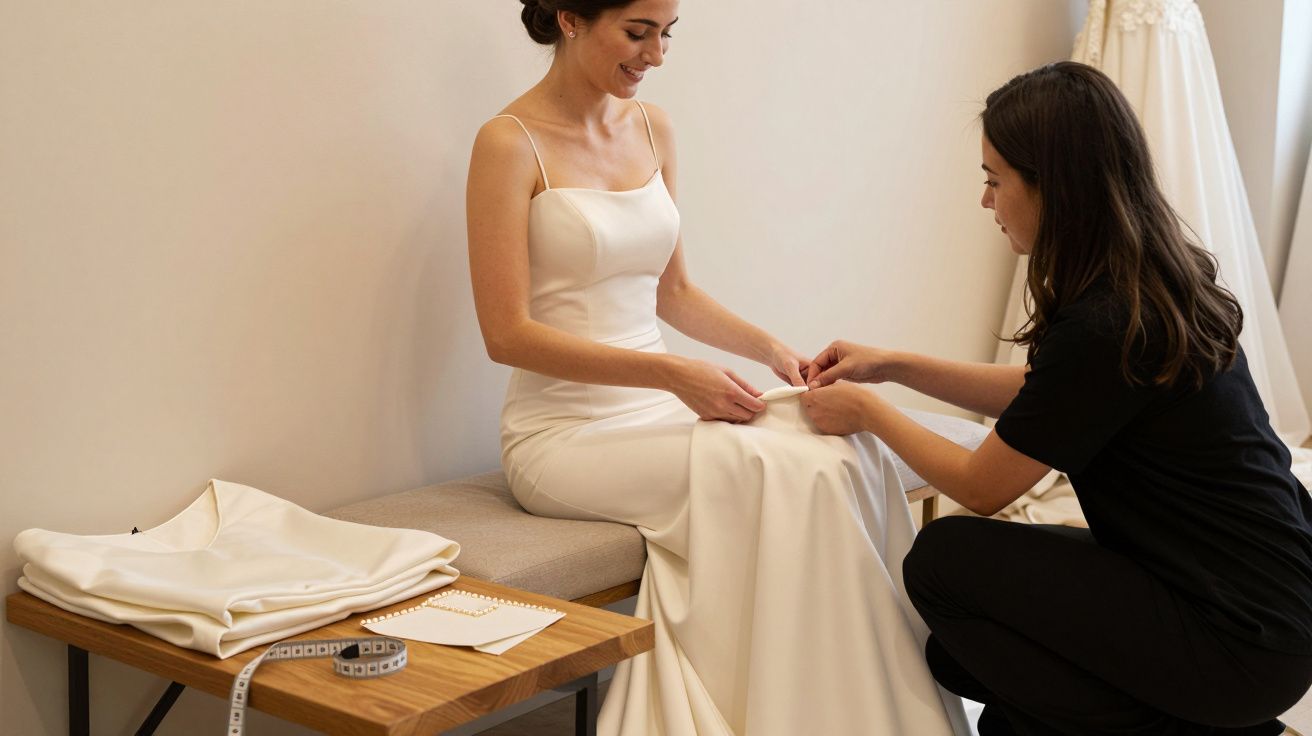
Because of that, fitters tend to work in smaller, safer increments. They pin, mark, stitch, reassess. They avoid big cuts until the dress has proven itself on your body more than once.
That can feel slow, but it’s the careful kind of slow. The kind that prevents a “quick fix” from becoming an irreversible one.
The underlayers matter more than people expect
With silk, the dress isn’t just the outer shell. It’s also what’s under it: the bra cups, corsetry, boning, linings, and any slip or underskirt that controls glide. Change the understructure and you change the way the silk sits.
A bride might switch shapewear between fittings, or decide last-minute to go braless, or add nipple covers that slightly shift the bust point. In sturdier fabrics you can sometimes get away with that. In silk, the dress notices.
Bring the exact undergarments and shoes early, and keep them consistent. It won’t remove the need for fittings, but it reduces the number of surprises.
A sensible fitting timeline (that still leaves room for real life)
Silk rewards planning, but it also demands flexibility. A clean approach looks like this:
- Foundation fitting (8–12 weeks out): establish bust/waist/hip balance and neckline behaviour.
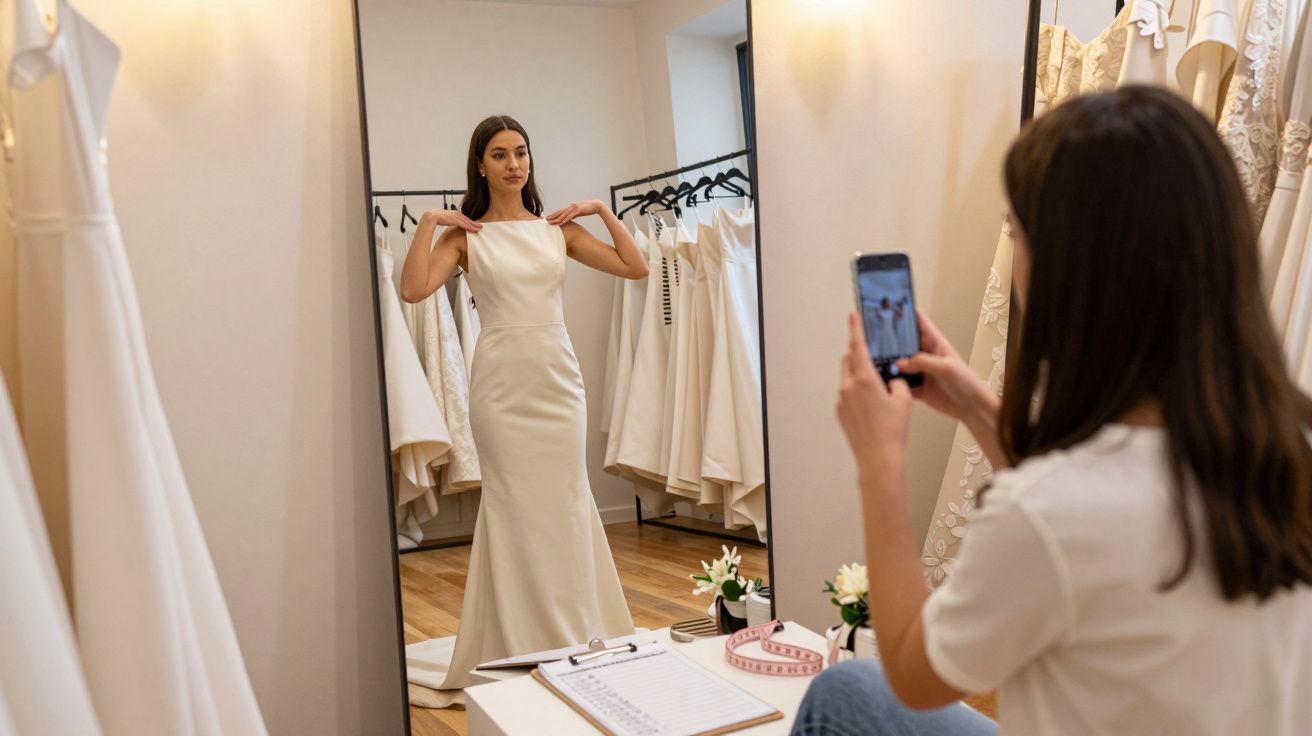
- Movement fitting (6–8 weeks out): walk, sit, raise arms, practise a hug; refine strap and bodice security.
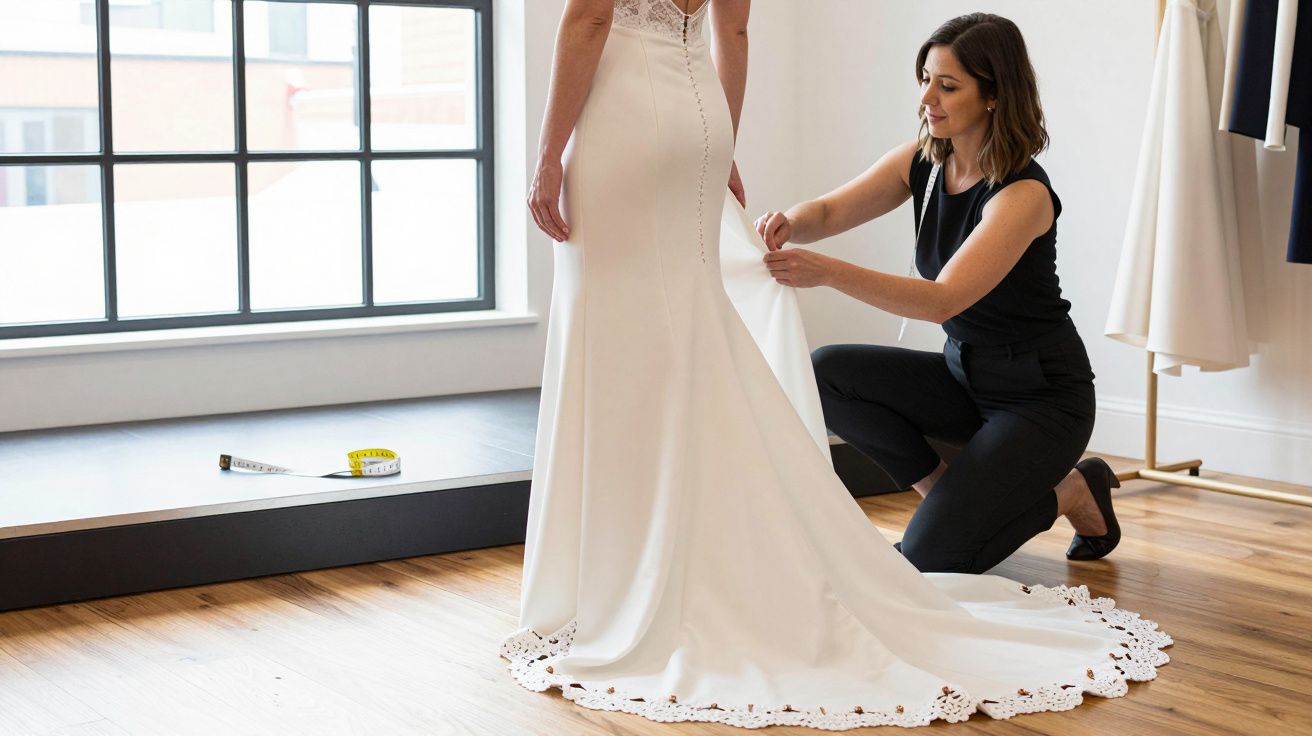
- Hem and train fitting (3–5 weeks out): set length with the real shoes; confirm bustle points if needed.
- Finish fitting (1–2 weeks out): final check after the dress has hung; tiny tweaks only.
If you’re travelling, fluctuating in weight, or your venue is hot, you may add one more check-in. That’s not indulgence-it’s risk management for a fabric that doesn’t bluff.
“Silk doesn’t want to be forced,” one fitter told me. “It wants to be guided, then left alone to settle.”
What you can do to need fewer emergency tweaks
You can’t eliminate the nature of silk, but you can make fittings more efficient:
- Practise your posture in the dress, not just your pose. Standing like a statue helps nobody.
- Eat and breathe normally during fittings. Your wedding day body will.
- Do a two-minute “real life loop”: sit, stand, step up, step down, arms up, arms around someone.
- Keep your kit consistent: shoes, underwear, planned jewellery, even your hairstyle if it affects straps or neckline.
Silk wedding dresses are worth the extra appointments, not because they’re fussy, but because they’re alive to the day you’re about to have. The fittings aren’t a hurdle; they’re the rehearsal that makes the dress look effortless when it counts.
| What changes in silk | What it affects | What the fitter does |
|---|---|---|
| Drape relaxes over time | Length, bias areas, skirt hang | Re-check hem after hanging |
| Movement reveals tension | Neckline, straps, waist level | Adjust in small increments |
| Underlayers alter glide | Bodice stability, smoothness | Fit with final foundations |
FAQ:
- Why did my silk dress feel perfect at one fitting and different at the next? Silk can relax after hanging and respond to steam, handling, and body heat. Tiny shifts in drape can change how it sits.
- Is it normal to need more fittings with silk than with crepe or mikado? Yes. Silk tends to be less forgiving and more responsive to fabric movement, so fitters work more gradually and test changes in motion.
- Will adding a lining reduce the need for adjustments? It can stabilise the dress and improve glide, but it also changes how the outer layer drapes. It’s helpful, not a guarantee.
- What should I bring to every fitting? Your wedding shoes, your chosen underwear/shapewear, and anything that affects the neckline or straps (bra cups, tapes, jewellery). Consistency matters with silk.
- When should the final fitting be? Usually 1–2 weeks before the wedding, after the dress has had time to hang and settle, so the last tweaks are truly final.


Comments
No comments yet. Be the first to comment!
Leave a Comment