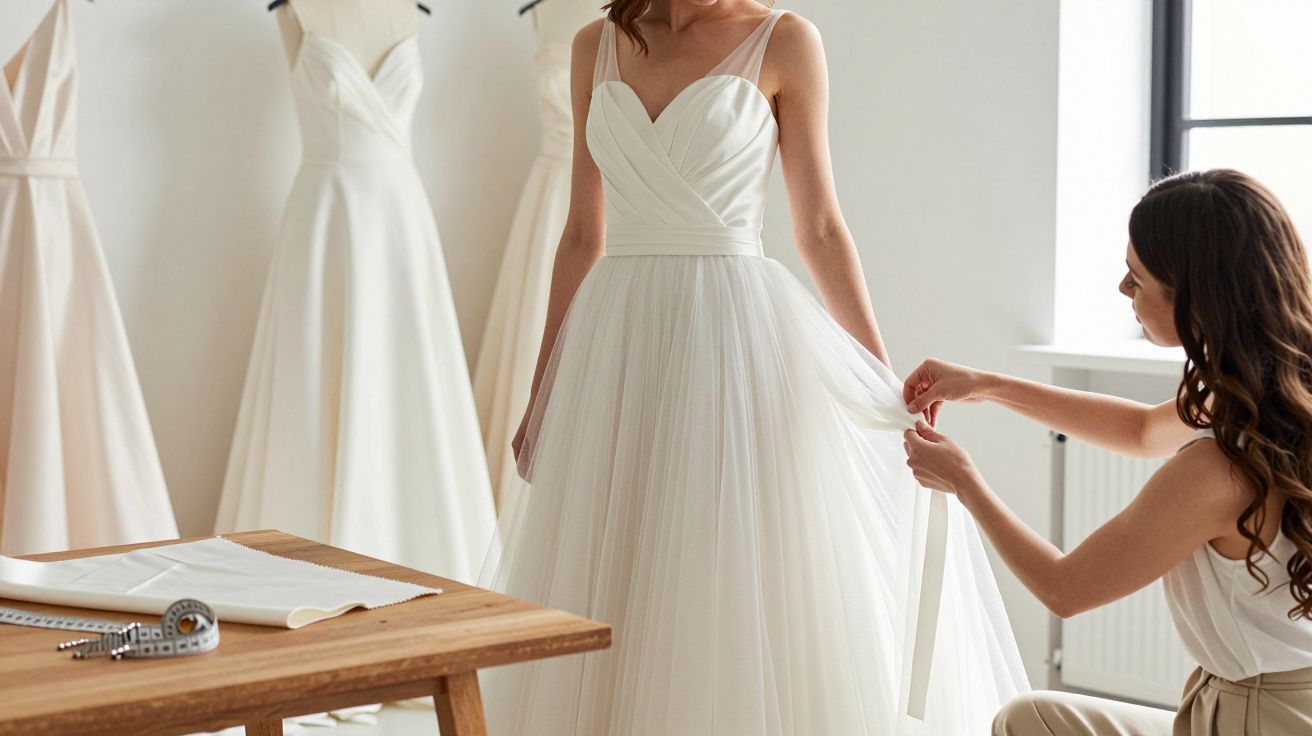
You can try on a gown at noon and feel fine, then swear it gained five kilos by the time the band starts. That delayed heaviness is usually a mix of wedding dress weight and layer interaction: fabrics warming, shifting, and beginning to drag on each other as you move. It matters because the “it’s fine” moment in the boutique isn’t the same as four hours of walking, hugging, dancing, and standing for photos.
I noticed it at a summer wedding where the dress felt almost floaty at the ceremony, then strangely stubborn after dinner. Nothing had changed on the hanger, but everything had changed on the body: heat, humidity, posture, and the way the skirt started to pull from the waist. It wasn’t one big problem; it was lots of small forces adding up.
The quiet physics behind “it only got heavy later”
Wedding dress weight is not just what the gown reads on a scale. It’s the weight you carry once the fabric is in motion, once it’s warm, and once the structure is relying on your body rather than a mannequin. A dress that is technically light can still feel heavy if the load sits in the wrong place or starts to shift.
Layer interaction is the sneaky part. Multiple layers (lining, tulle, crinoline, appliqué, overskirt) create friction, and friction turns movement into effort. Over hours, that effort shows up as a tired lower back, sore shoulders, or the feeling that the skirt is “sticking” to your legs.
A few familiar culprits tend to stack together:
- Heat and moisture soften fibres and increase cling, especially with linings and tulle.
- Micro-slippage at the waist means the skirt gradually hangs lower, so you’re carrying it differently.
- Friction between layers grows once layers are no longer perfectly aligned from standing still.
- Posture fatigue changes how the bodice sits; tiny shifts at the ribcage can translate into big drag at the hem.
The dress didn’t get heavier. Your body became the stand, and the fabric started behaving like it lives there.
Where the heaviness actually comes from (and where you feel it)
Skirt load that migrates
At first, a skirt often sits “up” because you’re standing tall, adrenaline high, and everything is freshly fastened. Later, the skirt can settle as fabrics relax and the waistband finds the smallest path downwards. Even a one-centimetre drop can change leverage and make the front feel like it’s pulling.
You’ll feel this as pressure at the natural waist, a tug at the hips, or that constant urge to hitch the skirt up when you walk.
Bodice support that gets quietly compromised
If the bodice is doing real work-holding structure, supporting bust, anchoring skirt weight-then tiny fit changes matter. After eating, after deep breathing, after a warm room, the bodice can twist slightly. Straps (if any) start to take more load than intended, and the top edge may press in more sharply.
That’s when “heavy” feels like a sore neck, red marks under the arms, or a ribcage that wants a break.
The hem that becomes a brake
The longer the day, the more likely the hem picks up tiny bits of moisture and grit: grass outside the venue, damp pavement, spilled drink, even just humidity. A hem that’s slightly damp or dirty drags more against itself and the floor, and the skirt stops swinging freely.
This is the moment when dancing feels like wading rather than gliding.
The layer interaction checklist (so you can spot it early)
You don’t need to become a textile engineer. You just need to notice what happens when you move like you’ll move on the day-fast turns, steps backwards, sitting down, getting in and out of a car.
Try these checks during fittings or at home:
- The twist test: turn left and right quickly. Does the lining lag behind the outer layer?
- The sit-and-stand test: sit for two minutes, stand up without adjusting. Did the waistline settle lower?
- The stair test: walk up and down a few steps. Does the skirt catch at the knees?
- The “warm room” test: wear it for 20–30 minutes indoors. Does it start to cling or feel stickier?
If the heaviness appears only after these tests, you’re not imagining it-you’re recreating the conditions that make friction and slippage show up.
Small fixes that change how heavy a gown feels
Most of the time, you don’t need a different dress. You need smarter load management.
Shift weight to where your body can carry it
- Add or adjust an internal waist stay (a grosgrain ribbon inside the bodice). It takes skirt load off the zip and distributes weight around the torso.
- Rebalance the bustle plan so the train weight doesn’t pull at one point. Multiple points often feel lighter than one dramatic hook.
Reduce friction where layers fight
- Smoother lining or slip options can cut cling dramatically; some linings grip when warm.
- Strategic tacking between layers (tiny stitches that stop layers rotating independently) can prevent the “skirt twist” that makes walking feel harder.
- Check petticoat structure: too stiff can cause catching; too soft can collapse into the legs.
Plan for the reality of a long day
The best dresses are designed for movement, not just standing still.
- Eat and drink during at least one fitting (even a small snack) to see how the bodice behaves.
- Practise dancing in the shoes you’ll actually wear; heel height changes posture, posture changes load.
- Build in a two-minute “reset”: loosen shoulders, re-seat the waist, check bustle points. It’s basic, and it works.
Think “distribution and glide”: distribute wedding dress weight, and make layers glide rather than grip.
A quick guide to what “heavy” is trying to tell you
| What you feel | Likely cause | Quick adjustment to ask about |
|---|---|---|
| Neck/shoulder ache | Straps taking load; bodice slipping | Waist stay; bodice snug at ribcage; strap balance |
| Skirt pulling down at front | Waistline settling; hem drag | Refit waist; hem check; better bustle distribution |
| Legs fighting the skirt | High friction from lining/tulle | Smoother lining; light tacking; petticoat tweak |
FAQ:
- Why did my dress feel light in the shop but heavy at the reception? Short try-ons hide fatigue, heat, and movement. Over hours, wedding dress weight and layer interaction show up as slippage and friction.
- Is a heavier fabric always worse? Not necessarily. A well-supported heavier satin can feel easier than a lighter skirt that twists and grips because the load is better distributed.
- Will a bustle automatically make the dress feel lighter? Only if it’s balanced. A single-point bustle can concentrate weight and feel heavier than a multi-point plan.
- What’s the one alteration that helps most with “dragging” heaviness? An internal waist stay is often the quiet hero; it stops the skirt slowly migrating down and changes how the weight sits on your body.
- Can humidity really make that much difference? Yes. Moisture increases cling and friction, especially with tulle and certain linings, so the same gown can feel different between a dry ceremony and a warm, crowded dancefloor.




Comments (0)
No comments yet. Be the first to comment!
Leave a Comment