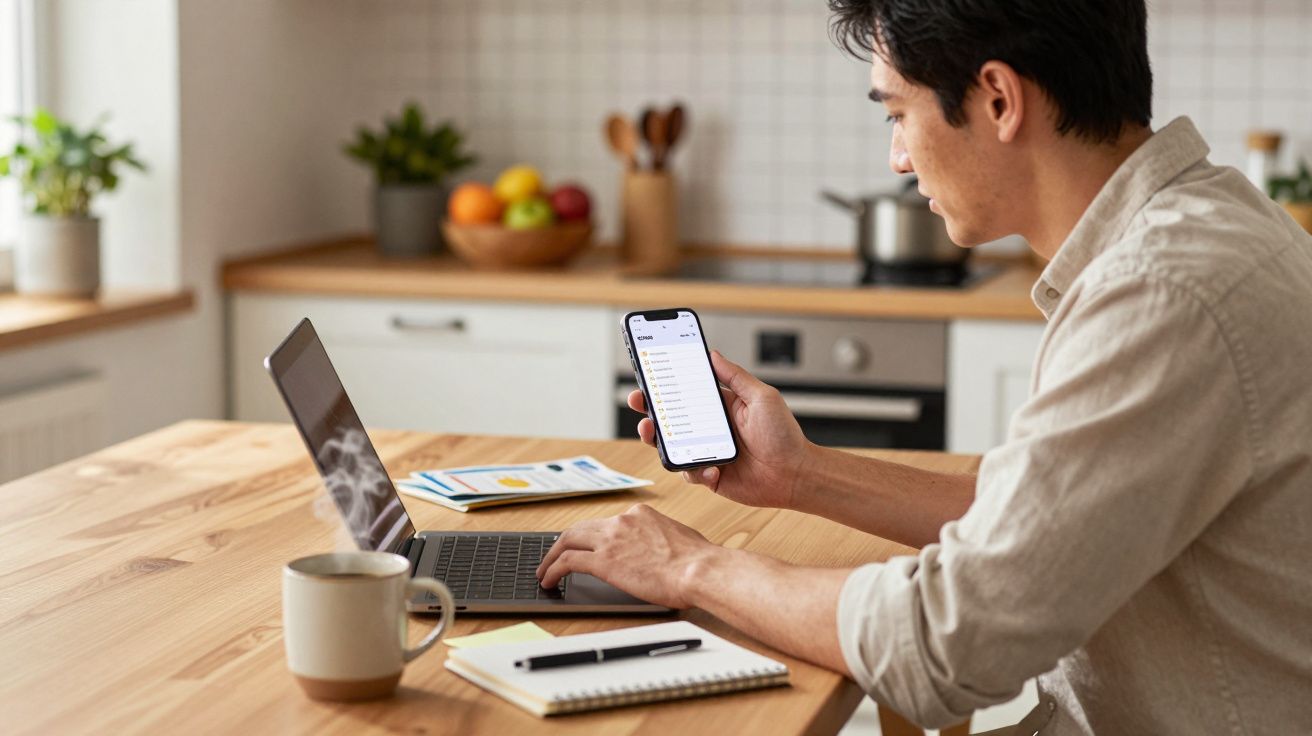
By Tuesday, my calendar had started talking back to me. A Slack ping at 07:58, a dentist appointment I’d tried to “do in my lunch break”, and a meeting that should have been an email had merged into one long, sticky strip of time. I found myself typing, almost by muscle memory, “of course! please provide the text you would like translated.” into a chat where the real request was simpler: can you be online, visible, and calm for eight hours straight?
Later that morning, a colleague copied in “of course! please provide the text you would like me to translate.” as a joke under a thread about return-to-office rules. It landed because it wasn’t really a joke. Work from home has stopped being a location and become a language, and the language is changing faster than most people realise.
The shift isn’t only about where your laptop sits. It’s about who gets to set the pace, how trust is measured, and what “being at work” is supposed to look like when the office is a browser tab you can close.
The moment WFH stopped being a perk
In the early days, remote work was treated like a concession. A Friday at home. A snow day. A quiet favour for the person with a plumber coming. Then it became a blanket policy, and people tried to carry the old office into their kitchens like a heavy plant that keeps shedding leaves.
Now we’re in the third act: work from home as a negotiated system. Some companies are hauling people back in with badge swipes and attendance dashboards. Others are quietly admitting that forcing bums on seats doesn’t fix poor management, unclear goals, or burnt-out teams.
The surprise is how quickly the meaning of “remote” is splitting into different species. It’s not one trend; it’s several, pulling in different directions.
What’s changing faster than you think (and why it feels weird)
The headlines make it sound like a tug-of-war: bosses versus employees, office versus home. The real shift is subtler. It’s the rules of the day-how work is seen, counted, and rewarded-being rewritten in real time.
Here’s what’s accelerating beneath the surface:
- Presence is being replaced by proof. Not “I was online”, but “this shipped, this closed, this improved.”
- Meetings are losing their monopoly. Asynchronous updates, short voice notes, and written decisions are becoming the default in functional teams.
- The workday is fracturing. People are stacking focus time early, doing school runs midday, and finishing admin later-then pretending it’s still 9–5.
- Visibility has become performance. Status dots, quick replies, and camera-on fatigue are the new “looking busy” at your desk.
- Hiring is quietly widening. Even firms pushing office returns are keeping remote talent when skills are scarce.
If you’ve felt more tired at home than you ever did commuting, it’s often because remote work can turn into constant low-level signalling. Not the work itself-everything around it.
The new friction: your home is not an office, but it’s treated like one
A lot of the change is emotional, not technical. The office used to contain work. At home, work leaks.
You take calls where you used to make tea. You write reports within earshot of the washing machine. You finish one more thing because your laptop is right there, and stopping feels like leaving a tap running.
And the organisation responds by trying to recreate control: mandatory “core hours”, more check-ins, more tracking, more polite phrases that mean “we don’t trust what we can’t see”. It’s the corporate equivalent of tapping the fish tank to prove the fish is alive.
WFH is changing because people are pushing back-not always loudly, often quietly-with boundaries, better writing, and a refusal to keep acting busy for the sake of it.
What actually works now (the boring, practical bits)
The teams that are thriving remotely aren’t the ones with the fanciest tools. They’re the ones with simple, repeatable behaviours that reduce ambiguity. No magic. Just clarity.
A few moves that tend to pay off quickly:
- Write the decision down. If it isn’t written, it will be re-litigated in the next meeting.
- Define “done” in public. Outcomes, deadlines, and owners-visible to everyone, not hidden in someone’s head.
- Use fewer meetings, but make them sharper. Clear agenda, fewer attendees, finish early by default.
- Protect focus like it’s a resource. Two hours of uninterrupted work beats six hours of “available”.
- Normalise delayed replies. Fast isn’t always good; thoughtful is usually better.
Let’s be honest: no one does this perfectly every day. The point is not purity; it’s reducing the noise that makes remote work feel like living inside a call centre.
The bigger truth: WFH is becoming a trust system
Work from home is changing fastest where managers stop measuring effort and start measuring impact. That sounds obvious until you see how many organisations still reward:
- the quickest responder,
- the person who talks most in meetings,
- the one who looks calm on camera while drowning off-screen.
Remote work exposes weak leadership because it removes the theatre. There’s nowhere to hide a lack of priorities when everything is written down and time is visible. It also exposes good leadership because calm, clear teams suddenly move faster than loud ones.
This is why the fight about “back to the office” often misses the point. The real question is: can your workplace operate without constant supervision?
Where this is heading (so you can plan for it)
Most people are expecting a single outcome-everyone back, or everyone remote. What we’re actually getting is a messy middle that keeps shifting.
Three patterns are hardening already:
- Hybrid as default, but uneven. Some roles get flexibility, others get told it’s “not possible” (sometimes true, often lazy).
- More written work. Not essays-briefs, updates, decision logs. Writing becomes the new meeting room.
- Lifestyle relocation with career friction. People move, then discover their pay, promotion, and influence still orbit a physical HQ.
If you work from home, the smartest move isn’t to wait for the policy to settle. It’s to build your own operating system: boundaries, documentation habits, and a way to show value that doesn’t rely on being seen.
| Shift | What it replaces | Why it matters |
|---|---|---|
| Proof over presence | “Online = working” | Rewards outcomes and reduces performative busyness |
| Asynchronous by default | Meeting-heavy days | Protects focus and makes decisions traceable |
| Boundaries as skill | Work leaking into life | Prevents burnout and makes performance sustainable |
FAQ:
- Is work from home going away? For some companies, office-first will return. But WFH as a capability isn’t disappearing-too many teams rely on it for hiring, retention, and continuity.
- Why does WFH feel more exhausting sometimes? The mental load often comes from constant availability, more written communication, and blurred boundaries-not necessarily the work itself.
- What’s one change that helps immediately? Agreeing what “done” means, in writing, for each piece of work. It cuts follow-up meetings and reduces anxiety.
- How do I stay visible without burning out? Share short, regular updates tied to outcomes (what moved, what’s blocked, what’s next). Visibility works best when it’s calm and consistent, not frantic.
- Will hybrid fix the problem? Only if the rules are fair and explicit. Hybrid without clarity can create two classes of workers: those in the room and those on the screen.





Comments (0)
No comments yet. Be the first to comment!
Leave a Comment